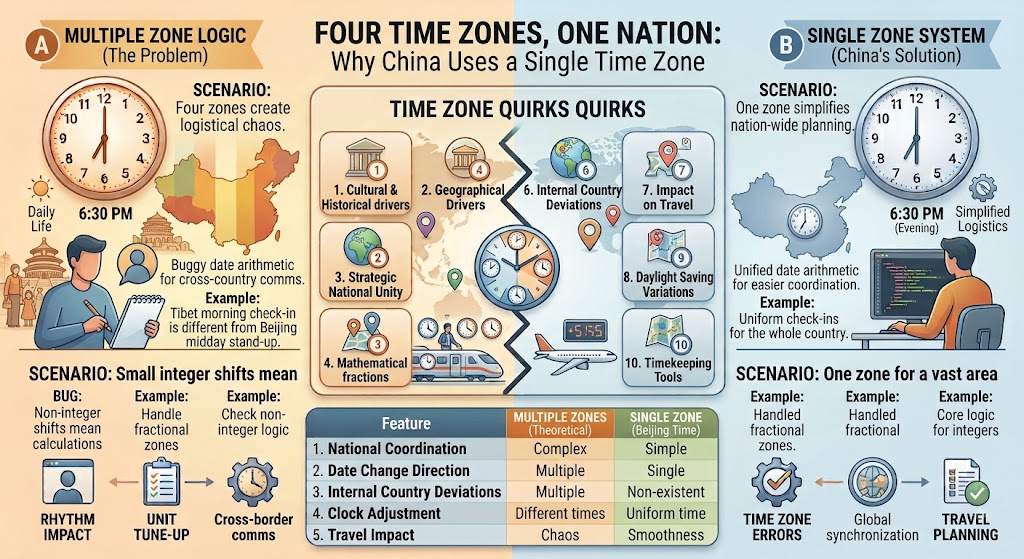
Four Time Zones, One Nation: Why China Uses a Single Time Zone
Imagine living in a country where the sun rises at 10:00 AM in winter. Not 6:00 AM. Not 7:00 AM. Ten in the morning.
That's the reality for people in western China.
China is as wide as the United States. The US has four time zones. China has one.
Officially, the entire country runs on Beijing Time (UTC+8). Every clock, every train schedule, every business — all on the same time. This means that when it's noon in Beijing, it's also noon in far western Xinjiang — even though the sun hasn't risen yet in some parts.
Here's how China ended up with one time zone for a country the size of a continent, and what it means for the people who live there.
Use the free time zone converter here →
The Short Answer: What's China's Time Zone?
China officially operates on a single time zone: China Standard Time (CST), also called Beijing Time, which is UTC+8.
This applies to the entire country — from the eastern coast to the far western regions of Xinjiang and Tibet.
| Region | Official Time | Natural Time Zone | Difference |
|---|---|---|---|
| Eastern China (Beijing, Shanghai) | UTC+8 | UTC+8 | 0 hours |
| Central China (Chengdu, Wuhan) | UTC+8 | UTC+7 | +1 hour |
| Western China (Xinjiang, Tibet) | UTC+8 | UTC+5 to UTC+6 | +2 to +3 hours |
The result: In winter, the sun in Xinjiang rises around 10:00 AM and sets around 7:00 PM. In summer, it can stay light until 11:00 PM.
China's Five Natural Time Zones
Before 1949, China had multiple time zones. Geographically, the country spans five natural time zones:
| Time Zone | UTC Offset | Region |
|---|---|---|
| Kunlun Time | UTC+5 | Western Xinjiang, Tibet |
| Tibet Time | UTC+6 | Tibet, Qinghai |
| Sichuan Time | UTC+7 | Central China, Sichuan |
| Beijing Time | UTC+8 | Eastern China (official standard) |
| Changbai Time | UTC+9 | Northeast China |
Historical context: In 1912, the Republic of China officially divided the country into five time zones. These were ratified in 1939.
The change: After the Chinese Civil War, the People's Republic of China unified the country under a single time zone in 1949. The exact date is believed to be around September 27, 1949 — when Beijing (formerly Beiping) was renamed and the new time zone policy was adopted.
Why Did China Choose One Time Zone?
1. National Unity
The single time zone policy was a political decision to symbolize national unity. After decades of civil war and foreign occupation, the new government wanted to project strength and cohesion. A unified time zone was part of that message.
2. Administrative Simplicity
With a single time zone, transportation, communication, and government services are simpler to coordinate. Train schedules, flight times, and business hours are consistent nationwide.
3. International Coordination
UTC+8 aligns China with major economic centers in Asia, including Singapore, Malaysia, and parts of Australia. This makes trade and communication more efficient.
4. Avoiding Confusion
Multiple time zones would have meant different business hours across the country. A single time zone eliminates this confusion — though it creates a different kind of confusion with the sun.
The Impact on Daily Life
Eastern China: Business as Usual
In Beijing, Shanghai, and Guangzhou, the time zone aligns naturally with the sun. People wake up around 6:00 AM, start work at 9:00 AM, and finish around 6:00 PM. Nothing unusual.
Western China: The Sun Arrives Late
In Xinjiang and Tibet, the situation is completely different.
Winter:
- Sunrise: 9:00 AM to 10:00 AM
- Sunset: 6:00 PM to 7:00 PM
Summer:
- Sunrise: 6:00 AM to 7:00 AM
- Sunset: 10:00 PM to 11:00 PM
What this means:
- Schools often start at 10:00 AM
- Businesses open later
- People eat lunch at 2:00 PM or later (because that's when the sun is at its highest)
- Dinner can be as late as 10:00 PM in summer
The Unofficial Time Zone: Xinjiang Time
Despite the official policy, not everyone in China follows Beijing Time.
The Xinjiang exception: In the Xinjiang Uyghur Autonomous Region, many locals unofficially use "Xinjiang Time" — which is UTC+6, two hours behind Beijing Time.
How it works:
- Officially: Everything is in Beijing Time (UTC+8)
- Unofficially: Many local businesses, schools, and social events run on Xinjiang Time (UTC+6)
- Confusion: When someone says "10 AM," you need to ask: "Beijing Time or Xinjiang Time?"
Who uses which?
- The ethnic Han Chinese population in Xinjiang tends to use Beijing Time
- The ethnic Uyghur population often uses Xinjiang Time
- This can create confusion in mixed settings
IANA database recognition: The official time zone database recognizes Asia/Urumqi (Xinjiang's capital) as UTC+6, acknowledging the unofficial time zone used in the region.
Comparison: China vs. the United States
| Aspect | China | United States |
|---|---|---|
| Land area | ~9.6 million km² | ~9.8 million km² |
| Natural time zones | 5 | 4 (continental) |
| Official time zones | 1 | 4 (continental) |
| Time zone policy | Political unification | Practical convenience |
| Western regions | Sun rises at 10 AM | Sun rises at normal times |
The contrast: The US is roughly the same size as China. But the US has four time zones (Eastern, Central, Mountain, Pacific). China has one.
Why the difference? The US values practical convenience. China values national unity. The result: very different experiences for people in western regions.
Daylight Saving Time in China
China briefly experimented with Daylight Saving Time.
History:
- China observed DST from 1986 to 1991
- The last DST transition was on September 15, 1991
- Since then, China has not observed DST
The PRC Rule:
| Year | Rule |
|---|---|
| 1986 | DST started May 4, ended September 14 |
| 1987-1991 | DST started second Sunday in April, ended second Sunday in September |
Why it ended: The energy savings from DST were minimal, and the disruption to daily life was significant. China abandoned the practice.
Historical Context: The Debate About When the Change Happened
When exactly did China switch to a single time zone? The answer is surprisingly complex.
The traditional view: 1949, after the Communist Party took power.
The technical view: The IANA time zone database records the switch as happening on May 1, 1980. This is based on historical data from Shanks & Pottenger (2003).
Why the discrepancy?
- The 1949 date is when the government announced the policy
- The 1980 date is when the change was fully implemented across the entire country
- There were transitional periods where different regions adopted the new time zone at different times
Historian's perspective: Thomas Mullaney, a historian of China, notes that the implementation of Beijing Time must have happened between September 27, 1949 (when Beijing was officially renamed) and October 7, 1949 (the earliest known source using "Beijing Time").
What This Means for Travelers
Tips for Visiting China
1. Set your devices to Beijing Time
Your phone will automatically update to China Standard Time (UTC+8). But if you're traveling to Xinjiang or Tibet, don't be surprised if the sun doesn't match the clock.
2. Double-check times in Xinjiang
In Xinjiang, always ask: "Is that Beijing Time or local time?" Many businesses operate on Xinjiang Time (UTC+6).
3. Transportation always uses Beijing Time
Trains, planes, and buses in China operate on Beijing Time nationwide. Always use Beijing Time for bookings.
4. Plan activities around the sun
In western China, plan outdoor activities later in the day. In winter, the sun might not rise until 10:00 AM. In summer, it can be light until 11:00 PM.
5. Adjust your sleep schedule
If you're coming from a different time zone, China's single time zone can make jet lag feel different. In eastern China, the time zone aligns with the sun. In western China, it doesn't. Your body clock might be confused.
The Bigger Picture: Time Zones as Political Statements
China's single time zone is a perfect example of how time zones aren't just about geography. They're about power, politics, and national identity.
What time zones communicate:
- A single time zone says: "We are one nation, united"
- Multiple time zones say: "We respect regional differences"
- Choosing a time zone says: "We align with these trading partners, not those"
Other countries with single time zones:
| Country | Natural Time Zones | Official Time Zone |
|---|---|---|
| China | 5 | 1 (UTC+8) |
| India | 2 | 1 (UTC+5:30) |
| Argentina | 3 | 1 (UTC-3) |
| Malaysia | 2 | 1 (UTC+8) |
Why they chose this:
- India: National unity after independence
- Argentina: Political decisions over multiple decades
- Malaysia: Aligning with trading partners
Frequently Asked Questions
How many time zones does China officially have?
One. China officially uses a single time zone: China Standard Time (UTC+8).
How many time zones does China naturally span?
Five natural time zones, from UTC+5 in the west to UTC+9 in the east.
Why does China use only one time zone?
The single time zone policy was established in 1949 to symbolize national unity and simplify administration.
Does China observe Daylight Saving Time?
No. China briefly observed DST from 1986 to 1991 but abandoned it.
What time is it in Xinjiang?
Officially, Xinjiang uses Beijing Time (UTC+8). Unofficially, many locals use Xinjiang Time (UTC+6), two hours behind Beijing Time.
When did China switch to one time zone?
The policy was announced in 1949, but full implementation across the country may have taken until 1980.
What is the difference between Beijing Time and China Standard Time?
They're the same. Beijing Time and China Standard Time (CST) both refer to UTC+8.
Is Xinjiang Time recognized officially?
No. The official time zone in all of China is Beijing Time (UTC+8). Xinjiang Time is unofficial.
Does my phone change time in China?
Yes. If your phone is set to automatic time zone updates, it will change to China Standard Time (UTC+8) when you arrive.
What's the biggest challenge of China's single time zone?
In western China, the sun rises and sets at drastically different times from the official clock. This creates confusion for daily life, business, and travel.
Final Thoughts
China's single time zone is a unique experiment. A country the size of a continent, operating on one clock.
For eastern China, it's natural. For western China, it's a constant adjustment. People in Xinjiang eat lunch when the sun says it's noon — even if the clock says it's 2:00 PM. They go to work when the sun says it's morning — even if the clock says it's 10:00 AM.
The lesson: Time zones aren't just about longitude. They're about politics, history, and identity. China's choice to have one time zone says as much about the country as it does about the sun.
Check time zones instantly → /timezone-converter
Tags: China time zone, Beijing Time, China single time zone, why China has one time zone, Xinjiang time zone, China Standard Time, UTC+8 China, China time zone policy, China five time zones, one time zone China, China travel time zone, Xinjiang unofficial time, China time zone history, Chinese time zone explained, Beijing Time UTC+8