Half-Hour and 45-Minute Time Zones Explained: Why Some Countries Are Off the Hour
Most time zones are on the hour. UTC+1, UTC+2, UTC-5 — nice, clean numbers.
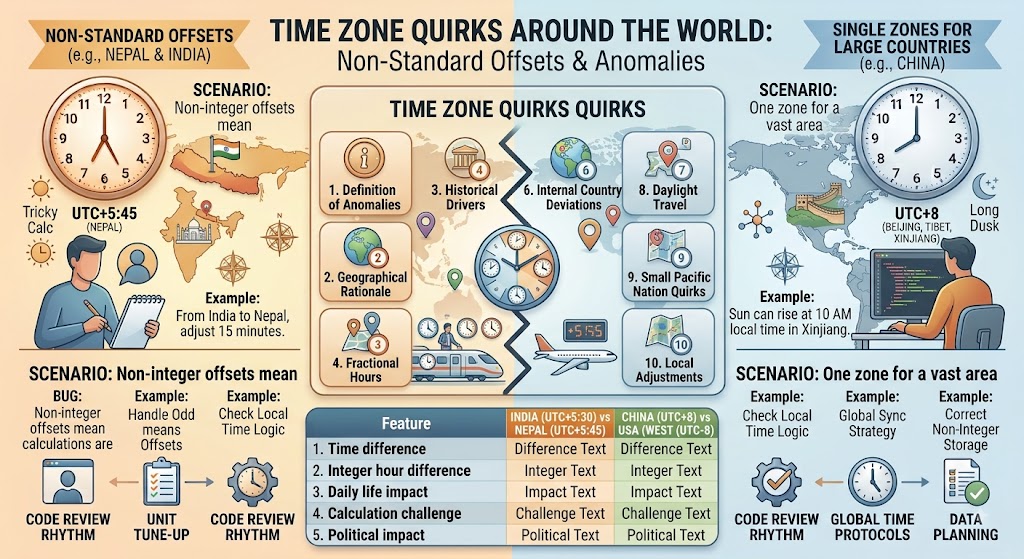
But then there's India. UTC+5:30. Nepal. UTC+5:45. Myanmar. UTC+6:30. Newfoundland. UTC-3:30.
These aren't mistakes. They're deliberate choices — a mix of geography, history, and politics.
This guide explains why half-hour and 45-minute time zones exist, which countries use them, and the fascinating stories behind each one.
Use the free time zone converter here →
The Short Answer: Why Do Non-Hour Time Zones Exist?
Countries choose non-hour time zones for three main reasons:
- Geography — The country's longitude falls between hourly time zones
- Politics — Countries choose to align with trading partners or avoid splitting
- History — Time zones were set before modern standardization
The result:
- 30-minute offsets: UTC+5:30 (India), UTC+6:30 (Myanmar), UTC+9:30 (Australia)
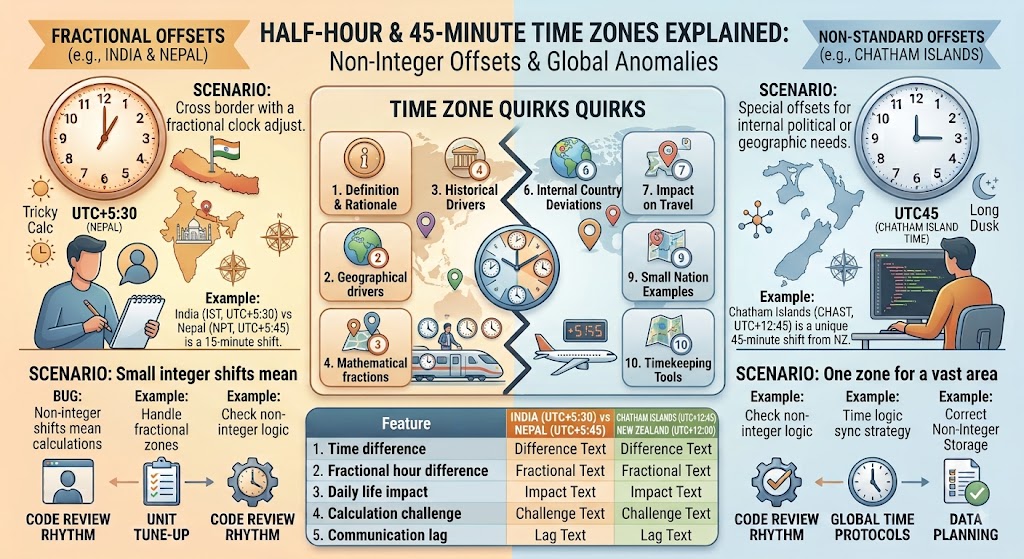
- 45-minute offsets: UTC+5:45 (Nepal), UTC+12:45 (Chatham Islands), UTC+8:45 (Eucla)
Here's the full list of non-hour time zones on Earth.
Complete List of Non-Hour Time Zones
| Time Zone | UTC Offset | Countries/Regions | Population |
|---|---|---|---|
| UTC+5:30 | +5:30 | India, Sri Lanka | 1.4 billion+ |
| UTC+5:45 | +5:45 | Nepal | ~30 million |
| UTC+6:30 | +6:30 | Myanmar, Cocos Islands | ~55 million |
| UTC+8:45 | +8:45 | Australia (Eucla) | ~200 |
| UTC+9:30 | +9:30 | Australia (South Australia, NT) | ~2 million |
| UTC+10:30 | +10:30 | Australia (Lord Howe Island) | ~3,000 |
| UTC+12:45 | +12:45 | New Zealand (Chatham Islands) | ~600 |
| UTC-3:30 | -3:30 | Canada (Newfoundland and Labrador) | ~500,000 |
| UTC-4:30 | -4:30 | Venezuela (until 2016, now UTC-4) | — |
| UTC-9:30 | -9:30 | French Polynesia (Marquesas Islands) | ~9,000 |
Total population affected: Over 1.4 billion people live in non-hour time zones.
The Geography: Why Half-Hour Offsets Make Sense
The Earth's Rotation
Earth rotates 360° in 24 hours. That means:
- 15° of longitude = 1 hour of time difference
- 1° of longitude = 4 minutes of time difference
Ideal time zone lines:
- UTC+5: 75°E longitude
- UTC+6: 90°E longitude
- UTC+7: 105°E longitude
The Problem
Many countries straddle these lines. If they choose one hour offset, they're either too early or too late for their actual solar time.
The Compromise:
Choose a 30-minute or 45-minute offset that splits the difference.
Example: India
- India spans 68°E to 97°E longitude
- Natural time difference: about 2 hours (68°E to 97°E = 29° = 1 hour 56 minutes)
- 82.5°E meridian (Mirzapur) passes through India
- 82.5°E ÷ 15° = 5.5 hours
- Result: UTC+5:30
Detailed Stories: Why Each Non-Hour Time Zone Exists
1. India (UTC+5:30) — The Giant Half-Hour
Population: Over 1.4 billion people
Why it exists:
India spans about 30° of longitude. The natural time difference from east to west is about 2 hours. India chose a single time zone to avoid splitting the country.
The 82.5°E meridian:
India's standard meridian passes through Mirzapur, Uttar Pradesh. Since 82.5°E ÷ 15° = 5.5, India chose UTC+5:30.
Historical context:
- Before 1947, India had multiple time zones
- After independence, India unified under a single time zone
- UTC+5:30 was chosen as the compromise
Fun fact: India tried DST briefly during the Sino-Indian War (1962) and the Indo-Pakistan wars (1965, 1971). They abandoned it each time.
2. Nepal (UTC+5:45) — The Only 45-Minute Time Zone
Population: ~30 million people
Why it exists:
Nepal sits between India (UTC+5:30) and China (UTC+8). They chose UTC+5:45 to be roughly in the middle.
The 82.5°E meridian:
Nepal's time zone is based on the 82.5°E meridian, which runs through Nepal. But the country's longitude goes up to 88°E, which would be UTC+5:52.
The compromise:
Nepal chose UTC+5:45 as a practical compromise between India and China time.
Fun fact: Nepal is the only country with a 45-minute offset. It's the most unusual time zone on Earth.
3. Myanmar (UTC+6:30) — The Half-Hour Southeast Asian
Population: ~55 million people
Why it exists:
Myanmar lies between India (UTC+5:30) and Thailand (UTC+7). They chose UTC+6:30 as a compromise.
Historical context:
- Myanmar (formerly Burma) was under British rule
- After independence, they kept the half-hour offset
- It aligns with their geographical position (92°E to 101°E)
Fun fact: Myanmar shares its UTC+6:30 time zone with the Cocos Islands, a small Australian territory.
4. Australia's Central Time (UTC+9:30) — The Great Aussie Half-Hour
Population: ~2 million people (South Australia, NT)
Why it exists:
Australia has three time zones. The central time zone (UTC+9:30) is a half-hour offset between the west (UTC+8) and the east (UTC+10).
The regions:
| Region | Time Zone | UTC Offset |
|---|---|---|
| Western Australia | AWST | UTC+8 |
| South Australia, NT | ACST | UTC+9:30 |
| Queensland, NSW, Victoria | AEST | UTC+10 |
Why UTC+9:30?
South Australia's longitude is roughly 134°E. 134°E ÷ 15° = 8.93 hours. South Australia chose UTC+9:30 as a compromise.
Fun fact: South Australia is 30 minutes behind the east coast and 90 minutes ahead of the west coast.
5. Eucla, Australia (UTC+8:45) — The Tiny 45-Minute Town
Population: ~200 people
Why it exists:
Eucla is a small town in Western Australia near the South Australian border. It's on the border between two time zones.
The problem:
- Western Australia: UTC+8
- South Australia: UTC+9:30
- Eucla is exactly in the middle
The solution:
Eucla unofficially uses UTC+8:45. It's not an official time zone, but everyone in the area uses it.
Fun fact: Eucla's time zone is so obscure that many time zone databases don't include it. It's one of the smallest time zones on Earth.
6. Lord Howe Island (UTC+10:30) — The 30-Minute Island
Population: ~3,000 people
Why it exists:
Lord Howe Island is a small island in the Tasman Sea between Australia and New Zealand.
The problem:
- Australia (east coast): UTC+10
- New Zealand: UTC+12
- Lord Howe Island is geographically between them
The solution:
Lord Howe Island uses UTC+10:30 — a 30-minute offset between Australia and New Zealand.
Fun fact: Lord Howe Island also observes DST, moving to UTC+11 during summer.
7. Chatham Islands (UTC+12:45) — The Remote 45-Minute Islands
Population: ~600 people
Why it exists:
The Chatham Islands are a small group of islands about 800 km east of New Zealand.
The problem:
- New Zealand: UTC+12
- The Chatham Islands are 800 km east (natural time difference: about 45 minutes)
The solution:
The Chatham Islands use UTC+12:45 — a 45-minute offset from New Zealand.
Fun fact: The Chatham Islands are one of the few places with a 45-minute offset. They're also one of the first places to see the sun each day.
8. Newfoundland (UTC-3:30) — North America's Half-Hour
Population: ~500,000 people
Why it exists:
Newfoundland is on the eastern edge of Canada. It's geographically between UTC-4 (Atlantic Time) and UTC-3 (Greenland).
The problem:
- Atlantic Time: UTC-4
- Greenland: UTC-3
- Newfoundland's longitude falls between them
The solution:
Newfoundland uses UTC-3:30 — a 30-minute offset from both.
Fun fact: Newfoundland's time zone is the only one in North America with a half-hour offset. It's also one of the oldest time zones in the world (established in 1935).
9. Marquesas Islands (UTC-9:30) — The Pacific Half-Hour
Population: ~9,000 people
Why it exists:
The Marquesas Islands are part of French Polynesia. They're located between UTC-10 (Tahiti) and UTC-9 (Gambier Islands).
The problem:
- Tahiti: UTC-10
- Gambier Islands: UTC-9
- Marquesas Islands are between them
The solution:
The Marquesas Islands use UTC-9:30 — a 30-minute offset.
Fun fact: The Marquesas Islands are one of the few places in the Pacific with a half-hour offset.
The History of Non-Hour Time Zones
Before Time Zones
Before 1884, every city had its own local time based on the sun. There were thousands of different times.
The problem:
- Travel was becoming faster (railroads, steamships)
- Communication was becoming global (telegraph)
- The world needed a unified system
The 1884 International Meridian Conference
In 1884, 25 countries met in Washington D.C. They established:
- The Prime Meridian at Greenwich (0° longitude)
- 24 time zones, each 15° of longitude apart
- Each time zone would be 1 hour apart
The exception:
- Some countries chose to keep their own time zones
- Half-hour and 45-minute offsets existed even back then
Why Some Countries Kept Non-Hour Offsets
- National pride: Some countries didn't want to align with Greenwich
- Geography: Half-hour offsets made more sense for some locations
- Politics: Some countries didn't want to be in the "wrong" time zone
The Politics of Time Zones
National Identity
Many countries see time zones as a matter of national identity. Choosing a time zone is a political decision.
Trading Partners
Some countries choose time zones to align with trading partners (Samoa, 2011).
National Unity
Some countries choose a single time zone to symbolize unity (China, India).
Simplicity
Some countries choose one time zone to avoid confusion (India).
Impact on Daily Life
Business
- India (UTC+5:30) is 10.5 hours ahead of US East Coast (UTC-5)
- This makes scheduling meetings complicated
- But the half-hour offset helps align with both Europe and Asia
Travel
- Nepal (UTC+5:45) is 15 minutes ahead of India
- This is confusing for travelers
- Flight schedules between India and Nepal are complicated
Technology
- Time zone databases (IANA) support all non-hour offsets
- APIs and programming languages handle them automatically
- But software developers sometimes miss them
Quick Reference: Non-Hour Time Zone Cheat Sheet
30-Minute Offsets
| Time Zone | UTC Offset | Countries |
|---|---|---|
| Indian Standard Time (IST) | UTC+5:30 | India, Sri Lanka |
| Myanmar Time (MMT) | UTC+6:30 | Myanmar, Cocos Islands |
| Australian Central Time (ACST) | UTC+9:30 | South Australia, NT |
| Lord Howe Time (LHST) | UTC+10:30 | Lord Howe Island |
| Newfoundland Time (NST) | UTC-3:30 | Newfoundland |
| Marquesas Time (MART) | UTC-9:30 | Marquesas Islands |
| Iran Standard Time (IRST) | UTC+3:30 | Iran |
45-Minute Offsets
| Time Zone | UTC Offset | Countries |
|---|---|---|
| Nepal Time (NPT) | UTC+5:45 | Nepal |
| Eucla Time (UTC) | UTC+8:45 | Eucla, Australia |
| Chatham Islands Time (CHAST) | UTC+12:45 | Chatham Islands |
15-Minute Offsets
| Time Zone | UTC Offset | Countries |
|---|---|---|
| Chatham Islands (DST) | UTC+13:45 | Chatham Islands (summer) |
Frequently Asked Questions
Why does India have a 30-minute time zone?
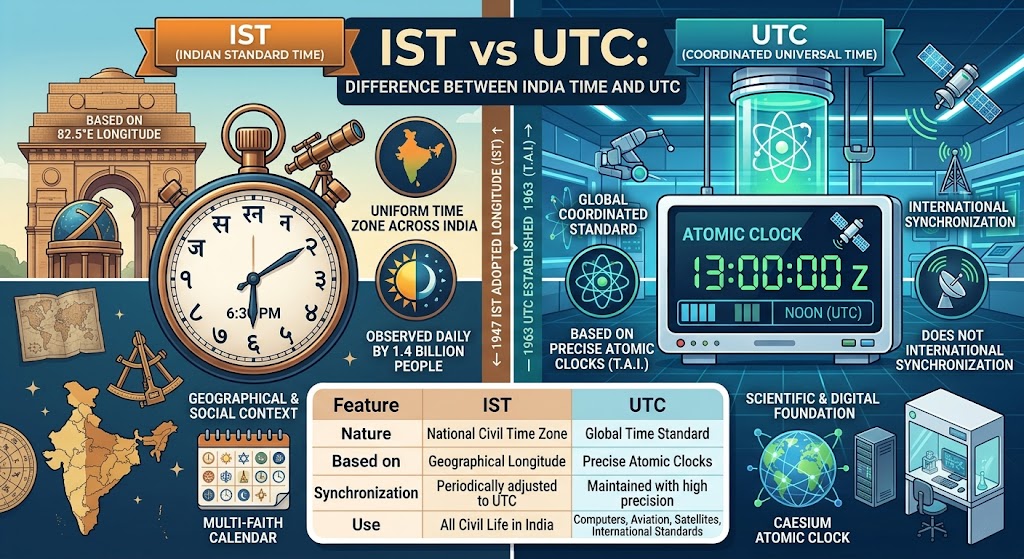
India chose UTC+5:30 as a compromise to cover its wide east-west span with a single time zone. The 82.5°E meridian passes through India, which is 5.5 hours ahead of UTC.
Why does Nepal have a 45-minute time zone?
Nepal sits between India (UTC+5:30) and China (UTC+8). They chose UTC+5:45 to be roughly in the middle.
Which country has the most unusual time zone?
Nepal's UTC+5:45 is the only 45-minute time zone in the world. It's the most unusual.
How many people live in non-hour time zones?
Over 1.4 billion people live in half-hour or 45-minute time zones — mostly in India.
Why does Australia have a half-hour time zone?
South Australia chose UTC+9:30 as a compromise between Western Australia (UTC+8) and Eastern Australia (UTC+10).
What is the only 45-minute time zone?
Nepal's UTC+5:45 is the only 45-minute time zone. There are also UTC+8:45 (Eucla) and UTC+12:45 (Chatham Islands).
Does any country have a 15-minute time zone?
The Chatham Islands use UTC+12:45, which is a 45-minute offset. During DST, they use UTC+13:45, which is 1 hour 45 minutes ahead of UTC. No country uses a 15-minute offset as standard (though Maldives did until 2016).
Why did Venezuela change from UTC-4:30 to UTC-4?
Venezuela switched from UTC-4:30 to UTC-4 in 2016 to align with electricity saving measures.
What is Eucla time?
Eucla is a small town in Western Australia that unofficially uses UTC+8:45, a 45-minute offset between Western Australia (UTC+8) and South Australia (UTC+9:30).
How do time zone databases handle half-hour time zones?
The IANA time zone database includes all official time zones, including half-hour and 45-minute offsets. Libraries like Luxon, date-fns-tz, and pytz support them.
Final Thoughts
Half-hour and 45-minute time zones aren't mistakes. They're deliberate choices that reflect geography, politics, and history.
India's 30-minute offset balances east and west. Nepal's 45-minute offset splits the difference between neighbors. Newfoundland's half-hour offset acknowledges its position between time zones.
Understanding these quirks helps us appreciate the complexity of time. Time zones aren't natural laws — they're human inventions, shaped by the same forces as everything else.
The next time you convert a time zone and it's off by 30 or 45 minutes, remember: there's a reason for it.
Check time zones instantly → /timezone-converter
Tags: half-hour time zones, 45 minute time zone, non-hour time zone offsets, India 30 minute offset, Nepal 45 minute offset, Myanmar 30 minute offset, Chatham Islands 45 minute offset, Newfoundland 30 minute offset, why do some countries have half hour time zones, unusual time zone offsets, 30 minute time zone countries, 45 minute time zone countries, time zone history, half hour offset explained, non-standard time zones, time zone anomalies, UTC+5:30, UTC+5:45, UTC+6:30, UTC+12:45, UTC-3:30