Time Zone Changes You Can Actually See: Countries That Moved Their Clocks
Time zones feel permanent. They seem like facts of nature, like mountains or rivers.
They are not.
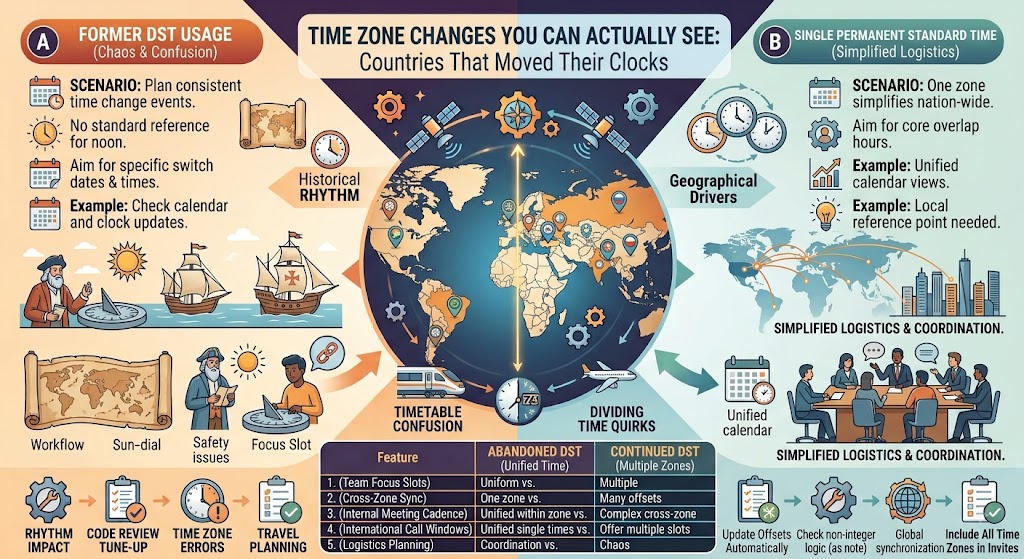
Time zones are human inventions, and humans change them all the time. Countries have moved their clocks by hours, skipped entire days, and even erased dates from the calendar for political and economic reasons.
Here are the most fascinating time zone changes you can actually see — and the stories behind them.
Use the free time zone converter here →
Samoa: The Country That Skipped a Day
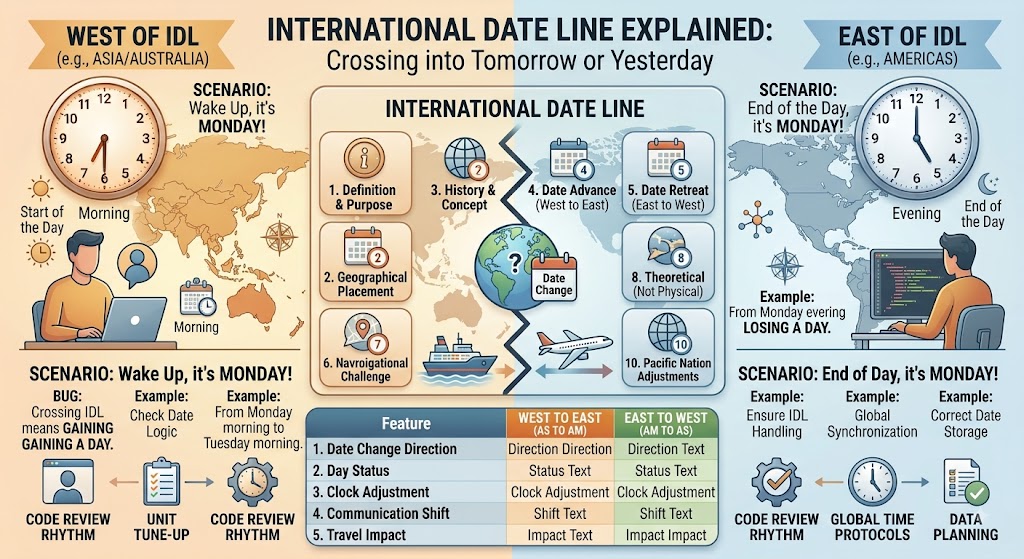
Date: December 29, 2011 What Happened: Samoa skipped December 30, 2011, entirely. The country jumped from Thursday, December 29, straight to Saturday, December 31 .
The Reason: Samoa wanted to align with its major trading partners — Australia and New Zealand . Before the change, Samoa was 23 hours behind New Zealand. When it was Monday in Sydney, it was still Sunday in Samoa. Businesses were losing two working days per week .
The Change: At midnight on December 29, Samoa moved from the eastern side of the International Date Line (UTC-11) to the western side (UTC+13) .
The Result:
- Samoa went from being one of the last countries to ring in the New Year to being one of the first
- Samoa is now one hour ahead of Wellington and three hours ahead of Sydney
- The shift created a 24-hour time difference with American Samoa, which is only 137 miles (about 220 km) away
Did you know? This was not Samoa's first time zone change. The decision reversed a move made 120 years earlier when Samoa aligned with US and European trading partners .
Fun Fact: Samoan businessman Rico Tupai said, "On our Friday, which is already the weekend in Australia and New Zealand, we send emails across and we have enquiries and we have no answers. And when answers come back from Australia and New Zealand it's our Sunday — time we spend with our families" .
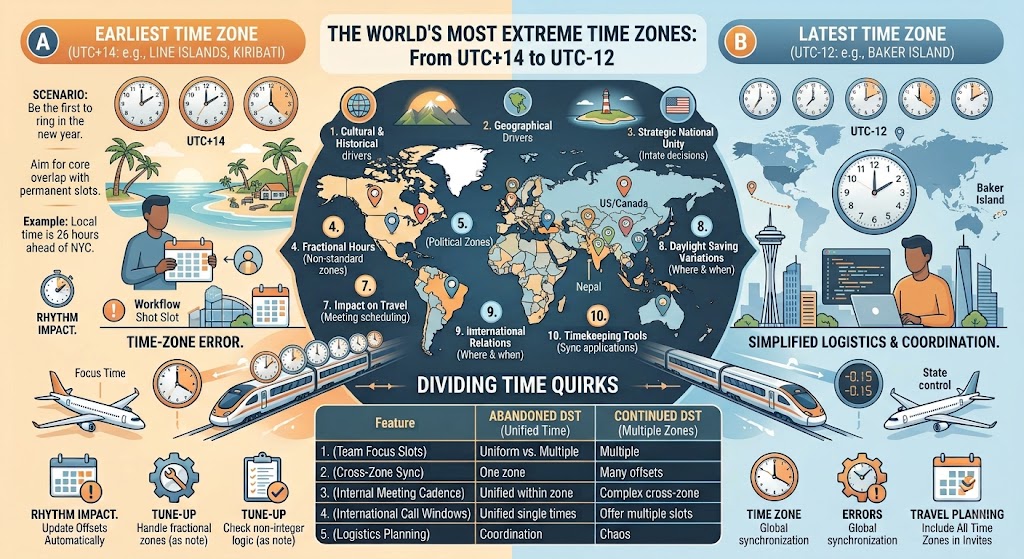
Kiribati: Creating UTC+14
Date: January 1, 1995 What Happened: Kiribati moved the International Date Line eastward, shifting its eastern half from UTC-11 and UTC-10 to UTC+13 and UTC+14 .
The Reason: When Kiribati gained independence from Britain in 1979, it acquired the Phoenix and Line Islands from the United States . The country was split by the International Date Line. Government offices on opposite sides could only communicate on the four days of the week when both sides experienced weekdays simultaneously .
The Change: The date line was moved eastward to encircle Kiribati, ensuring the entire country shared the same calendar date .
The Result: Kiribati's Line Islands became the first place on Earth to enter each new day at UTC+14 .
Bonus: Kiribati capitalized on this change to become the first place to see the new millennium on January 1, 2000, generating significant tourism interest .
North Korea: Erasing Colonial History
Date: August 15, 2015 What Happened: North Korea created its own time zone, "Pyongyang Time," moving clocks back 30 minutes from UTC+9 to UTC+8:30 .
The Reason: The change was political — intended to erase the legacy of Japanese colonial rule . Before Japanese occupation, Korea was 8.5 hours ahead of GMT, the time North Korea reverted to .
The Result: North Korea was 30 minutes behind South Korea and Japan until May 2018, when it moved back to UTC+9 to align with South Korea ahead of diplomatic talks.
Russia: Permanent Summer Time — And Back
2011: Russia switched to permanent summer time, reducing time zones from 11 to 9 .
2014: The experiment was abandoned. Russia switched to permanent winter time and restored all 11 time zones .
The Reason: The 2011 change was introduced by President Dmitry Medvedev to reduce time zones and keep summer time year-round . But many Russians, especially those in the north, complained about darker winter mornings .
The Twist: Representatives of the Russian Academy of Sciences said the latest change was carried out to please advertisers, as it would result in more people watching television .
Bonus: When Crimea was annexed from Ukraine in March 2014, its clocks were moved forward two hours to synchronize with Moscow time (GMT+4) .
China: From Five Time Zones to One
Date: 1949 What Happened: After taking power, the Communist Party abolished China's five time zones and unified the country under "Beijing Time" (GMT+8) .
The Reason: The change simplified governance and brought cohesion to the diverse nation .
The Problem: China stretches almost 5,000 kilometers from east to west . The decision has created problems for those living in the west, particularly Tibet and Xinjiang, whose residents rise two hours earlier than they naturally would .
The Unofficial Workaround: Some residents set their clocks back by two hours to reflect actual conditions, an unofficial practice sometimes interpreted as disloyalty to Beijing .
Venezuela: Chavez's Half-Hour Shift
Date: 2007 What Happened: President Hugo Chavez moved Venezuela's clocks back 30 minutes from UTC-4 to UTC-4:30 .
The Reason: Chavez said he wanted children to wake up in daylight to go to school . Critics said the move was politically motivated — Chavez often railed against "U.S. domination" and wanted to break from international standards .
The Result: The move strained an economy already facing power shortages because lights went on earlier in the evening .
History: Venezuela had used a half-hour offset until 1965, when it shifted to UTC-4 to conform to international standards . The country now uses UTC-4 .
Spain: The Wrong Time Zone Since WWII
Date: 1940s What Happened: Spain moved its clocks forward one hour to align with Nazi Germany .
The Reason: When Nazi-occupied France switched to German time (UTC+1), Spain's Franco dictatorship followed suit .
The Result: Spain has never switched back. The country is on the same latitude as Britain and Portugal but remains one hour ahead .
The Impact:
- Spaniards eat dinner at 10:00 PM
- The sun sets very late in summer (around 10:00 PM)
- A 2016 study estimated the "wrong" time zone costs Spain over €100 million per year in lost productivity
Recent Attempts: A petition to switch back to British time has gathered some support. In 2013, a parliamentary commission said a switch could have profound effects on eating, sleeping, and working habits in Spain . No action has been taken.
Crimea: The Annexation Time Shift
Date: March 30, 2014 What Happened: Crimea's clocks were moved forward two hours to synchronize with Moscow time .
The Reason: Crimea was annexed by Russia from Ukraine. The time change reflected the political shift .
The Result: Crimea gave up daylight saving time since Russia doesn't observe it. Crimea is now two hours ahead of Ukraine in winter and one hour ahead in summer .
Other Notable Time Zone Changes
Nepal: 15 Minutes of Fame (1956)
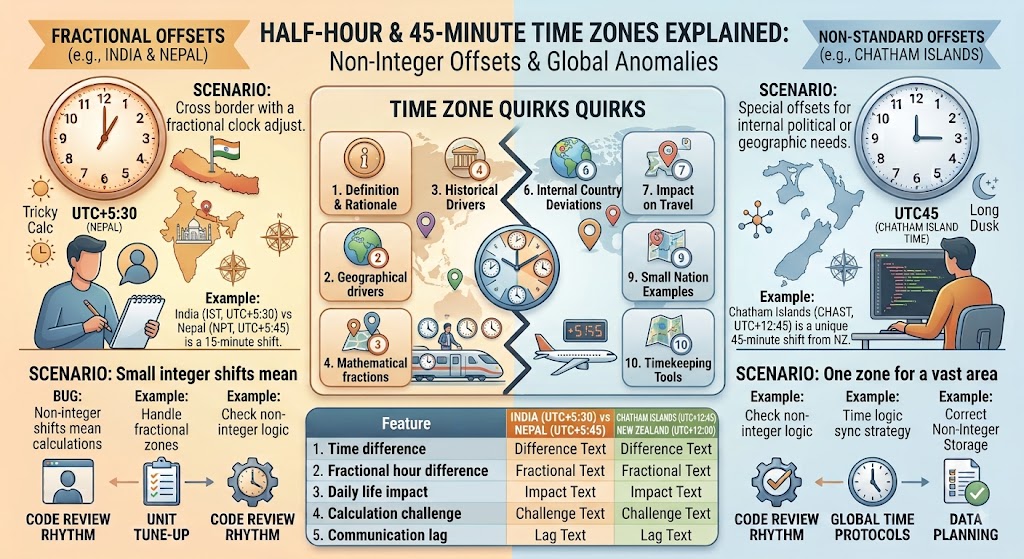
Nepal moved to GMT+5:45 to mark the time the sun passes over a famous mountain . It remains one of only three places with a 45-minute offset.
India: The Tea Garden Time
India divided into two time zones for most of its colonial history, then chose a unified time zone (UTC+5:30) upon independence . But in Assam state, many tea plantations work on "tea garden time" — clocks set one hour ahead so field hands have more sunlight .
Sri Lanka: Two Time Zones at Once
In 1996, Sri Lanka's central government set clocks back 30 minutes during a power crisis. But Tamil Tiger rebels, controlling northern Sri Lanka, refused to follow . The country effectively operated on two different time zones until the Tigers were crushed in 2009 .
Turkey: Staying on Summer Time (2016)
Turkey permanently retained daylight saving time (summer time) year-round . Clocks stay forward all year at UTC+3, leading to dark winter mornings but later sunsets.
Quick Reference: Major Time Zone Changes
| Country | Year | Change | Reason |
|---|---|---|---|
| Samoa | 2011 | Skipped Dec 30, moved UTC-11 → UTC+13 | Trade with Australia/NZ |
| Kiribati | 1995 | UTC-11 → UTC+14 | National unity |
| North Korea | 2015 | UTC+9 → UTC+8:30 | Anti-Japanese colonial sentiment |
| Russia | 2014 | Abandoned permanent summer time | Public health complaints |
| China | 1949 | 5 time zones → 1 | National unity |
| Venezuela | 2007 | UTC-4 → UTC-4:30 | Political symbolism |
| Spain | 1940s | UTC+0 → UTC+1 | Franco-Nazi alignment |
| Crimea | 2014 | UTC+2 → UTC+4 | Russian annexation |
| Nepal | 1956 | UTC+5:30 → UTC+5:45 | Mountain sun position |
| Turkey | 2016 | UTC+2 → UTC+3 | Permanent summer time |
Why Countries Change Time Zones
| Reason | Examples |
|---|---|
| Trade and Economics | Samoa, Kiribati, Turkey |
| Politics and Identity | North Korea, China, Venezuela |
| War and Conquest | Spain, Crimea |
| Health and Practicality | Russia |
| Geography | Nepal, India's tea gardens |
Frequently Asked Questions
Which country skipped an entire day?
Samoa skipped December 30, 2011, to move across the International Date Line .
Which country has the earliest time zone?
Kiribati's Line Islands at UTC+14 .
Why did North Korea change its time zone?
To erase the legacy of Japanese colonial rule .
Why does Spain have the "wrong" time zone?
Franco aligned Spain with Nazi Germany during World War II, and the country never switched back .
Why did China switch to one time zone?
The Communist Party abolished five time zones in 1949 to unify the country .
Why did Russia abandon permanent summer time?
Many Russians complained about darker winter mornings, especially in the north .
Did any country have two time zones at once?
Sri Lanka operated on two different time zones in the 1990s because Tamil Tiger rebels refused to follow government time changes .
What is "tea garden time" in India?
In Assam state, tea plantations set clocks one hour ahead so field hands have more sunlight .
Final Thoughts
Time zones are not natural laws. They are human decisions, shaped by politics, economics, and history. Countries move their clocks to align with trading partners, erase colonial history, assert national identity, or simply make life more practical.
Three things to remember:
- Time zones change all the time — Samoa, Kiribati, and North Korea all changed in the last 30 years
- Politics drives time zones — Most changes are about identity, trade, or power
- You can see the effects — The 24-hour gap between Samoa and American Samoa is visible on any world clock
Check time zone conversions instantly → /timezone-converter
Tags: countries that moved time zones, Samoa skipped December 30 2011, Kiribati time zone change 1995, North Korea Pyongyang time, Venezuela time zone change Chavez, China single time zone Beijing time, Russia permanent winter time, Spain wrong time zone, International Date Line changes, time zone politics, countries that changed time zones