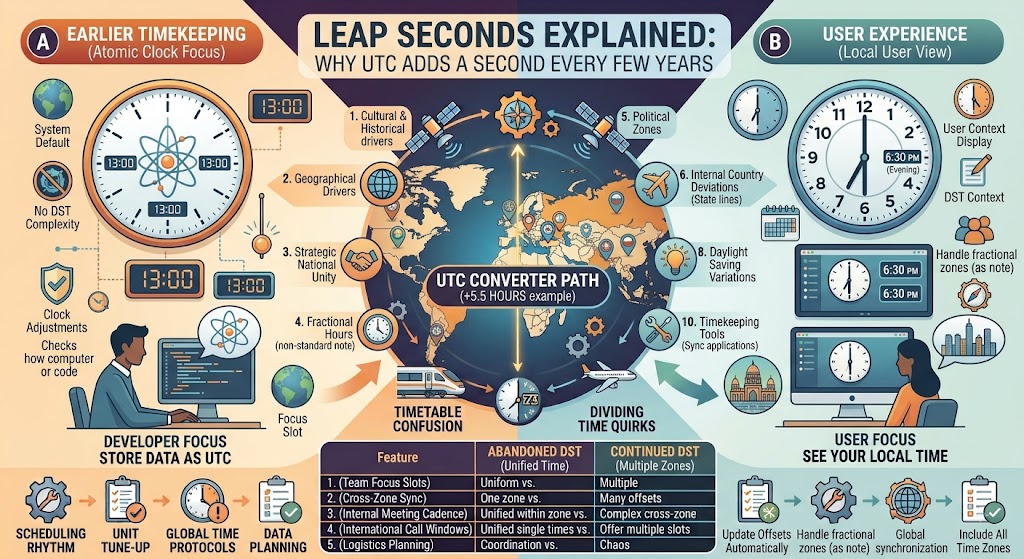
Leap Seconds Explained: Why UTC Adds a Second Every Few Years
You know the drill: every few years, just before midnight on December 31 or June 30, the world's atomic clocks pause for a moment and add an extra second. Digital clocks flash 23:59:60 before rolling over to midnight .
Why do we do this? Because atomic clocks are too accurate for their own good.
Atomic time is perfectly stable, but Earth's rotation is not. The planet slows down unpredictably, and if we never adjusted, atomic time and solar time would drift apart. So we insert leap seconds to keep them in sync .
This guide explains what leap seconds are, why they exist, how they affect technology, and why they might soon disappear forever.
Use the free time zone converter here →
The Short Answer: What Is a Leap Second?
A leap second is an extra second added to Coordinated Universal Time (UTC) to keep it synchronized with astronomical time (UT1), which is based on Earth's rotation .
| Aspect | Details |
|---|---|
| Why it exists | Atomic clocks and Earth's rotation don't stay in sync |
| When it is added | June 30 or December 31 at 23:59:59 UTC |
| How it looks | 23:59:59 → 23:59:60 → 00:00:00 |
| Who decides | International Earth Rotation and Reference Systems Service (IERS) |
| First added | June 30, 1972 |
| Total added | 27 leap seconds since 1972 |
| Last added | December 31, 2016 |
The Problem: Atomic Time vs. Earth Time
Two Different Kinds of Time
There are two ways to measure time:
| Time Scale | What It Is Based On | Characteristics |
|---|---|---|
| UTC (Coordinated Universal Time) | Atomic clocks (9,192,631,770 cesium atom oscillations per second) | Perfectly stable, never wavers |
| UT1 (Astronomical Time) | Earth's rotation (mean solar day) | Irregular, gradually slowing |
The second was originally defined as 1/86,400 of a mean solar day. But Earth's rotation is not constant — it slows down due to tidal braking from the Moon at about 2.3 milliseconds per day per century . The Moon is gradually moving away from Earth, and this tidal interaction gradually slows our planet's rotation .
Atomic clocks were designed to match the astronomical second as closely as possible . But they are not exactly the same, and over time the mismatch grows . Earth's rotation also experiences irregular fluctuations due to geophysical effects .
The Result: Drifting Clocks
If we never adjusted UTC, atomic time would slowly pull ahead of solar time. Eventually, noon on atomic clocks would happen at sunrise, and the stars would be in the wrong places for astronomers .
The fix: Insert leap seconds whenever the difference between UTC and UT1 reaches 0.9 seconds .
How Leap Seconds Work
The Process
The International Earth Rotation and Reference Systems Service (IERS) monitors Earth's rotation using Very Long Baseline Interferometry (VLBI) — a technique that measures the distance between radio telescopes by timing signals from distant quasars .
When the difference between UTC and UT1 approaches 0.9 seconds, the IERS announces a leap second in Bulletin C .
When They Happen
Leap seconds are always inserted at the end of June 30 or December 31, UTC . The sequence looks like this:
23h 59m 59s
23h 59m 60s  ← The leap second
00h 00m 00s  ← The next day
So far, all leap seconds have been positive — a second has been added . There is provision for a negative leap second (removing a second), but it has never been done .
The History
| Period | Average Leap Seconds |
|---|---|
| 1972-1999 | About 1 every 1-2 years |
| 2000-2016 | About 1 every 3-4 years |
| 2016-present | None |
The last leap second was inserted on December 31, 2016 . Since then, Earth's rotation has actually been speeding up — likely due to shifts in mass distribution caused by melting glaciers and water storage in reservoirs . In 2020, the record for the shortest day was broken 28 times .
No leap second is scheduled for December 2026, meaning it will be 10 years since the last leap second .
The Tech Headache: Why Leap Seconds Break Computers
Leap seconds seem simple. But for computer systems that rely on precise time, they are a nightmare.
The Problem with "23:59:60"
Most computer systems represent time as a number of seconds since an epoch (like Unix time). There is no standard way to represent 23:59:60 in these systems . Some systems effectively stop the clock for one second during the leap second, but this creates its own problems .
Real-World Disruptions
| Incident | Year | Impact |
|---|---|---|
| Qantas flight delays | 2012 | Over 400 flights delayed when check-in systems crashed |
| Reddit, Mozilla, LinkedIn | 2012 | Glitches and slow performance due to leap second handling |
| Google, Amazon, Meta | Various | These companies implement "smearing" — running clocks slightly slower to spread the extra second over hours or a full day |
The "Smearing" Solution: Instead of inserting the leap second at a single instant, large tech companies add it gradually over 24 hours. Each minute is slightly longer than normal, so the time never jumps backward or forward .
The Negative Leap Second: A New Challenge
Earth's rotation has been speeding up, raising the possibility of a negative leap second — removing a second from the clock .
| Aspect | Explanation |
|---|---|
| What it would be | 23:59:58 → 00:00:00 (skipping 23:59:59) |
| Why it might happen | Earth's rotation is accelerating |
| When it might happen | Potentially by 2029, according to some projections |
| Why it might not | Global warming is melting polar ice, moving water to the equator, which actually slows Earth down |
The catch: A negative leap second would be even harder for computer systems to handle. No one has ever done one, and the tech industry is not ready .
The Future: Abolishing Leap Seconds
Because of the headaches leap seconds cause for technology, the General Conference on Weights and Measures voted in 2022 to abolish them .
| Aspect | Details |
|---|---|
| The decision | Abolish leap seconds by 2035 |
| The alternative | Allow the difference between UTC and UT1 to grow larger — possibly up to 100 seconds over a century |
| Who needs UT1 | Astronomers and scientists who observe celestial bodies |
| The plan | Publish the growing difference as a correction for those who need it |
The result: By 2035, you may never see "23:59:60" again. The leap second will become a historical curiosity, remembered only by those who used it.
Quick Reference Card
━━━━━━━━━━━━━━━━━━━━━━━━━━━━━━━━━━━━━━━━━━━━━━━━━━━━━━━━━━
               LEAP SECOND CHEAT SHEET
━━━━━━━━━━━━━━━━━━━━━━━━━━━━━━━━━━━━━━━━━━━━━━━━━━━━━━━━━━

WHAT: Extra second added to UTC to sync with Earth's rotation
WHEN: June 30 or December 31 at 23:59:59 UTC
HOW: 23:59:59 → 23:59:60 → 00:00:00
WHO: International Earth Rotation Service (IERS)
FIRST: June 30, 1972
TOTAL: 27 leap seconds
LAST: December 31, 2016
NEXT: No leap second in December 2026

━━━━━━━━━━━━━━━━━━━━━━━━━━━━━━━━━━━━━━━━━━━━━━━━━━━━━━━━━━
           WHY THEY ARE GOING AWAY
           • Break computer systems
           • Tech industry hates them
           • Abolished by 2035 (General Conference on Weights and Measures)
━━━━━━━━━━━━━━━━━━━━━━━━━━━━━━━━━━━━━━━━━━━━━━━━━━━━━━━━━━
           Check live conversions at: /timezone-converter
━━━━━━━━━━━━━━━━━━━━━━━━━━━━━━━━━━━━━━━━━━━━━━━━━━━━━━━━━━
Frequently Asked Questions
What is a leap second?
A leap second is an extra second added to UTC to keep it synchronized with astronomical time, which is based on Earth's rotation .
Why do we need leap seconds?
Atomic clocks are perfectly stable, but Earth's rotation is not. It gradually slows down due to tidal braking from the Moon . Without leap seconds, atomic time and solar time would drift apart .
When was the last leap second?
The last leap second was added on December 31, 2016 .
Will there be a leap second in 2026?
No. The IERS announced no leap second will be added at the end of December 2026 .
What is a negative leap second?
A negative leap second would remove a second from the clock, making the sequence 23:59:58 → 00:00:00. It would be needed if Earth's rotation speeds up. It has never been done .
Why are leap seconds going away?
The General Conference on Weights and Measures voted in 2022 to abolish leap seconds by 2035 because they cause problems for computer systems .
What is "time smearing"?
Large tech companies like Google and Meta spread the leap second over 24 hours by running clocks slightly slower. This avoids a sudden jump in time .
How many leap seconds have there been?
There have been 27 leap seconds since the system was adopted in 1972 .
Final Thoughts
Leap seconds exist because atomic clocks are too accurate for a planet that refuses to rotate steadily. They keep our clocks aligned with the Sun and stars, but they come at a cost — they break computer systems and make software engineers' lives difficult.
Three things to remember:
- Atomic time is perfect; Earth's rotation is not. Leap seconds bridge the gap
- The last leap second was in 2016. Earth has been speeding up recently
- Leap seconds are being abolished by 2035. Tech won
Check time zone conversions instantly → /timezone-converter
Tags: leap second explained, UTC leap second, why leap seconds are added, Earth rotation slowing, atomic clock vs Earth time, IERS leap second, 23:59:60, negative leap second, leap second abolished 2035, time synchronization, GPS time, leap second IT problems