International Date Line Explained: Why Traveling East Can Make You Lose a Day
Imagine this: You board a flight from Los Angeles to Tokyo on Monday morning. It's a 12-hour flight. You arrive in Tokyo — and it's Tuesday afternoon.
You've lost a day. Your Monday basically didn't happen.
Now imagine the reverse: You fly from Tokyo to Los Angeles. You leave on Monday afternoon. You arrive in Los Angeles — and it's still Monday morning.
You've gained a day. You've time-traveled backward.
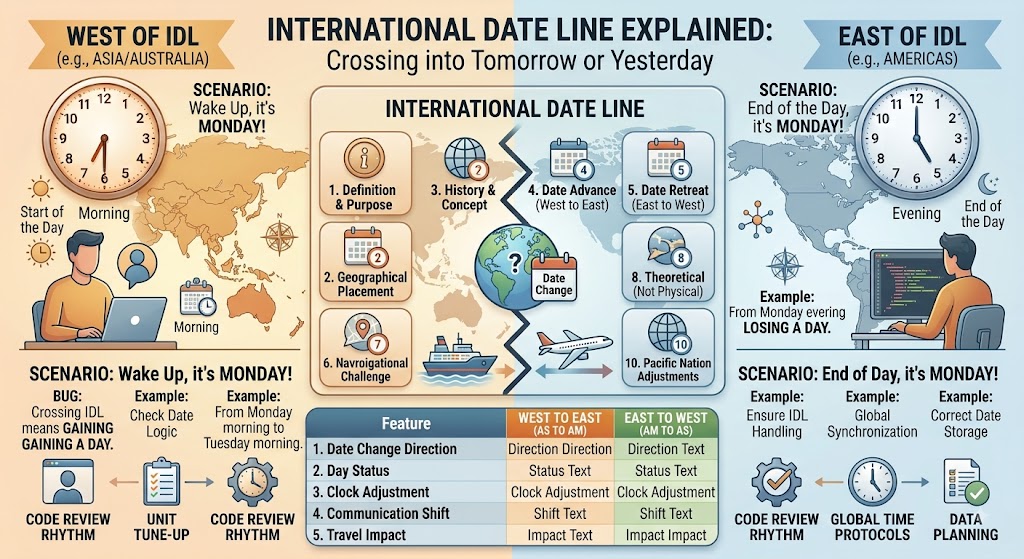
This is the magic of the International Date Line (IDL). It's the invisible line on Earth where the date changes depending on which direction you're traveling.
This guide explains everything you need to know about the International Date Line — how it works, why it exists, and what happens when you cross it.
Use the free time zone converter here →
The Short Answer: What Is the International Date Line?
The International Date Line (IDL) is an imaginary line on Earth's surface that runs roughly along the 180th meridian of longitude. When you cross it, the date changes by one day.
- Crossing west (Asia → Americas): The date advances by one day
- Crossing east (Americas → Asia): The date goes back by one day
Simple rule:
- Westbound (toward Asia): Add a day
- Eastbound (toward Americas): Subtract a day
Example:
| Travel Direction | Departure | Arrival | Date Change |
|---|---|---|---|
| Los Angeles → Tokyo (West) | Monday 9 AM | Tuesday 3 PM | +1 day |
| Tokyo → Los Angeles (East) | Monday 3 PM | Monday 9 AM | -1 day |
Note: The IDL is not a straight line. It zigzags to avoid splitting countries and island groups.
Why Does the International Date Line Exist?
The Basic Problem
If you travel around the world, you experience different sunrises and sunsets. Time zones handle this — each zone is roughly 15° of longitude apart.
But there's a problem: if you go all the way around, you gain or lose a day.
The Solution:
Somewhere on Earth, there needs to be a line where the date resets. That's the International Date Line. It's the place where "today" ends and "tomorrow" begins.
How It Works
Imagine you travel west around the world:
- You start in London at 12:00 PM on Monday
- You travel west across time zones, moving your clock back 1 hour each time
- After 24 time zones, you're back in London
- Your clock shows 12:00 PM, but your date says Sunday
The problem: You've lost a day.
The fix: When you cross the International Date Line going west, you add a day. So instead of Sunday, it's Monday.
Where Is the International Date Line?
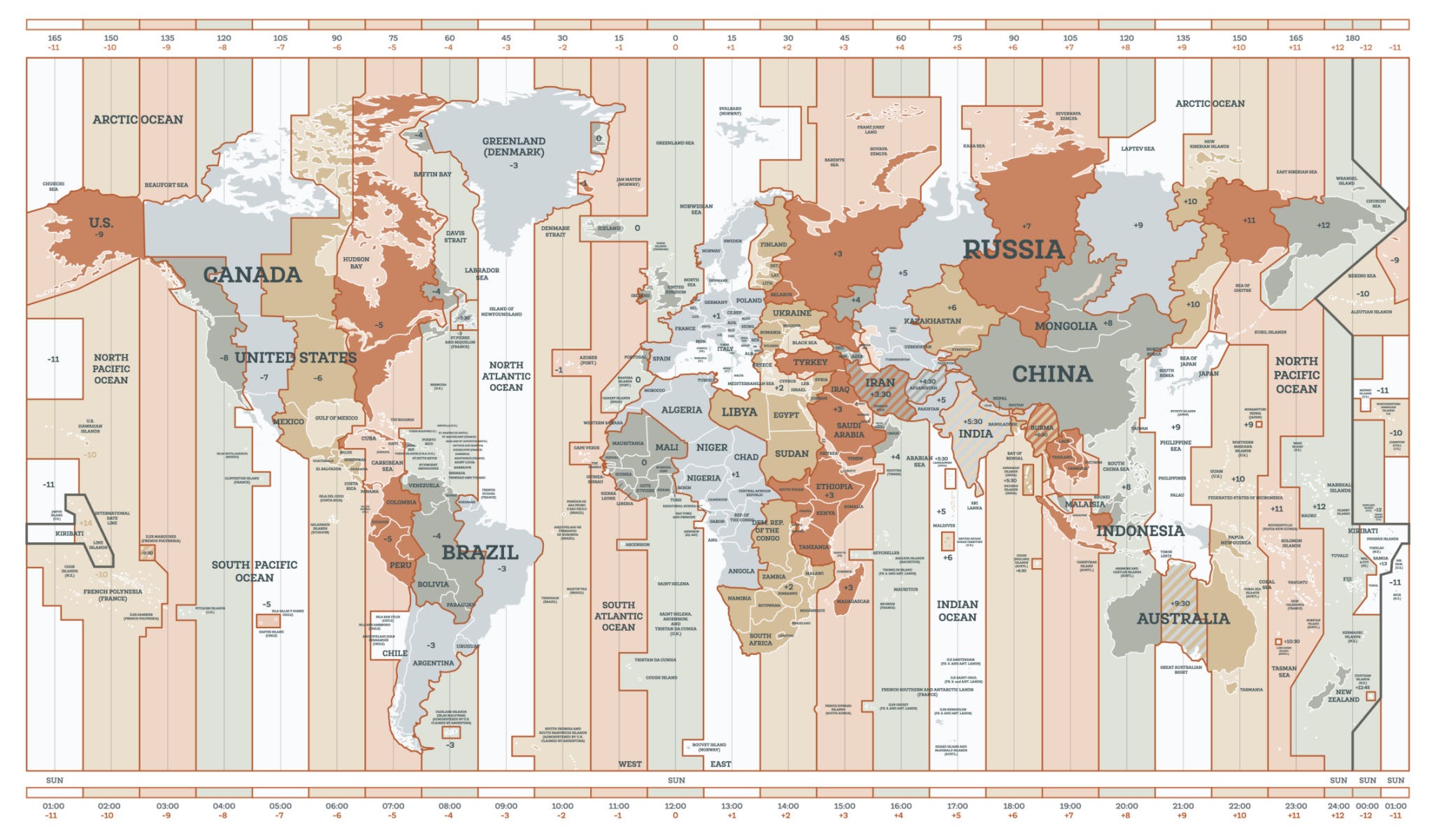
The IDL roughly follows the 180th meridian of longitude. But it's not a straight line — it zigzags to avoid cutting through countries and island groups.
The Path of the IDL
North to South:
- Starts near the North Pole at 180° longitude
- Goes south through the Bering Strait
- Zigzags east to keep the Aleutian Islands (Alaska) on the same side
- Straightens through the central Pacific
- Zigzags west to keep Fiji, Tonga, and Samoa on the same side
- Zigzags east to keep the Chatham Islands (New Zealand) on the same side
- Ends near the South Pole at 180° longitude
Why the Zigzags?
The IDL zigzags so that:
- Countries aren't split into different dates
- Entire island groups share the same date
- Trade and communication are easier
Major Cities Near the IDL
| City | Country | Time Zone | Position Relative to IDL |
|---|---|---|---|
| Suva | Fiji | UTC+12 | West of IDL |
| Apia | Samoa | UTC+13 | West of IDL |
| Pago Pago | American Samoa | UTC-11 | East of IDL |
| Nuku'alofa | Tonga | UTC+13 | West of IDL |
| Kiritimati | Kiribati | UTC+14 | West of IDL |
| Auckland | New Zealand | UTC+12 | West of IDL |
Real Examples of Date Line Crossings
Example 1: Los Angeles to Tokyo
Scenario: You fly from LAX to Narita (Tokyo)
- Depart: Los Angeles, Monday, 9:00 AM
- Flight time: 12 hours
- Arrive (UTC calculation): 9:00 AM + 12 hours = 9:00 PM Monday UTC
- Convert to Tokyo time: Tokyo = UTC+9, so 9:00 PM + 9 hours = 6:00 AM Tuesday
Result: You left on Monday and arrived on Tuesday. You lost a day.
Example 2: Tokyo to Los Angeles
Scenario: You fly from Narita to LAX
- Depart: Tokyo, Monday, 3:00 PM
- Flight time: 12 hours
- Arrive (UTC calculation): 3:00 PM - 9 hours = 6:00 AM UTC
- Convert to LA time: LA = UTC-8, so 6:00 AM - 8 hours = 10:00 PM Sunday
Result: You left on Monday and arrived on Sunday. You gained a day.
Example 3: The Record-Breaking Flight
Scenario: A flight from Fiji to American Samoa
- Depart: Nadi, Fiji (UTC+12) — Tuesday, 8:00 AM
- Flight time: 4 hours
- Arrive: Pago Pago, American Samoa (UTC-11)
- UTC conversion: 8:00 AM - 12 hours = 8:00 PM Monday UTC
- Convert to American Samoa: 8:00 PM - 11 hours = 9:00 AM Monday
Result: You traveled 4 hours but arrived a day earlier. This is the shortest "time travel" flight in the world.
The Samoa Time Zone Change: Skipping December 30, 2011
In 2011, Samoa made a dramatic change. They moved from UTC-11 to UTC+13. The reason? Trade and business ties with New Zealand and Australia.
Before the Change
- Samoa: UTC-11 (Thursday, 11:00 PM)
- New Zealand: UTC+12 (Friday, 11:00 PM)
The Problem: Samoa was almost a day behind its main trading partners. Business week was effectively one day shorter.
The Change
On December 30, 2011, 11:59 PM, Samoa jumped forward to December 31, 2011, 11:00 PM.
Result: Samoa skipped December 30, 2011 entirely. It was just gone.
The Impact
- Positive: Samoa is now 1 hour ahead of New Zealand, not 23 hours behind
- Trade: Business with Australia and New Zealand became easier
- Travel: Samoa and American Samoa are now 24 hours apart (despite being very close geographically)
Did you know? American Samoa is just 160 km away from Samoa but is 24 hours behind. You can watch the sunrise in American Samoa, fly to Samoa, and watch the same sunrise again!
Kiribati: The Country in the Future
Kiribati is a special case. The country spans both sides of the IDL and was originally split into two different dates.
The Problem
- Eastern Kiribati: UTC-10 (Line Islands)
- Western Kiribati: UTC+12 (Gilbert Islands)
Issue: The country had two different dates. One half was a day ahead of the other.
The Solution
In 1995, Kiribati moved the IDL eastward so that the entire country was on the same side.
Result: The Line Islands are now in UTC+14, making them the first place on Earth to see the New Year.
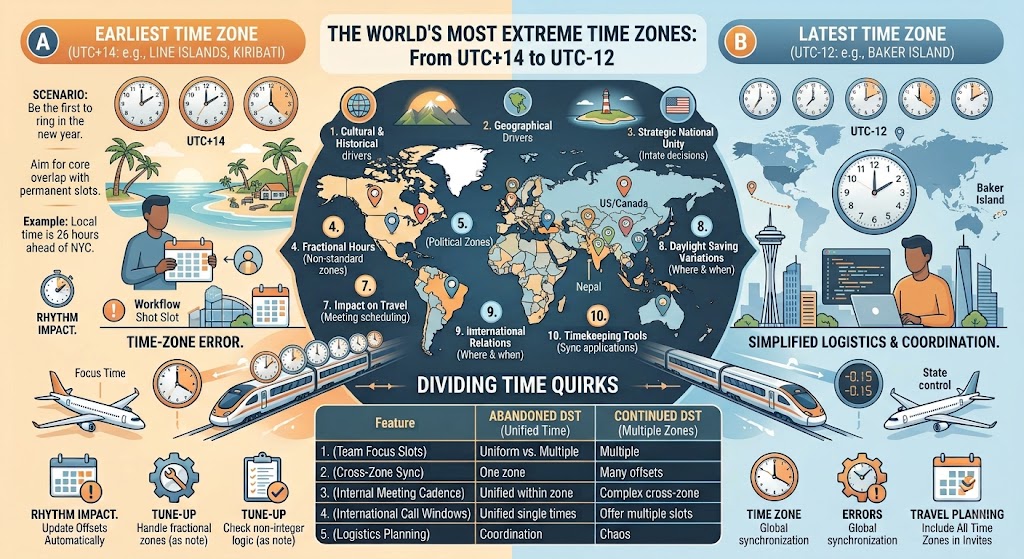
The Time Zone Extremes
| Time Zone | Location | UTC Offset | Date |
|---|---|---|---|
| UTC-12 | Baker Island (US) | -12:00 | Yesterday |
| UTC-11 | American Samoa | -11:00 | Yesterday |
| UTC+12 | Fiji, New Zealand | +12:00 | Today |
| UTC+13 | Samoa, Tonga | +13:00 | Today |
| UTC+14 | Kiribati (Line Islands) | +14:00 | Tomorrow |
Interesting: At 10:00 AM on Monday in Baker Island (UTC-12), it's already 10:00 AM on Tuesday in Kiribati (UTC+14) — a full 26-hour difference on the same planet.
Travel Tips for Crossing the Date Line
For Flights
Going West (Americas → Asia/Australia):
- You'll likely lose a day
- You might arrive after midnight even if you left in the morning
- Book hotels for the day you arrive (not the day you left)
Example:
- Leave LA on Monday → Arrive in Tokyo on Tuesday
- Book hotel for Tuesday arrival, not Monday
Going East (Asia/Australia → Americas):
- You'll likely gain a day
- You might arrive before you left
- You're "traveling back in time"
Example:
- Leave Tokyo on Monday → Arrive in LA on Monday
- You can call it a "same day" flight
For Travel Planning
- Always confirm your arrival date — Don't just look at arrival time
- Book hotels for the correct date — This is a common mistake
- Double-check your calendar — Your phone will update automatically, but your brain might not
- Plan for jet lag — Crossing the date line is disorienting
Real Travel Example
Flight: Los Angeles → Sydney (Qantas QF12)
| Item | Information |
|---|---|
| Departure | LAX, 10:00 PM, Monday |
| Flight time | 15 hours |
| Arrival (UTC) | 10:00 PM + 15 hours = 1:00 PM Tuesday UTC |
| Sydney time | UTC+10, so 1:00 PM + 10 hours = 11:00 PM Tuesday |
Result: You left Monday at 10:00 PM and arrived Tuesday at 11:00 PM. You lost a day.
Time Zones and the Date Line: Quick Reference
Map of Time Zones Near IDL
                 West ←------------------→ East
                 (Toward Asia)         (Toward Americas)

                 UTC+14   UTC+13   UTC+12   |   UTC-11   UTC-12
                 ────────────────────────IDL─────────────────────────
                 Kiribati  Samoa    Fiji    |   American  Baker
                 (Tomorrow)         NZ      |   Samoa    Island
                                            |   (Yesterday)
Date Line Crossing Rules
| Direction | Date Change | Example |
|---|---|---|
| Westbound (Asia) | +1 day | Monday → Tuesday |
| Eastbound (Americas) | -1 day | Tuesday → Monday |
Common Mistakes (And How to Avoid Them)
1. Confusing Direction
Mistake: Adding a day when going east (toward Americas)
Fix: Remember — when you go west (toward Asia), you add a day. When you go east (toward Americas), you subtract a day.
2. Not Accounting for Time Zones
Mistake: Thinking the date change happens instantly
Fix: The date change happens when you cross the IDL, not when you cross any other time zone. Time zones change the hour, the IDL changes the date.
3. Booking Hotel on Wrong Date
Mistake: Arriving in Sydney on Tuesday but booking a hotel for Monday
Fix: Always check the arrival date, not just the arrival time.
4. Forgetting About Samoa and Kiribati
Mistake: Assuming the IDL is a straight line
Fix: The IDL zigzags. Check the specific country's time zone before assuming the date.
Fun Facts About the International Date Line
Fact 1: The earliest place on Earth
Kiribati's Line Islands (UTC+14) are the first place to celebrate New Year. They're 26 hours ahead of Baker Island (UTC-12).
Fact 2: The two Samoas are 24 hours apart
Samoa and American Samoa are just 160 km apart but are 24 hours different. You can have the same sunrise twice.
Fact 3: You can skip a birthday
If you're born on a ship crossing the IDL, your birthday depends on which direction you're traveling.
Fact 4: The IDL moves
The IDL isn't fixed. It changed in 1995 for Kiribati and in 2011 for Samoa. It can change again.
Fact 5: Some countries have 24-hour time zones
Countries near the IDL have enormous time zone differences. Kiribati is UTC+14, while Baker Island is UTC-12 — a 26-hour difference on the same planet.
Frequently Asked Questions
What is the International Date Line?
An imaginary line roughly along the 180th meridian where the date changes by one day when crossed.
What happens when you cross the International Date Line?
Going west (toward Asia): Add a day. Going east (toward Americas): Subtract a day.
Why does the International Date Line zigzag?
To avoid splitting countries and island groups. It zigzags so that entire countries share the same date.
Where is the International Date Line located?
It runs roughly along the 180th meridian of longitude, zigzagging through the Pacific Ocean.
What countries are affected by the International Date Line?
Fiji, Samoa, Tonga, Kiribati, New Zealand, and many Pacific islands are near the IDL.
Why did Samoa skip a day in 2011?
Samoa moved from UTC-11 to UTC+13 to align with trading partners in New Zealand and Australia. December 30, 2011 was skipped.
What is the biggest time difference on Earth?
Kiribati (UTC+14) and Baker Island (UTC-12) have a 26-hour difference.
Can you travel across the date line without flying?
Yes. Traveling across the Pacific via ship also crosses the IDL. The date changes depending on the direction.
What's the shortest flight that crosses the date line?
Fiji to American Samoa is about 4 hours and crosses the IDL, arriving a day earlier.
What's the longest flight that crosses the date line?
Los Angeles to Sydney is about 15 hours and crosses the IDL, arriving two days later.
Does my phone automatically update the date when crossing the IDL?
Yes. Modern smartphones update time and date automatically based on cellular networks or GPS.
Can the International Date Line change?
Yes. The IDL changed for Kiribati in 1995 and for Samoa in 2011. It can change again if countries decide to switch time zones.
Final Thoughts
The International Date Line is one of the most fascinating quirks of our time zone system. It's an invisible line that can make you lose or gain a day just by crossing it.
For travelers, understanding the IDL is essential. It affects flight bookings, hotel reservations, and your internal body clock.
Three things to remember:
- Going west (toward Asia): Add a day
- Going east (toward Americas): Subtract a day
- Always check the date when booking travel across the Pacific
And if you're ever confused about what day it is on the other side of the IDL, use our time zone converter. It handles time zones, DST, and date changes automatically.
Check time zones and dates instantly → /timezone-converter
Tags: International Date Line, International Date Line explained, date line crossing, travel across date line, Samoa skipped a day, time zone date line, IDL explained, crossing the date line, losing a day traveling, gaining a day traveling, date line map, International Date Line in Pacific, why does date line exist, travel tips date line, flight across Pacific date line, Samoa time zone change 2011, Kiribati date line, date line history, how date line works