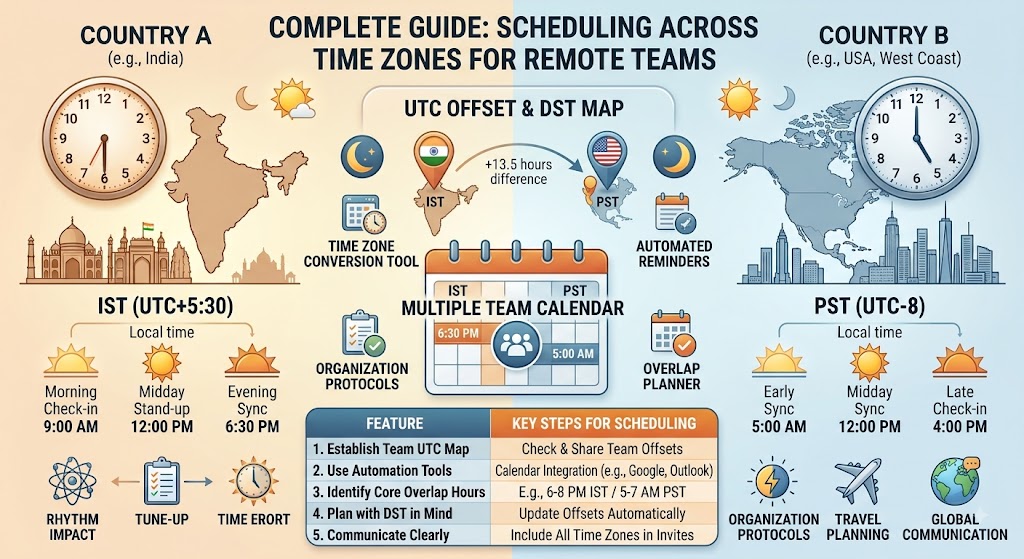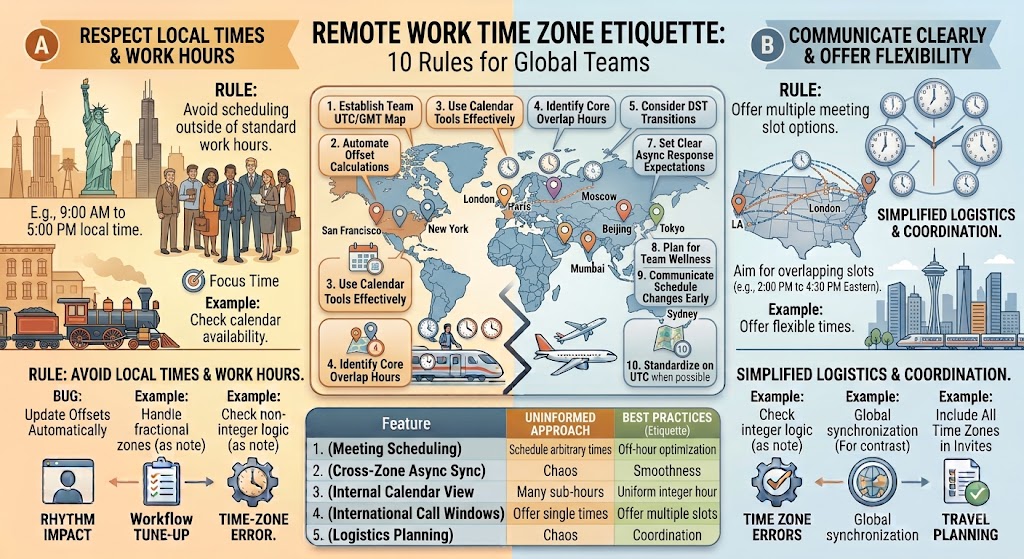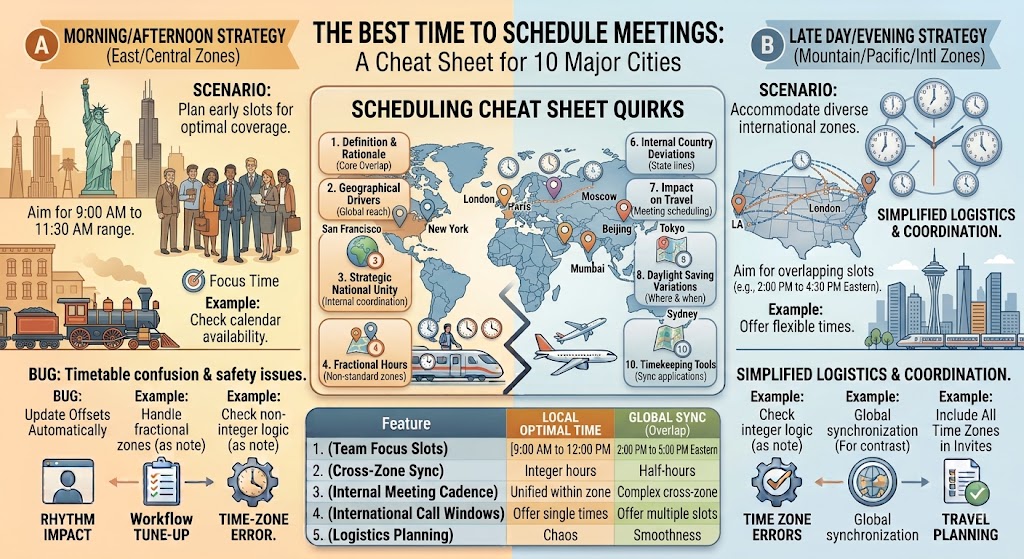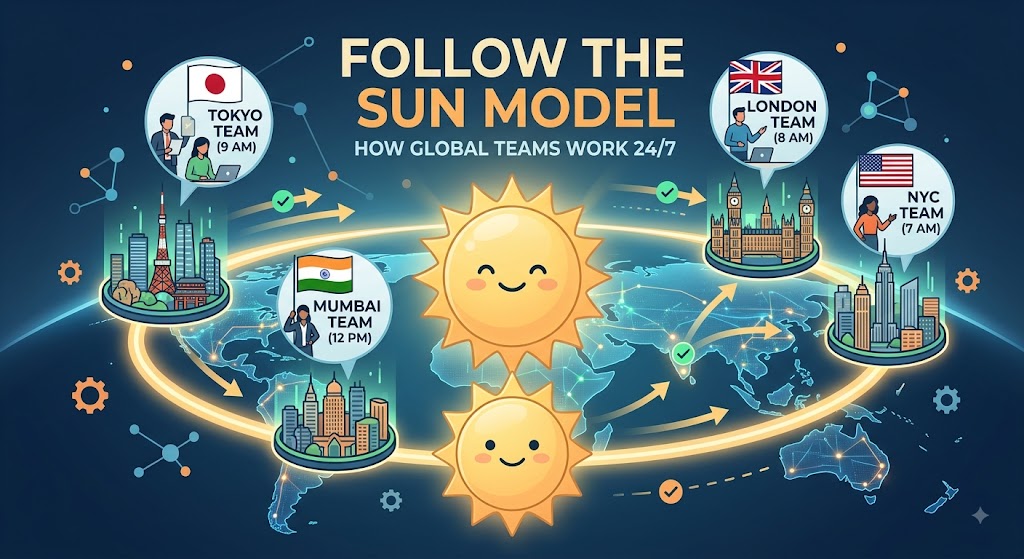
Follow the Sun Model: How Global Teams Work 24/7
The sun never sets on a well-run global team.
You are in San Francisco. It is 9:00 AM. You start your day by reviewing the work your Bangalore team completed overnight. You add your updates and pass the work to your London team. They finish their day and hand off to the Bangalore team again.
The cycle continues. Work happens 24 hours a day. No one works overnight. No one burns out.
This is the Follow the Sun model — a distributed work strategy where teams across time zones hand off work to each other, enabling continuous progress without anyone working outside their normal hours.
This guide explains how the Follow the Sun model works, who uses it, and how to implement it successfully.
Use the free time zone converter here →
The Short Answer: What Is the Follow the Sun Model?
Follow the Sun (FTS) is a work model where a global team hands off work across time zones so that work continues 24/7.
How it works:
| Time Zone | Region | Working Hours (Local) | What They Do |
|---|---|---|---|
| UTC+8 | Asia (Singapore, Tokyo) | 9 AM - 6 PM | Starts the day, does morning work |
| UTC+0 | Europe (London, Paris) | 9 AM - 6 PM | Takes over from Asia, does afternoon work |
| UTC-5 | Americas (New York, SF) | 9 AM - 6 PM | Takes over from Europe, finishes the day |
The handoff cycle:
- Asia starts the day and works
- Europe takes over when Asia finishes
- Americas takes over when Europe finishes
- Asia takes over when Americas finishes
Result: Work progresses 24 hours a day, 7 days a week.
Why Follow the Sun Works
1. Continuous Progress
Work never stops. Projects move forward every hour of the day.
Example: Software development
- Asia team fixes bugs
- Europe team adds features
- Americas team reviews and deploys
- Asia team starts again
2. No One Works Overnight
Every team works standard hours. No one burns out.
3. Faster Turnaround
What used to take weeks now takes days. Work doesn't sit idle waiting for the next working day.
4. Better Coverage
Customer support, IT operations, and incident response all have 24/7 coverage.
5. Attracts Global Talent
You can hire the best people anywhere in the world, not just in your time zone.
The Three-Legged Stool: Asia → Europe → Americas
The Classic Pattern
        Asia (UTC+8)
            ↓
        Europe (UTC+0)
            ↓
        Americas (UTC-5)
            ↓
        Asia (UTC+8)
Detailed Handoff Times
| Region | Working Hours (Local) | UTC Equivalent | Handoff To | Handoff Time (UTC) |
|---|---|---|---|---|
| Asia (Singapore) | 9 AM - 6 PM SGT | 1 AM - 10 AM UTC | Europe | 10 AM UTC |
| Europe (London) | 9 AM - 6 PM GMT | 9 AM - 6 PM UTC | Americas | 6 PM UTC |
| Americas (New York) | 9 AM - 6 PM EST | 2 PM - 11 PM UTC | Asia | 11 PM UTC |
What This Looks Like in Practice
Scenario: Software Development
| Time (UTC) | Region | Action |
|---|---|---|
| 1 AM - 10 AM | Asia (Singapore) | Bugs fixed, features coded |
| 9 AM - 6 PM | Europe (London) | Features coded, code review |
| 2 PM - 11 PM | Americas (NYC) | Code review, deployment |
| 1 AM (next day) | Asia (Singapore) | Review deployment, start again |
Scenario: Customer Support
| Time (UTC) | Region | Action |
|---|---|---|
| 1 AM - 10 AM | Asia (Singapore) | Handles APAC customers |
| 9 AM - 6 PM | Europe (London) | Handles EMEA customers |
| 2 PM - 11 PM | Americas (NYC) | Handles AMERICAS customers |
Different Models for Different Needs
Model 1: Full Follow the Sun (3 Regions)
Best for: Global operations, 24/7 coverage
| Region | Time Zone | Role |
|---|---|---|
| APAC | UTC+8 | Development, Testing |
| EMEA | UTC+0 | Development, Review |
| AMERICAS | UTC-5 | Review, Deployment, Production Support |
Pros:
- Full 24/7 coverage
- Work never stops
- Everyone works standard hours
Cons:
- Complex coordination
- Requires strong handoff processes
- More expensive (3 teams)
Model 2: Two-Region Follow the Sun
Best for: Startups, smaller teams, targeted coverage
| Region | Time Zone | Role |
|---|---|---|
| EMEA | UTC+0 | Development, Testing |
| AMERICAS | UTC-5 | Review, Deployment |
Handoff:
| Time (UTC) | Region | Action |
|---|---|---|
| 9 AM - 6 PM | EMEA (London) | Work during Europe day |
| 2 PM - 11 PM | AMERICAS (NYC) | Take over from Europe |
| 9 AM (next day) | EMEA (London) | Review US work |
Pros:
- Simpler than 3-region model
- Still provides extended coverage
- Lower cost
Cons:
- Only ~16 hours coverage
- Gaps in coverage
Model 3: Follow the Sun for Customer Support
Best for: Support teams, operations
| Region | Time Zone | Coverage |
|---|---|---|
| APAC | UTC+8 | 9 AM - 6 PM SGT (1 AM - 10 AM UTC) |
| EMEA | UTC+0 | 9 AM - 6 PM GMT (9 AM - 6 PM UTC) |
| AMERICAS | UTC-5 | 9 AM - 6 PM EST (2 PM - 11 PM UTC) |
Handoff:
| Time (UTC) | Region |
|---|---|
| 1 AM - 10 AM | APAC |
| 9 AM - 6 PM | EMEA |
| 2 PM - 11 PM | AMERICAS |
Result: Full 24/7 customer support coverage
Model 4: Follow the Sun for DevOps / SRE
Best for: Infrastructure, incident response
| Region | Time Zone | Coverage |
|---|---|---|
| APAC | UTC+8 | 9 AM - 6 PM SGT |
| EMEA | UTC+0 | 9 AM - 6 PM GMT |
| AMERICAS | UTC-5 | 9 AM - 6 PM EST |
| On-call rotation | All regions | Handles incidents 24/7 |
Key difference: On-call rotation across all regions for incidents. During normal hours, each region handles its own incidents.
Real-World Examples
Example 1: Microsoft's Follow the Sun Model
Microsoft uses the Follow the Sun model for its Azure cloud operations:
- APAC: Azure support in Singapore and Tokyo
- EMEA: Azure support in Dublin and Amsterdam
- AMERICAS: Azure support in Redmond and Seattle
Result: Azure customers get 24/7 support for critical issues.
Example 2: A Global Software Company
Company: A SaaS company with teams in India, UK, and US
| Region | Team Size | Role |
|---|---|---|
| India (UTC+5:30) | 50 | Development, Testing |
| UK (UTC+0) | 30 | Development, QA |
| US (UTC-5) | 20 | Product Management, Deployment |
Handoff process:
| Time (UTC) | Region | Activity |
|---|---|---|
| 4:30 AM - 1:30 PM | India | Daily standup, development, testing |
| 9 AM - 6 PM | UK | Code review, QA, development |
| 2 PM - 11 PM | US | Product decisions, deployment, infrastructure |
Result:
- Features ship twice as fast
- Bugs are fixed the same day
- No team works overtime
Example 3: A Global Customer Support Team
Company: A financial services company with 24/7 customer support
| Region | Time Zone | Shift |
|---|---|---|
| Philippines | UTC+8 | 9 PM - 6 AM PHT (covers APAC night) |
| India | UTC+5:30 | 6 AM - 3 PM IST (covers APAC day) |
| UK | UTC+0 | 9 AM - 6 PM GMT (covers EMEA) |
| US | UTC-5 | 9 AM - 6 PM EST (covers AMERICAS) |
Result: 24/7 customer support coverage
How to Implement Follow the Sun
Step 1: Map Your Team's Time Zones
| Team Member | Location | Time Zone | Working Hours (Local) | UTC Equivalent |
|---|---|---|---|---|
| Priya | Bangalore | IST (UTC+5:30) | 10 AM - 7 PM | 4:30 AM - 1:30 PM |
| Tom | London | GMT (UTC+0) | 9 AM - 6 PM | 9 AM - 6 PM |
| Sarah | New York | EST (UTC-5) | 9 AM - 6 PM | 2 PM - 11 PM |
| Yuki | Tokyo | JST (UTC+9) | 9 AM - 6 PM | 12 AM - 9 AM |
Step 2: Define the Handoff Points
| Handoff | From | To | Time (UTC) |
|---|---|---|---|
| H1 | Tokyo | London | 9 AM UTC |
| H2 | London | New York | 6 PM UTC |
| H3 | New York | Tokyo | 12 AM UTC (next day) |
Step 3: Establish Handoff Process
What to hand off:
- Work in progress (code, designs, documents)
- Decisions made
- Issues encountered
- Questions for the next team
- Priorities for the next team
How to hand off:
| Method | Tool | When to Use |
|---|---|---|
| Written handoff | Shared document | Daily, standard |
| Video handoff | Loom / recorded meeting | Complex topics |
| Live handoff | Zoom / Teams | Critical issues |
| Chat handoff | Slack / Teams | Quick updates |
Step 4: Create Handoff Templates
Template for Daily Handoff:
--- HANDOFF REPORT ---
Date: [YYYY-MM-DD]
From: [Team Name]
To: [Team Name]

1. COMPLETED WORK:
   - [List completed items]

2. WORK IN PROGRESS:
   - [List current work]

3. BLOCKERS:
   - [List blockers and who can unblock]

4. PRIORITIES FOR NEXT TEAM:
   - [List priorities]

5. QUESTIONS:
   - [List questions for the next team]

6. CONTACT:
   - [Who to contact for each issue]
---
Step 5: Build Overlap Time
Why overlap matters: Handoffs work best with some overlap time where both teams are online.
| Handoff | Team 1 | Team 2 | Overlap (UTC) | Overlap Duration |
|---|---|---|---|---|
| H1 | Tokyo (9 AM - 6 PM) | London (9 AM - 6 PM) | 9 AM - 10 AM UTC | 1 hour |
| H2 | London (9 AM - 6 PM) | New York (2 PM - 11 PM) | 2 PM - 6 PM UTC | 4 hours |
Best practice: Have at least 1 hour of overlap per handoff.
Step 6: Set Up Communication Channels
| Channel | Purpose | Tool |
|---|---|---|
| Daily handoff channel | Daily handoff reports | Slack / Teams |
| Emergency channel | Critical issues | PagerDuty / OpsGenie |
| General chat | Day-to-day communication | Slack / Teams |
| Documentation | Shared knowledge | Notion / Confluence |
Step 7: Test and Refine
- Start with a pilot team
- Collect feedback
- Refine the handoff process
- Scale to more teams
Common Challenges (And How to Fix Them)
Challenge 1: Poor Handoff Quality
Problem: The next team doesn't understand what the previous team did.
Fix:
- Use a structured handoff template
- Record handoff meetings
- Create a "handoff checklist"
- Assign a handoff owner each day
Challenge 2: Misaligned Priorities
Problem: Each team works on different things. Nothing gets finished.
Fix:
- Have a single product backlog
- Prioritize work weekly
- Use a shared project management tool
- Have a single product owner
Challenge 3: Communication Gaps
Problem: Information gets lost in the handoff.
Fix:
- Document everything
- Use a single source of truth
- Create "living documents" that are always up to date
- Have a daily handoff call
Challenge 4: Cultural Differences
Problem: Communication styles vary. What is direct in one culture is rude in another.
Fix:
- Create a team charter with communication norms
- Train teams on cultural differences
- Encourage questions ("Is it okay to ask?")
- Use clear, simple language
Challenge 5: Time Zone Friction
Problem: Teams feel disconnected from each other.
Fix:
- Have a monthly all-hands meeting
- Rotate meeting times
- Encourage social connections
- Use video for handoffs (not just text)
Tools for Follow the Sun
For Handoffs
| Tool | Purpose |
|---|---|
| Slack / Teams | Daily handoff communication |
| Loom / Zoom | Recorded handoff meetings |
| Notion / Confluence | Handoff documentation |
| Jira / Asana | Work tracking and handoff |
For Scheduling
| Tool | Purpose |
|---|---|
| Time Zone Converter | Find overlap windows |
| Calendly | Schedule meetings across zones |
| Clockwise | Optimize team calendars |
For Collaboration
| Tool | Purpose |
|---|---|
| Google Workspace | Document collaboration |
| Figma | Design collaboration |
| GitHub | Code collaboration |
| Miro | Visual collaboration |
Quick Reference: Follow the Sun Cheat Sheet
The Three Key Regions
    ┌─────────────────────────────────────────────┐
    │           FOLLOW THE SUN MODEL              │
    └─────────────────────────────────────────────┘

    ASIA (UTC+8) ──────→ EUROPE (UTC+0) ──────→ AMERICAS (UTC-5)
        9 AM - 6 PM          9 AM - 6 PM          9 AM - 6 PM
            ↓                    ↓                    ↓
        Starts work        Takes over           Takes over
        Handoff:           Handoff:             Handoff:
        10 AM UTC          6 PM UTC             11 PM UTC
Handoff Checklist
| Before Handoff |
|---|
| [ ] Complete current work |
| [ ] Document work in progress |
| [ ] Identify blockers |
| [ ] Prioritize for next team |
| [ ] Add questions for next team |
| [ ] Share handoff report |
| During Handoff |
|---|
| [ ] Review completed work |
| [ ] Discuss blockers |
| [ ] Clarify priorities |
| [ ] Answer questions |
| [ ] Record the handoff |
| After Handoff |
|---|
| [ ] Start next phase |
| [ ] Update project status |
| [ ] Share decisions |
| [ ] Ask questions if unclear |
Frequently Asked Questions
What is the Follow the Sun model?
A distributed work model where teams across time zones hand off work to each other, enabling 24/7 progress without anyone working outside their normal hours.
How many regions does Follow the Sun need?
Typically 3 regions (APAC, EMEA, AMERICAS) for full 24/7 coverage. Two regions can work for extended coverage.
What is the best time zone combination?
APAC (UTC+8), EMEA (UTC+0), and AMERICAS (UTC-5) provide the best coverage with 8-9 hour time differences.
How do you handle handoffs?
Use a structured handoff template, have overlap time between teams, record handoff meetings, and document everything.
What are the benefits of Follow the Sun?
24/7 progress, no overtime, faster turnaround, better coverage, and access to global talent.
What are the challenges?
Handoff quality, communication gaps, cultural differences, and time zone friction.
What companies use Follow the Sun?
Microsoft, Google, IBM, and many global SaaS companies use Follow the Sun for their operations.
Can small teams use Follow the Sun?
Yes. A two-region model (Europe + Americas) works well for smaller teams.
How do you know if Follow the Sun is working?
Track: handoff quality, team satisfaction, delivery speed, and customer coverage.
What is the difference between Follow the Sun and Follow the Moon?
"Follow the Moon" is sometimes used for overnight work or opposite schedules. Follow the Sun is the standard term for this model.
Final Thoughts
The Follow the Sun model is one of the most effective ways to build a truly global team. It enables 24/7 progress without burning out your people. It attracts the best talent from around the world. And it creates a team that is always moving forward.
Three things to remember:
- Handoffs are everything — Invest in making them smooth
- Overlap time is essential — Build at least 1 hour of overlap
- Culture matters — Respect differences and build connections
Start your Follow the Sun journey → /timezone-converter
Tags: follow the sun model, global teams 24/7, time zone handoff, distributed team strategy, 24/7 operations, global workforce management, team handoff process, remote work model, follow the sun development, global team collaboration, time zone coverage, business continuity strategy