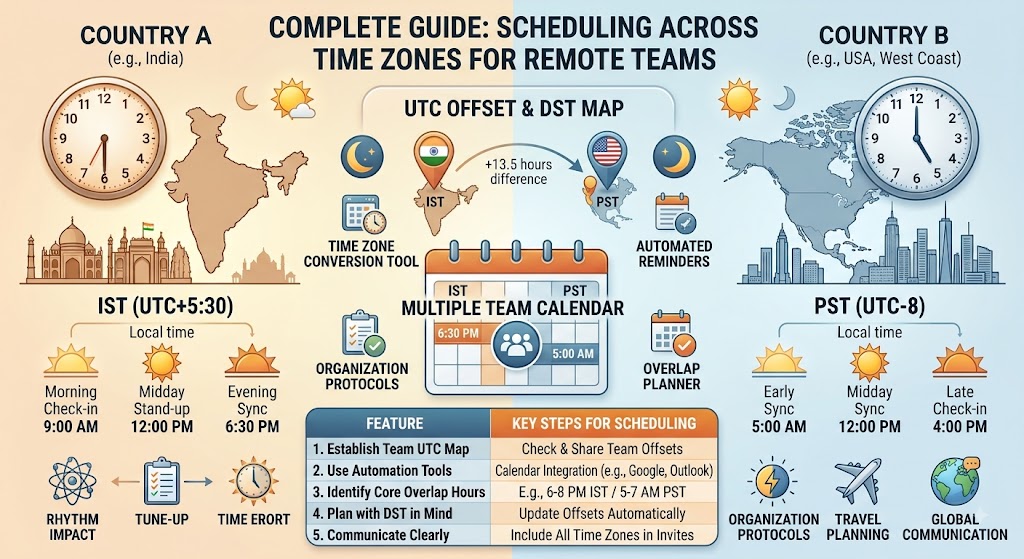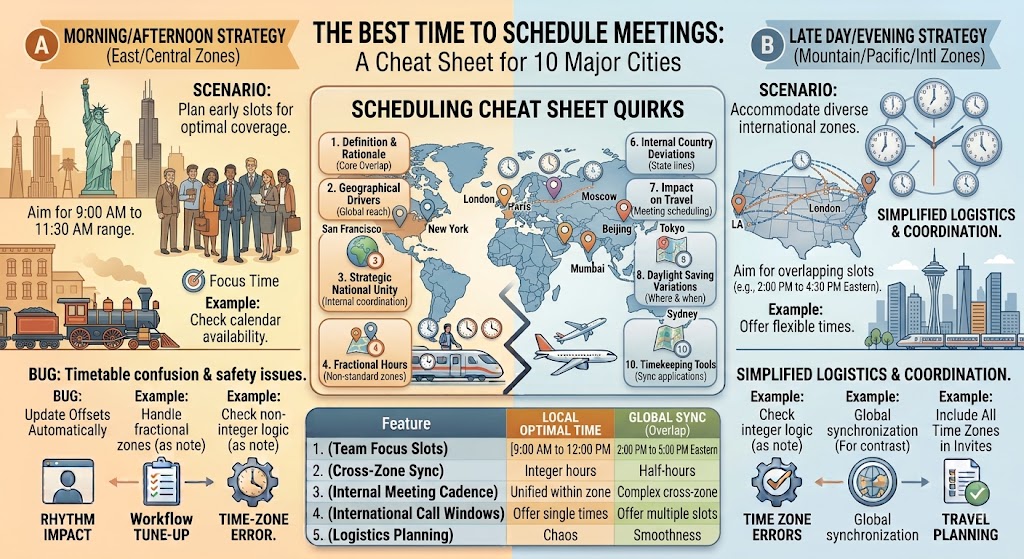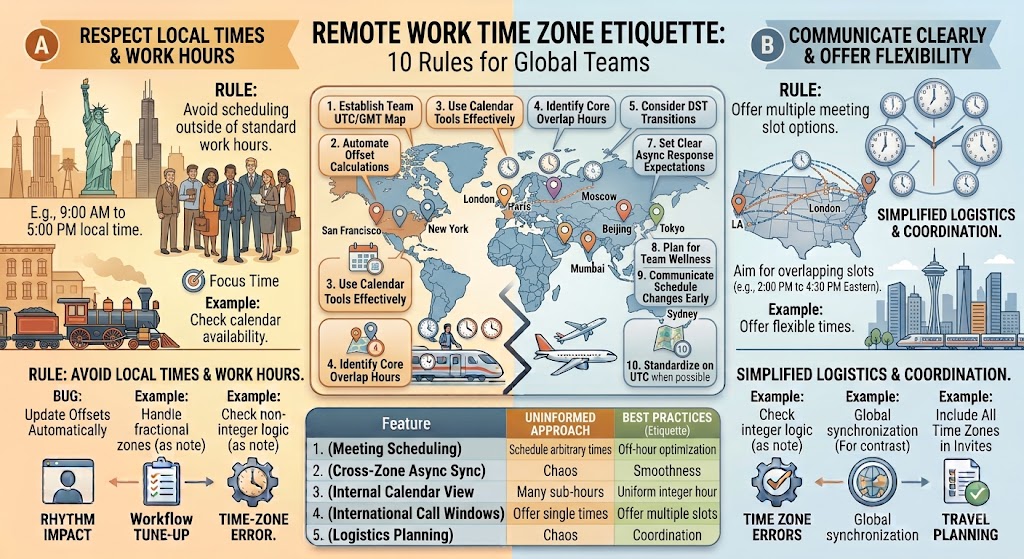
Remote Work Time Zone Etiquette: 10 Rules for Global Teams
You wake up to 47 Slack messages. Three are from your boss in London. Five are from your teammate in Singapore. The rest are from your developer in California who has been working all night.
You scroll through them. Some are urgent. Some are not. Some expect an immediate reply. You have no idea which is which.
This is the reality of distributed teams. Time zones don't just affect when you meet — they affect how you communicate, collaborate, and survive as a team.
Here are 10 essential rules for time zone etiquette in remote global teams.
Use the free time zone converter here →
The Short Answer: What Is Time Zone Etiquette?
Time zone etiquette is the set of practices that help distributed teams work respectfully across different time zones. It covers:
- Scheduling meetings at times that work for everyone
- Communicating asynchronously so no one is pressured to reply outside work hours
- Respecting boundaries so team members don't burn out
- Documenting decisions so everyone has access to information
Golden rule: If it can be async, make it async. If it must be live, rotate the burden.
Rule 1: Always Include Time Zones in Communication
The Problem
"Let's meet at 2 PM."
2 PM where? New York? London? Dubai? The message is ambiguous and creates confusion.
The Fix
Always include the time zone and UTC equivalent:
| ❌ Bad | ✅ Good |
|---|---|
| "Meeting at 2 PM" | "Meeting at 2 PM EST / 7 PM UTC" |
| "Let's sync tomorrow morning" | "Let's sync at 9 AM your time (3 PM UTC)" |
| "I'll send this by EOD" | "I'll send this by 5 PM EST (10 PM UTC)" |
Best practice: Use UTC in calendar invites. Everyone converts from UTC to their local time.
Rule 2: Use Async Communication by Default
The Problem
Not every question needs an immediate response. But when you ping someone directly, it creates an implicit pressure to reply — even if it is outside their working hours.
The Fix
Use different channels for different levels of urgency:
| Urgency | Channel | Example |
|---|---|---|
| Extremely urgent | Phone call / SMS | Production outage, system down |
| Urgent | Slack DM with @mention | "@priya can you review this?" |
| Moderately urgent | Slack channel | "Does anyone know how to fix this?" |
| Not urgent | Email / Asana / Notion | "Here is the Q4 roadmap for review" |
| Can wait | Shared document | "Thoughts on this proposal?" |
Golden rule: If someone is offline, use a channel that doesn't demand an immediate reply.
Rule 3: Respect Working Hours
The Problem
You work 9-5. Your teammate in Singapore works 9-5 Singapore time. That's 9 PM to 5 AM your time. You DM them at 10 PM your time — which is 10 AM their time.
Your teammate was working. They responded immediately. Now you have trained them to respond outside their hours.
The Fix
Before sending a message, ask yourself:
- Is this urgent enough to interrupt them now?
- Can this wait until their working hours?
- Is there someone else in their time zone who can help?
If it can wait, use scheduled send:
| Tool | Feature |
|---|---|
| Slack | Schedule message to send during their working hours |
| Gmail | Schedule send for their morning |
| Outlook | Delay delivery to their time zone |
If you must send outside hours:
- Use @mention sparingly
- Start with: "No need to respond now — just sharing this for when you are online"
- Send in a channel, not a DM (less pressure to reply)
Rule 4: Record All Meetings
The Problem
You schedule a meeting at 9 AM NYC time. Your Sydney teammate is attending at 12 AM their time. They show up, take notes, and are exhausted for the rest of their workday.
The Fix
Always record meetings when team members are in different time zones.
Best practices:
- Record every meeting that has 3+ time zones represented
- Share the recording within 2 hours of the meeting ending
- Provide a written summary (3-5 bullet points)
- Allow async feedback via comments or a shared doc
Example:
"Hey team, the meeting recording is here: [link]. Key decisions: (1) Approved Q4 budget (2) New design direction confirmed (3) Next steps assigned. Please add comments by Wednesday if you have feedback."
Rule 5: Rotate Meeting Times
The Problem
The same team members are always staying late or waking up early for meetings. They are burning out. You are losing them.
The Fix
Rotate the burden.
| Week | Who Stays Late | Who Starts Early |
|---|---|---|
| Week 1 | India team (10 PM) | California team (6 AM) |
| Week 2 | California team (6 PM) | India team (7 AM) |
| Week 3 | UK team (7 PM) | California team (6 AM) |
How to implement:
- Ask each team member for their "unacceptable" hours (e.g., 2 AM - 6 AM)
- Rotate the early/late burden weekly
- Keep meetings under 30 minutes
- Offer compensation (comp time, flexible days)
- Track who is always inconvenienced and fix it
Rule 6: Create an "Always-On" Document
The Problem
Information is scattered across Slack threads, emails, and ad hoc calls. Someone in a different time zone misses the context and has to ask for it again.
The Fix
Create a single source of truth for everything.
What to document:
| Type | Example |
|---|---|
| Decisions | "Why we chose this vendor" |
| Processes | "How to deploy the app" |
| Meeting notes | "Q4 planning meeting summary" |
| Project status | "This is where we are" |
| Team info | "Who is working on what" |
Where to document:
- Notion or Confluence for long-form documentation
- GitHub for technical decisions (ADRs)
- Shared Google Drive for working documents
- Asana or Jira for project management
Golden rule: If it is discussed, document it. If it is documented, link it in Slack.
Rule 7: Set Clear Response Expectations
The Problem
You sent a message. You wait. No response. You wait longer. You resent it. Still nothing.
Your teammate is offline. You didn't know. They didn't tell you. Frustration grows.
The Fix
Set clear response expectations:
| Communication Type | Expected Response Time |
|---|---|
| Slack DM (during hours) | Within 1-2 hours |
| Slack DM (outside hours) | Next working day |
| Within 24-48 hours | |
| @mention (urgent) | Within 30 minutes |
| @mention (non-urgent) | Within 1-2 hours |
Set your status clearly:
| Status | What It Means |
|---|---|
| "Working" | Online, responsive within 1 hour |
| "In a meeting" | May take 1-2 hours to respond |
| "Focus time" | Check messages in 2-3 hours |
| "Offline" / "Zzz" | Do not expect a response until next working day |
| "Traveling" | Time zone may change, may be delayed |
Rule 8: Avoid "Does Anyone Have Time for a Quick Call?"
The Problem
"Does anyone have time for a quick call?" posted in a global channel. Ten people reply. Someone schedules it immediately. Three people in other time zones can't attend. They miss critical context.
The Fix
Always schedule calls in advance with time zones included.
| ❌ Bad | ✅ Good |
|---|---|
| "Anyone free for a quick call?" | "I need 15 minutes to discuss X. Who is available at 2 PM UTC?" |
| "Jumping on a call now" | "Scheduling a call for 3 PM UTC — here is the agenda: [link]" |
Best practices:
- Always provide an agenda before the call
- Share the agenda 24 hours in advance
- If it is a spontaneous call, share the recording immediately after
- Consider if it could have been a Slack thread or a Loom video instead
Rule 9: Be Mindful of Cultural Differences
The Problem
Different cultures have different norms for communication, hierarchy, and work-life balance. Assuming everyone works the same way creates friction.
The Fix
Acknowledge cultural differences:
| Region | Typical Norms |
|---|---|
| USA | Direct, informal, work-life blend |
| UK | Polite, formal, clear boundaries |
| Germany | Direct, structured, punctual |
| India | Hierarchical, relationship-focused, flexible |
| Japan | Formal, consensus-driven, precise |
| Brazil | Relationship-focused, flexible, warm |
| Middle East | Hierarchy, relationship-focused, slower pace |
Practical tips:
- Ask: "What is your preferred communication style?"
- Be aware that "yes" may not always mean "yes" in some cultures
- Understand that punctuality expectations vary
- Respect different holidays — not everyone celebrates Thanksgiving or Christmas
- Learn about major holidays in your team members' countries
Rule 10: Lead by Example
The Problem
Leaders say "respect boundaries" but then send emails at midnight. Team members feel pressured to respond. The culture is set from the top.
The Fix
Leaders must model the behavior they want to see.
| What Leaders Do | What It Signals |
|---|---|
| Send emails at 2 AM | "Reply whenever" (but actually "reply now") |
| Use scheduled send | "I respect your time" |
| Ask for meeting times | "We work together, not for me" |
| Cancel meetings with no agenda | "Your time is valuable" |
| Record all meetings | "I value everyone's input" |
Leadership checklist:
- Use scheduled send for messages after hours
- Ask team members about their preferred meeting times
- Never schedule meetings during someone's "sacred" hours (e.g., 2-6 AM)
- Share meeting recordings proactively
- Celebrate async communication wins
- Check in on team members who are always inconvenienced
Common Mistakes (And How to Avoid Them)
Mistake 1: Scheduling Meetings During Someone's Lunch
Problem: "Let's meet at 12 PM." That's lunchtime for someone.
Fix: Avoid 12 PM - 1 PM in any participant's time zone.
Mistake 2: Assuming Everyone Works 9-5
Problem: Not everyone works 9-5. Some teams start at 10 AM. Some at 8 AM. Some have flexible schedules.
Fix: Ask each person for their preferred working hours. Don't assume.
Mistake 3: Not Using "Focus Time"
Problem: The most productive hours of the day are eaten up by meetings.
Fix: Block "focus time" on calendars. Make it sacred. No meetings allowed.
Mistake 4: Ignoring Holidays
Problem: Monday morning in the US might be Diwali in India. The team in India is offline.
Fix: Check holidays for all locations before scheduling something critical.
Quick Reference: Time Zone Etiquette Checklist
Before Sending a Message
- Is this urgent enough to interrupt them now?
- Can I use scheduled send for their working hours?
- Have I included the time zone (if it's about a meeting)?
- Is this a DM or a channel message? (DMs create more pressure)
Before Scheduling a Meeting
- Is this meeting necessary, or could it be async?
- Have I checked everyone's working hours?
- Have I found the best overlap window?
- Have I avoided lunch hours in any time zone?
- Have I shared an agenda 24 hours in advance?
- Will the meeting be recorded?
Before Sending an Email
- Does this need to be an email, or could it be a shared document?
- Have I included clear action items?
- Have I set a clear deadline for response?
Frequently Asked Questions
What is time zone etiquette in remote work?
Time zone etiquette is the set of practices that help distributed teams work respectfully across different time zones. It includes scheduling meetings fairly, communicating asynchronously, and respecting boundaries.
How do I schedule meetings respectfully across time zones?
Find the best overlap window, rotate the burden, keep meetings short, and record everything. Use a tool like our time zone converter to find the best times.
What is async communication?
Async communication is communication that doesn't require an immediate response. Examples: email, shared documents, recorded videos, project management tools.
How do I respect someone's time zone?
Send messages during their working hours (use scheduled send), avoid pinging them outside hours, and ask what times work best for them.
How do I handle a team member who is always online?
Check in with them. They may be burning out. Encourage them to set boundaries. Model good behavior by not pinging them outside hours.
What tools help with time zone etiquette?
Our time zone converter for finding overlaps, Slack's scheduled send, Gmail's schedule send, and recording tools like Zoom or Loom.
How do I say "no" to meetings outside my hours?
Politely say: "I would love to attend, but that is 2 AM for me. Would it be possible to record the meeting, or can we find a time that works for everyone?"
What is "follow the sun"?
Work flows from one time zone to the next. Asia starts the day, Europe takes over, America finishes. No single team works 24/7 — the work travels.
Final Thoughts
Time zone etiquette isn't just about being polite. It's about creating a sustainable work environment where everyone can thrive.
Three things to remember:
- If it can be async, make it async — Not everything needs a live meeting
- Rotate the burden — Don't always ask the same team to compromise
- Lead by example — Respect boundaries and others will too
When you respect someone's time, you respect them. And when you work across time zones, respecting time is the most important thing you can do.
Check time zones and find overlap windows → /timezone-converter
Tags: remote work etiquette, time zone etiquette, global team communication, async communication, distributed team culture, remote team best practices, time zone respect, global collaboration, remote work tips, team culture remote, cross timezone communication, remote work rules