Four Time Zones, One Nation: How the US Divided Time Across a Continent
Imagine trying to catch a train in 1880s America.
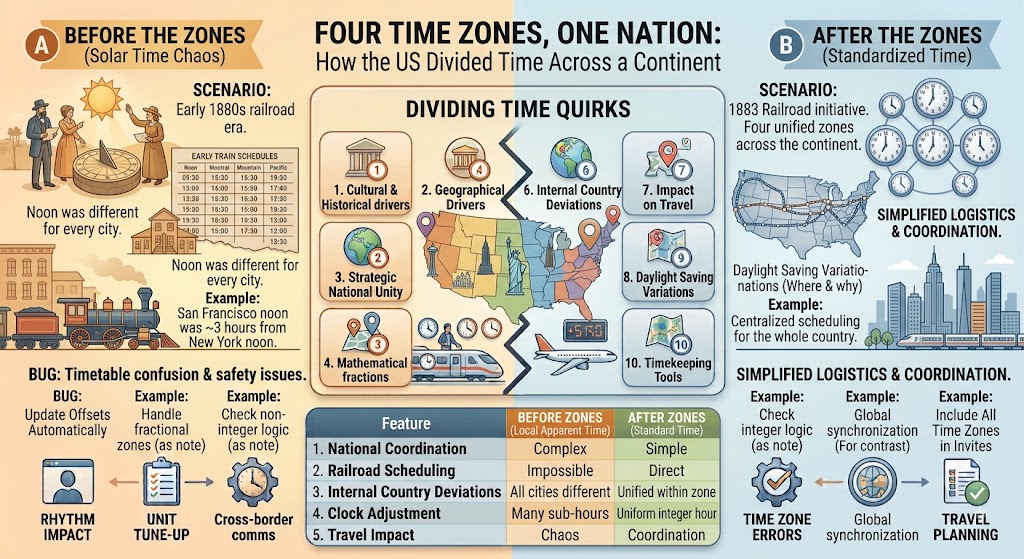
You are in New York City. Your train departs at 12:00 PM — but "12:00 PM" means something different in every city. Philadelphia has its own time. Pittsburgh has another. Chicago has yet another. Railroad schedules are a nightmare.
This was the reality before 1883. Every town had its own local time based on the sun. And it worked fine when travel was slow. But railroads changed everything.
Today, the United States spans four primary time zones across the contiguous states — Eastern, Central, Mountain, and Pacific — plus Alaska and Hawaii. Here is how this system came to be, how it works, and what makes it unique.
Use the free time zone converter here →
The Short Answer: US Time Zones at a Glance
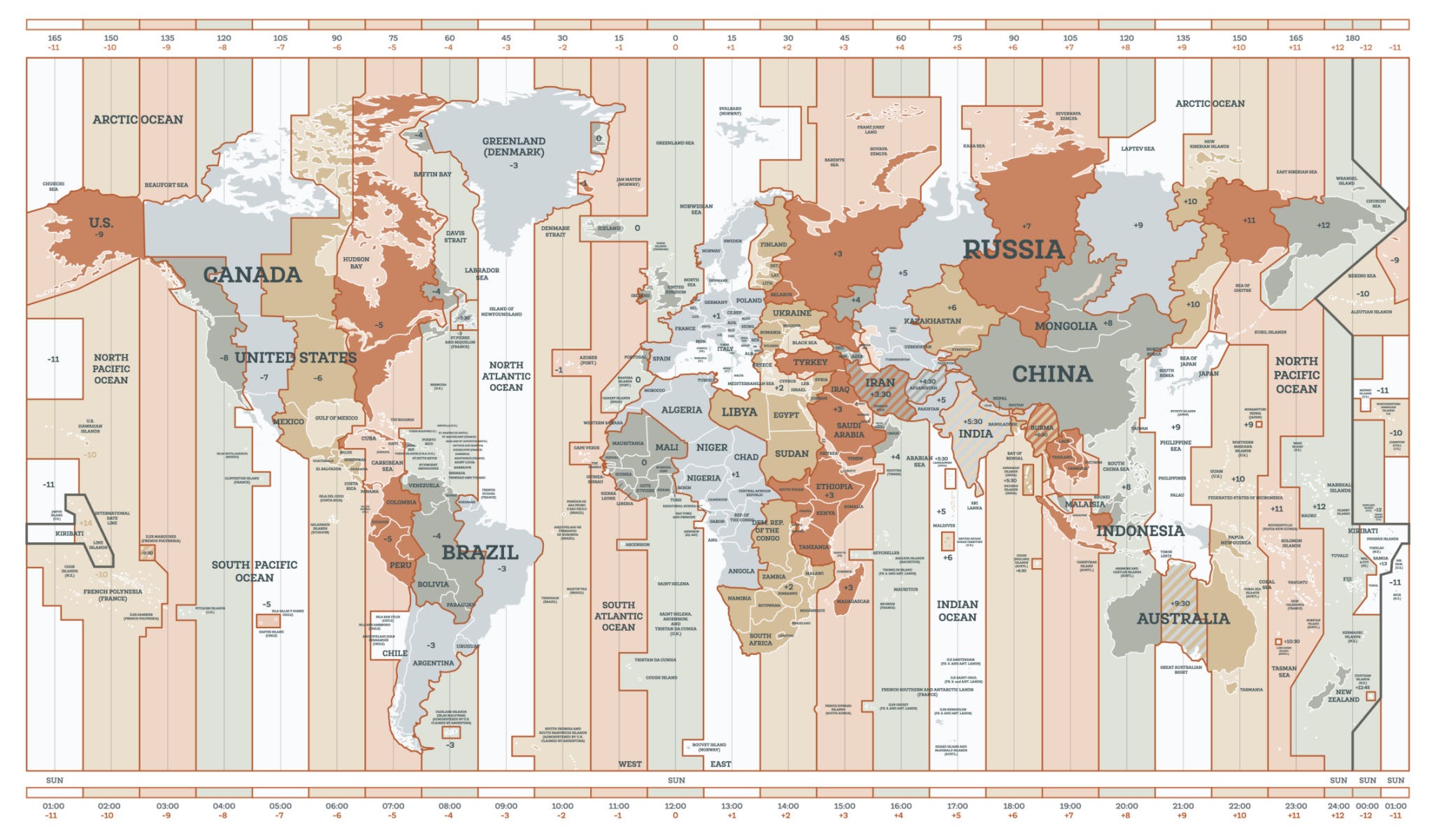
The contiguous 48 states are divided into four primary time zones:
| Time Zone | UTC Offset (Standard) | UTC Offset (DST) | Major Cities |
|---|---|---|---|
| Eastern Time (ET) | UTC-5 | UTC-4 | New York, Washington DC, Miami, Atlanta |
| Central Time (CT) | UTC-6 | UTC-5 | Chicago, Dallas, Houston, New Orleans |
| Mountain Time (MT) | UTC-7 | UTC-6 | Denver, Phoenix*, Salt Lake City |
| Pacific Time (PT) | UTC-8 | UTC-7 | Los Angeles, San Francisco, Seattle |
When it is 12:00 PM in New York:
- 11:00 AM in Chicago (Central)
- 10:00 AM in Denver (Mountain)
- 9:00 AM in Los Angeles (Pacific)
Plus two more time zones:
- Alaska: UTC-9 (AKST) / UTC-8 (AKDT)
- Hawaii-Aleutian: UTC-10 (HST) — no DST
*Most of Arizona does not observe DST and stays on MST year-round.
How the US Got Its Time Zones
The Problem: Thousands of Local Times
Before the 1880s, most towns in the US set their clocks to "high noon" — the moment when the sun was at its highest point in the sky. This meant every city had its own local time. For everyday life, that was fine.
But railroads changed everything. Train travel shrank travel time from days to hours. Railroad timetables had to list dozens of different arrival and departure times for the same train, each linked to a different local time zone. It was a scheduling nightmare.
The Solution: Railroads Create Time Zones
On November 18, 1883, American and Canadian railroads did something bold. They created their own time zone system — without waiting for the federal government.
What they did:
- Divided the continent into four time zones
- The dividing lines were very close to what we still use today
- Each railroad synchronized to the new system
Most Americans quickly adopted the new time zones because railroads were their lifeline. But it was not until 1918 that Congress officially adopted the railroad time zones under the Interstate Commerce Commission.
Sir Sandford Fleming's Contribution
While the railroads implemented the system, the idea came from a Canadian — Sir Sandford Fleming.
In 1876, Fleming missed a train in Ireland because a printed schedule listed "p.m." instead of "a.m." He proposed a single 24-hour clock for the entire world, divided into 24 time zones, each 15 degrees of longitude apart.
At the 1884 International Meridian Conference in Washington DC, Fleming's ideas helped establish the Greenwich Meridian as the prime meridian and set the foundation for the global time zone system.
The Uniform Time Act of 1966
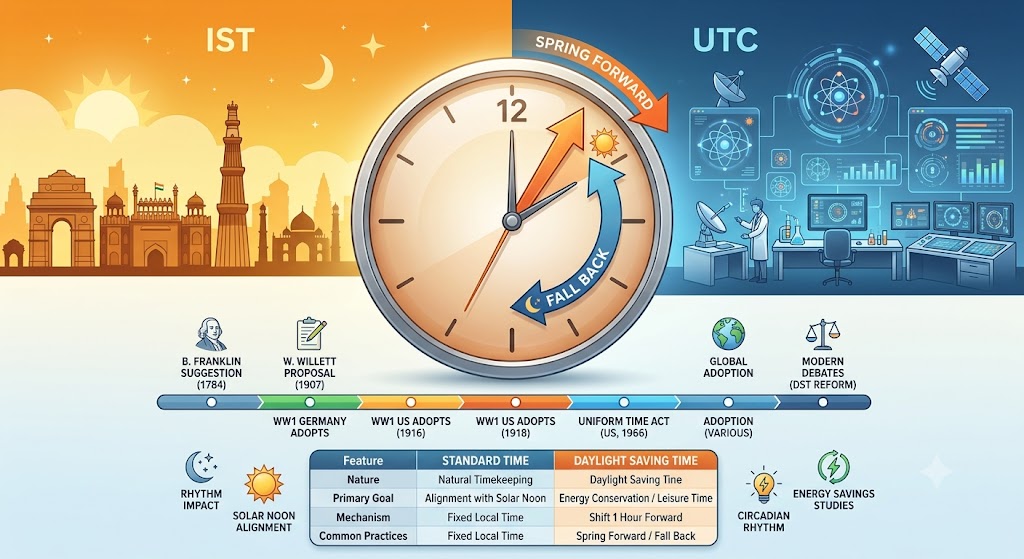
Before 1966, DST observance in the US was a complete mess. States and even individual towns could choose whether to observe it and when to start and end it.
The Problem
In 1966, the situation was chaotic:
- Different states had different DST start and end dates
- Some states observed DST, others did not
- Indiana had a famously complicated system
The Solution
Congress passed the Uniform Time Act of 1966, which:
- Established a uniform DST schedule nationwide
- States could opt out of DST entirely (Hawaii and Arizona did)
- States cannot independently choose to observe DST year-round — only Congress can make that change
Changes to DST Rules
2007 Update: The Energy Policy Act of 2005 extended DST, taking effect in 2007:
- DST now begins on the second Sunday in March
- DST now ends on the first Sunday in November
Previously, DST began in April and ended in October.
The Four Main Time Zones: What You Need to Know
Eastern Time (ET) — UTC-5 / UTC-4
States fully or mostly in ET:
Connecticut, Delaware, District of Columbia, Florida, Georgia, Maine, Maryland, Massachusetts, New Hampshire, New Jersey, New York, North Carolina, Ohio, Pennsylvania, Rhode Island, South Carolina, Vermont, Virginia, West Virginia
Key fact: Parts of Indiana, Kentucky, and Tennessee also use ET.
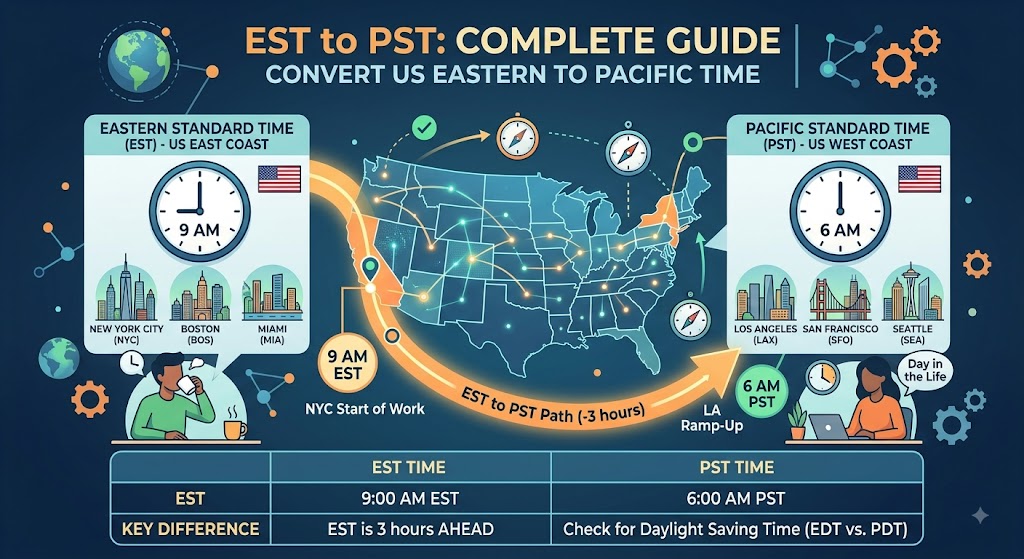
When it is 9:00 AM EST:
- 8:00 AM CST
- 7:00 AM MST
- 6:00 AM PST
Central Time (CT) — UTC-6 / UTC-5
States fully or mostly in CT:
Alabama, Arkansas, Illinois, Iowa, Louisiana, Minnesota, Mississippi, Missouri, Oklahoma, Wisconsin, most of Texas
Also includes: Western Indiana, western Kentucky, eastern Nebraska, eastern North Dakota, eastern South Dakota, western Tennessee
Key fact: Some Alabama towns near the Georgia border unofficially use Eastern Time because many residents work in Georgia.
Mountain Time (MT) — UTC-7 / UTC-6
States fully or mostly in MT:
Arizona (no DST), Colorado, Montana, New Mexico, Utah, Wyoming
Also includes: Western Nebraska, western North Dakota, western South Dakota, parts of Kansas and Texas
The Arizona exception: Most of Arizona stays on Mountain Standard Time year-round. The Navajo Nation does observe DST.
Pacific Time (PT) — UTC-8 / UTC-7
States fully or mostly in PT:
California, Oregon, Washington
Also includes: Parts of Idaho and Nevada
Key fact: When it is noon in New York, it is 9:00 AM in Los Angeles — a 3-hour difference.
Beyond the Four: Alaska and Hawaii
Alaska (UTC-9 / UTC-8)
Alaska was historically complicated. The time zone lines were redrawn in 1983 to give the state just two time zones.
Standard time zone names changed in 1967:
| Old Name | New Name |
|---|---|
| Pacific Standard Time (PST) | Same |
| Yukon Standard Time (YST) | Same |
| Central Alaska S.T. (CAT) | Alaska-Hawaii Standard Time (AHST) |
| Nome Standard Time (NT) | Bering Standard Time (BST) |
After 1983, most of Alaska uses Alaska Standard Time (UTC-9). Only part of the Aleutian Islands uses Hawaii-Aleutian Standard Time (UTC-10).
Hawaii (UTC-10, No DST)
Hawaii does not observe DST at all.
When it is 12:00 PM in New York:
- 7:00 AM in Hawaii (standard time, year-round)
DST Exceptions Across the US
| State/Territory | DST Status |
|---|---|
| Hawaii | No DST |
| Most of Arizona | No DST |
| Puerto Rico, US Virgin Islands | No DST |
| Guam, American Samoa | No DST |
| Navajo Nation (in Arizona) | Observes DST |
| Rest of the US | Observes DST |
Quick Reference: US Time Zone Conversions
US Time Zones vs. India (IST)
| US Time Zone | Difference vs India (Standard) | Example |
|---|---|---|
| Eastern (ET) | 10.5 hours behind | 12:00 PM ET = 10:30 PM IST |
| Central (CT) | 11.5 hours behind | 12:00 PM CT = 11:30 PM IST |
| Mountain (MT) | 12.5 hours behind | 12:00 PM MT = 12:30 AM IST (next day) |
| Pacific (PT) | 13.5 hours behind | 12:00 PM PT = 1:30 AM IST (next day) |
US Time Zones vs. China (Beijing Time)
| US Time Zone | Difference vs China (Standard) |
|---|---|
| Eastern (EST) | Beijing is 13 hours ahead |
| Central (CST) | Beijing is 14 hours ahead |
| Mountain (MST) | Beijing is 15 hours ahead |
| Pacific (PST) | Beijing is 16 hours ahead |
During DST: The difference is reduced by 1 hour.
The State That Does Its Own Thing: Indiana's Time Zone History
Indiana has a famously complicated time zone history. Before 2007, the state was split between Eastern and Central Time, with some counties observing DST and others not.
Current situation:
- Most of Indiana is in the Eastern Time Zone
- Some northwestern counties (near Chicago) and southwestern counties (near Evansville) are in the Central Time Zone
- Indiana now observes DST statewide
Frequently Asked Questions
How many time zones does the US have?
The US has six primary time zones across all 50 states: Eastern, Central, Mountain, Pacific, Alaska, and Hawaii-Aleutian.
Why does the US have four time zones?
The US spans about 3,000 miles from east to west. Earth rotates 15 degrees of longitude per hour, so the natural time difference from coast to coast is about 3 hours. Four time zones cover the contiguous states.
Who created the US time zone system?
American and Canadian railroads created the system on November 18, 1883. Congress officially adopted it in 1918.
What is the Uniform Time Act?
The 1966 law that standardized DST start and end dates across the US.
Why does not Arizona observe DST?
Arizona opted out of DST under the Uniform Time Act. The Navajo Nation in Arizona does observe DST.
Why does not Hawaii observe DST?
Hawaii also opted out of DST under the Uniform Time Act. Being near the equator, daylight hours do not change much, so DST has little benefit.
What is the time difference between US East Coast and West Coast?
3 hours. When it is noon in New York, it is 9 AM in Los Angeles.
When does DST start and end in the US?
Starts on the second Sunday in March. Ends on the first Sunday in November.
Does the US observe DST everywhere?
No. Hawaii, most of Arizona, and US territories do not observe DST.
Final Thoughts
The US time zone system is a product of history, politics, and technology. Railroads created the system in 1883 because they needed it. Congress made it official in 1918. DST rules have been tweaked multiple times, most recently in 2007.
Unlike China's single time zone policy, the US chose practicality. Four time zones across the contiguous states mean that the sun roughly matches the clock — though the 3-hour difference between New York and Los Angeles still makes scheduling a challenge.
The key takeaway: The US time zone system exists because railroads needed it. It stayed because it works. And DST complicates everything twice a year.
Check US time zones instantly → /timezone-converter
Tags: US time zones, Eastern Time, Central Time, Mountain Time, Pacific Time, Uniform Time Act, railroad time zones 1883, US time zone history, America time zones, four time zones USA, Daylight Saving Time USA, time zone map US, US time zone guide, Alaska time zone, Hawaii time zone