Countries That Abandoned DST: What Happened?
Every year, millions of people change their clocks twice a year. But most of the world does not bother.
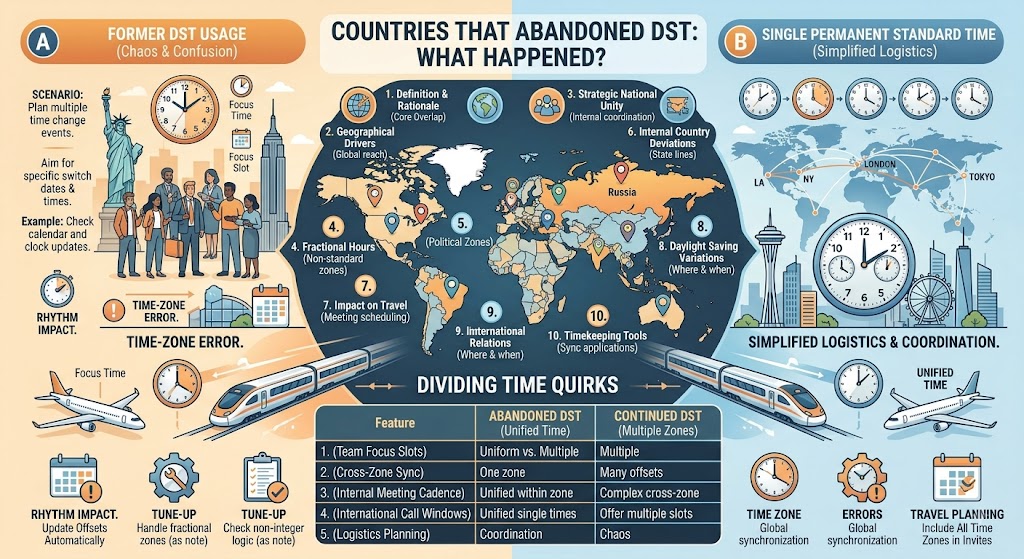
More than 140 countries have used Daylight Saving Time at some point. About half of them have since abandoned it . Today, only about 70 countries still observe DST. The rest stay on standard time year-round .
Over the past decade, a wave of countries has ended the practice — Russia, Turkey, Mexico, Brazil, Iran, Jordan, Namibia, and more .
This is the story of why they quit and what happened after.
Use the free time zone converter here →
The Short Answer: Why Do Countries Abandon DST?
| Reason | Examples |
|---|---|
| Health concerns | Russia (heart attacks + suicides), Mexico (heart attacks) |
| Energy savings are minimal | Brazil, Egypt, Mexico |
| Public dissatisfaction | China, Jordan, Uruguay |
| Geographic reasons | Countries near the equator see little daylight variation |
| Political/administrative | Azerbaijan, Syria, Iran |
The bottom line: Most countries that abandoned DST found that the costs — health issues, confusion, and administrative hassle — outweighed the benefits.
Russia: Health Was the Breaking Point
Year Abandoned: 2014
What Happened: Russia abolished DST and switched to permanent standard time (UTC+3) year-round .
The Reason:
Russia had tried permanent summer time from 2011 to 2014. The results were alarming. A report from the Russian Academy of Medical Sciences found that clock changes increased:
- Heart attacks by 1.5 times
- Suicides by 66%
People in northern Russia suffered the most. Permanent summer time meant darker mornings during the harsh winter months, creating stress and health problems .
The Result: Russia now stays on permanent standard time. No more clock changes .
Mexico: Public Health Over Energy Savings
Year Abandoned: 2022
What Happened: Mexico abolished DST nationwide, ending the practice of changing clocks twice a year .
The Reason:
President López Obrador cited a government study showing that while DST saved about $50 million annually, the damage to public health was greater .
Studies showed that DST was linked to increased rates of heart attacks, especially in the first weeks after the time change .
The Exception: Some border areas with the United States still observe DST to align with US schedules .
Turkey: The Switch to Permanent Summer Time
Year Abandoned: 2016
What Happened: Turkey permanently retained daylight saving time (summer time) year-round .
The Difference: Unlike Russia (which chose permanent standard time), Turkey chose permanent summer time. Clocks stay forward all year .
The Reason: Turkey wanted to align with its trading partners and maximize evening daylight. However, permanent summer time means darker winter mornings — a choice that has faced criticism.
Brazil: Minimal Energy Savings
Year Abandoned: 2019
What Happened: Brazil abolished DST, citing minimal energy savings and potential negative health effects .
The Twist: In 2024, Brazil's National Electric System Operator recommended reinstating DST to alleviate energy shortages . So far, the government has not acted.
The Result: Brazil now stays on standard time year-round, but the debate continues.
China: Public Dissatisfaction and Confusion
Year Abandoned: 1992
What Happened: China experimented with DST from 1986 to 1991 to conserve energy. The practice led to public dissatisfaction and confusion, prompting the government to abandon it .
The Reason: Despite China's size spanning five natural time zones, the country uses a single time zone (UTC+8). DST added confusion to an already complex system .
The Result: China has not observed DST since 1992.
Egypt: Back and Forth
Year Abandoned: 2015 (then reinstated in 2023)
What Happened: Egypt abolished DST in 2015 after concluding it was ineffective for energy savings. A report highlighted that DST:
- Had no practical benefits for energy
- Negatively impacted air traffic
- Disrupted people's health by reducing sleep hours
The Reversal: In 2023, the Egyptian government reinstated DST to reduce electricity consumption during peak summer months .
The Result: Egypt now observes DST again — a rare case of a country bringing it back .
Iran: Intermittent Implementation
Year Abandoned: 2022
What Happened: Iran's parliament voted to cancel DST to conserve energy and reduce costs .
The Catch: Implementation has been inconsistent. Government agencies have not always updated schedules, leaving the public confused .
The Result: Officially, Iran no longer shifts clocks. In practice, confusion remains .
The European Union: Still Debating
The Situation: The EU has been debating ending DST since 2019. So far, no action has been taken .
The Challenge: Any change requires coordination across 27 member countries. Some countries want permanent summer time. Others want permanent standard time. No consensus has emerged .
The Result: Europe still changes clocks twice a year, but the debate continues.
The United States: Will It End?
The Situation: The debate over DST has taken on new urgency. The House passed legislation that would end the twice-yearly clock change, but the measure now faces scrutiny in the Senate .
The History: The US briefly adopted year-round DST during the 1970s energy crisis. It was abandoned due to public opposition. Winter mornings were too dark .
The Problem: There is no agreement on whether to switch to permanent standard time or permanent daylight time.
- Permanent Standard Time: Health experts prefer it (aligns with circadian rhythms)
- Permanent Daylight Time: Most people prefer it (later sunsets)
The Result: No change yet .
Full List: Countries That Abandoned DST
Europe & Eurasia
| Country | Year Abandoned | Notes |
|---|---|---|
| Russia | 2014 | Permanent standard time |
| Turkey | 2016 | Permanent summer time |
| Azerbaijan | 2016 | Psychological and socio-moral issues |
| Georgia | 2005 | — |
| Armenia | 2012 | — |
Middle East & North Africa
| Country | Year Abandoned | Notes |
|---|---|---|
| Iran | 2022 | Inconsistent implementation |
| Syria | 2022 | — |
| Jordan | 2022 | — |
| Egypt | 2015 | Reinstated in 2023 |
Americas
| Country | Year Abandoned | Notes |
|---|---|---|
| Mexico | 2022 | Exceptions at US border |
| Brazil | 2019 | Debate about reinstatement |
| Uruguay | 2015 | Tourism impact |
| Paraguay | 2024 | — |
Africa
| Country | Year Abandoned | Notes |
|---|---|---|
| Namibia | 2017 | — |
Asia
| Country | Year Abandoned | Notes |
|---|---|---|
| China | 1992 | Public dissatisfaction |
| Japan | 1952 | — |
| South Korea | 1988 | — |
| India | Never used | — |
Why Some Countries Keep DST
| Reason | Countries |
|---|---|
| Align with trading partners | Europe (with US), Morocco (with Europe) |
| Maximize evening daylight | US, Canada, parts of Europe |
| Tourism and recreation | Mediterranean countries |
| Energy savings (in some cases) | Egypt (since 2023) |
The Arizona Exception (US)
What Happened: Arizona implemented DST in 1967 and abolished it the same year .
The Reason: Arizona is hot. When clocks spring forward, people run their air conditioners for longer in the evening. This drives energy use and costs up — not down .
The Exception: The Navajo Nation within Arizona still observes DST .
The Global Trend: Is DST Dying?
The numbers:
| Status | Count |
|---|---|
| Countries that observe DST | ~70 |
| Countries that abandoned DST | 70+ |
| Countries that never used DST | 100+ |
Sources:
The trend is clear: Most of the world does not change clocks. More countries are abandoning DST each year. The debate continues in the US and EU, but globally, the practice is in decline.
Frequently Asked Questions
How many countries have abandoned DST?
More than 70 countries have abandoned DST after using it at some point. About 70 countries still observe it .
Why did Russia abandon DST?
Russia cited health concerns. Studies showed clock changes increased heart attacks by 1.5 times and suicides by 66% .
Why did Mexico abandon DST?
President López Obrador cited public health concerns. Studies showed DST increased heart attack rates in the first weeks after the change .
Why did Brazil abandon DST?
Brazil cited minimal energy savings and potential negative health effects. However, there is now debate about reinstating it .
Why did Turkey abandon DST?
Turkey chose permanent summer time to align with trading partners. Clocks stay forward all year .
Will the US abandon DST?
The House passed legislation to end the clock change. The measure is now in the Senate. No change has been made yet .
Will Europe abandon DST?
The EU has been debating it since 2019. No consensus has emerged on whether to switch to permanent summer or permanent standard time .
Why doesn't Arizona observe DST?
Arizona is hot. DST would mean more air conditioning use in the evening, driving energy costs up .
What is permanent summer time vs. permanent standard time?
Permanent summer time: Clocks stay forward all year (later sunsets, darker mornings). Turkey uses this. Permanent standard time: Clocks stay on standard time all year (earlier sunsets, brighter mornings). Russia uses this .
Final Thoughts
The wave of countries abandoning DST tells a clear story: the benefits of changing clocks no longer outweigh the costs.
Health concerns, minimal energy savings, and public dissatisfaction have driven the change. Countries like Russia, Mexico, and Brazil have all concluded that the disruption is not worth it.
Three things to remember:
- Most of the world does not observe DST — Only ~70 countries still do
- Health is the biggest concern — Heart attacks, sleep disruption, and suicides increase after the change
- The trend is toward abolition — More countries are leaving DST each year
Check time zones instantly → /timezone-converter
Tags: countries that abandoned DST, Daylight Saving Time abolished, Russia DST abolished, Turkey DST abolished, Mexico DST ended, Brazil DST ended, countries without DST, DST history, why countries stopped DST, no time change countries, permanent standard time, DST health effects, DST energy savings, Russia permanent winter time, Turkey permanent summer time