EST to IST: Convert Eastern Time to India Time – Complete Guide
You're in New York. It's 9 AM. You need to call your team in Bangalore.
You pick up the phone and then stop. Wait — what time is it in India right now?
If you've ever been in this situation, you know the feeling. The US East Coast and India are on completely opposite schedules. One side is waking up while the other is heading to bed.
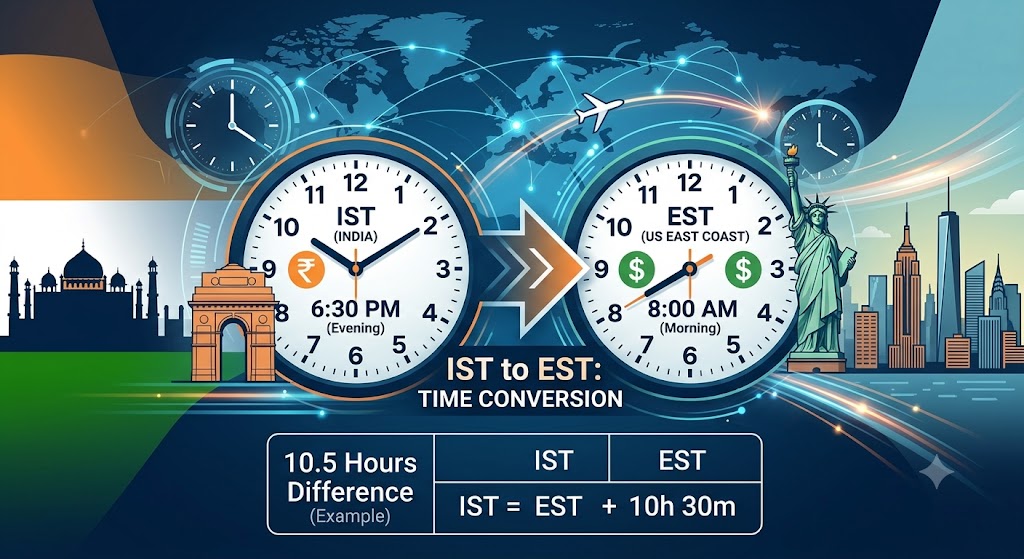
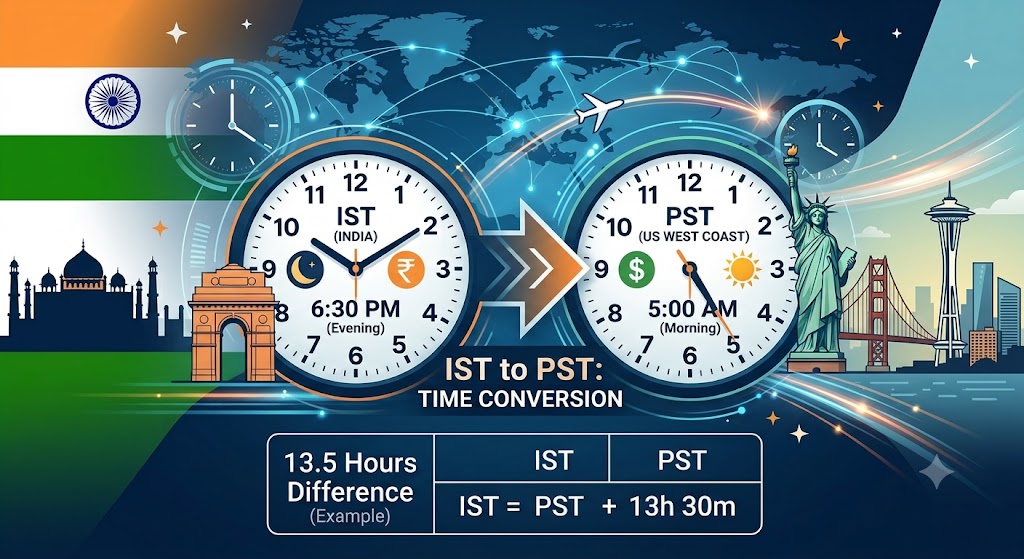
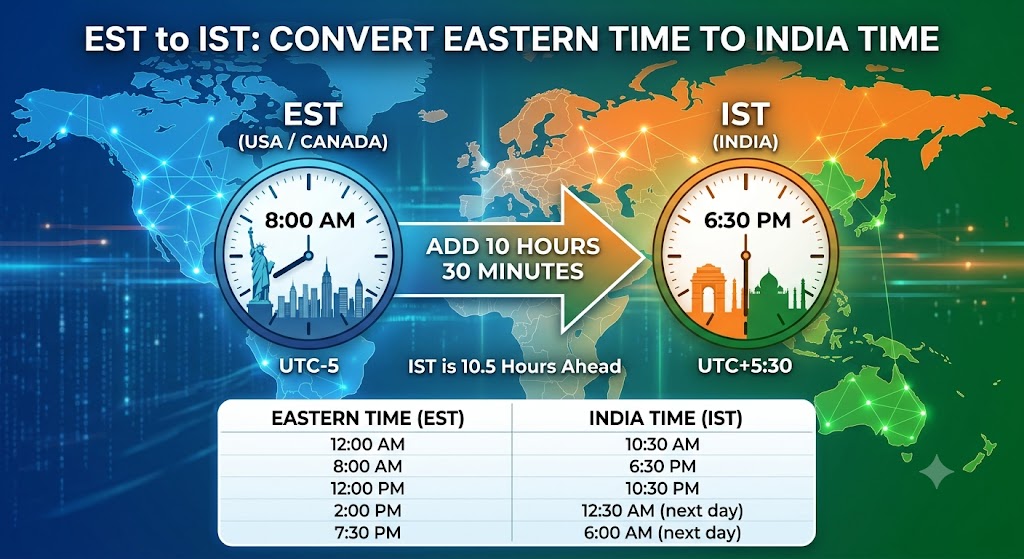
Eastern Standard Time (EST) is 10 hours and 30 minutes behind India Standard Time (IST).
So when it's 9 AM in New York, it's already 7:30 PM in India. Your team is wrapping up their day while you're just starting yours.
This guide breaks down everything you need to know about converting EST to IST — the math, the DST confusion, the best times to call, and how to avoid embarrassing scheduling mistakes.
Use the free EST to IST converter here →
The Short Answer: What's the Time Difference?
IST is 10.5 hours ahead of EST.
| If it's... | In New York (EST) | In India (IST) |
|---|---|---|
| Early morning | 6:00 AM | 4:30 PM |
| Morning | 9:00 AM | 7:30 PM |
| Noon | 12:00 PM | 10:30 PM |
| Evening | 6:00 PM | 4:30 AM (next day) |
| Night | 10:00 PM | 8:30 AM (next day) |
But here's the catch. That 10.5-hour difference only applies from November to March, when the US is on Standard Time.
From March to November, the US East Coast moves to Eastern Daylight Time (EDT) and the difference shrinks to 9.5 hours.
This is where most people mess up. Let's get into why.
Why Is India 10.5 Hours Ahead of the US East Coast?
It's simple math:
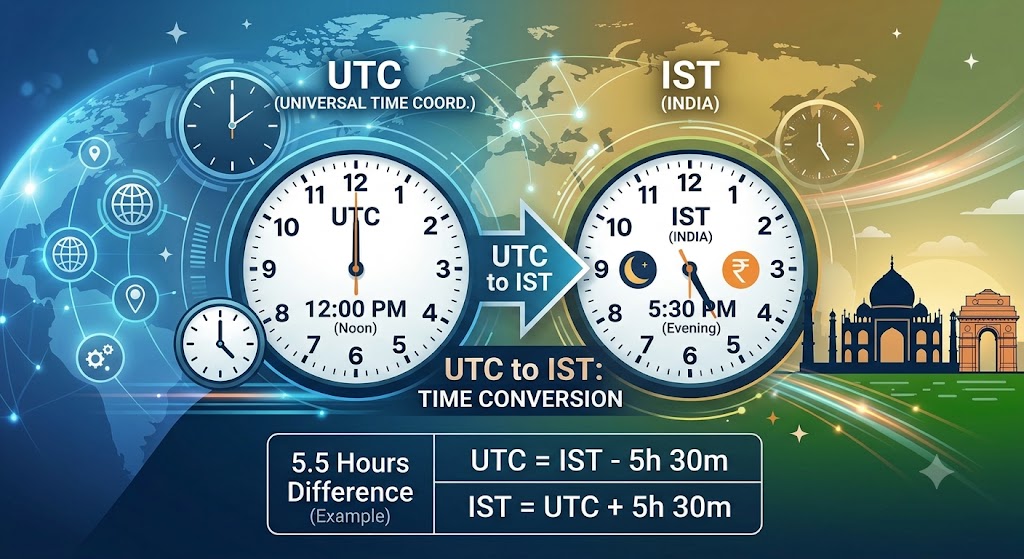
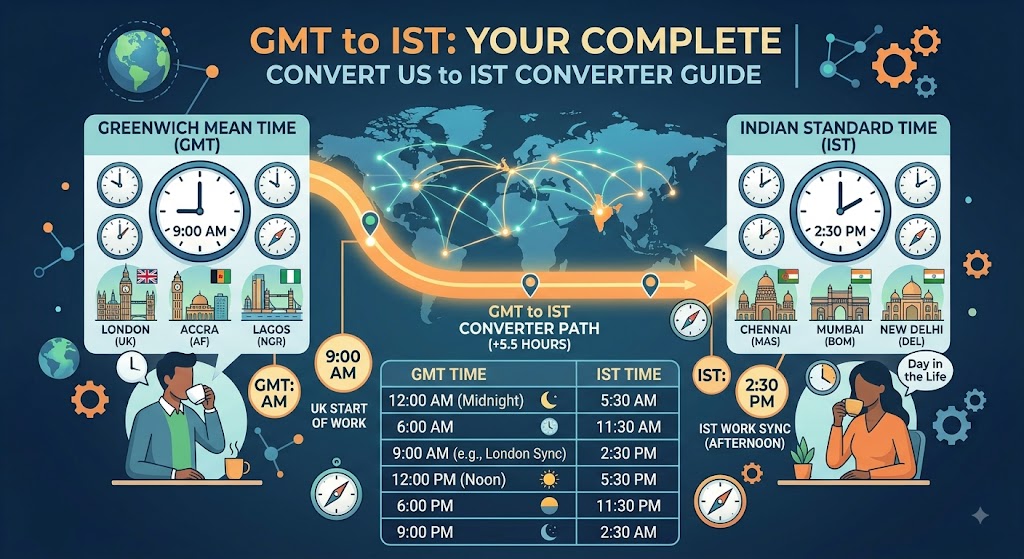
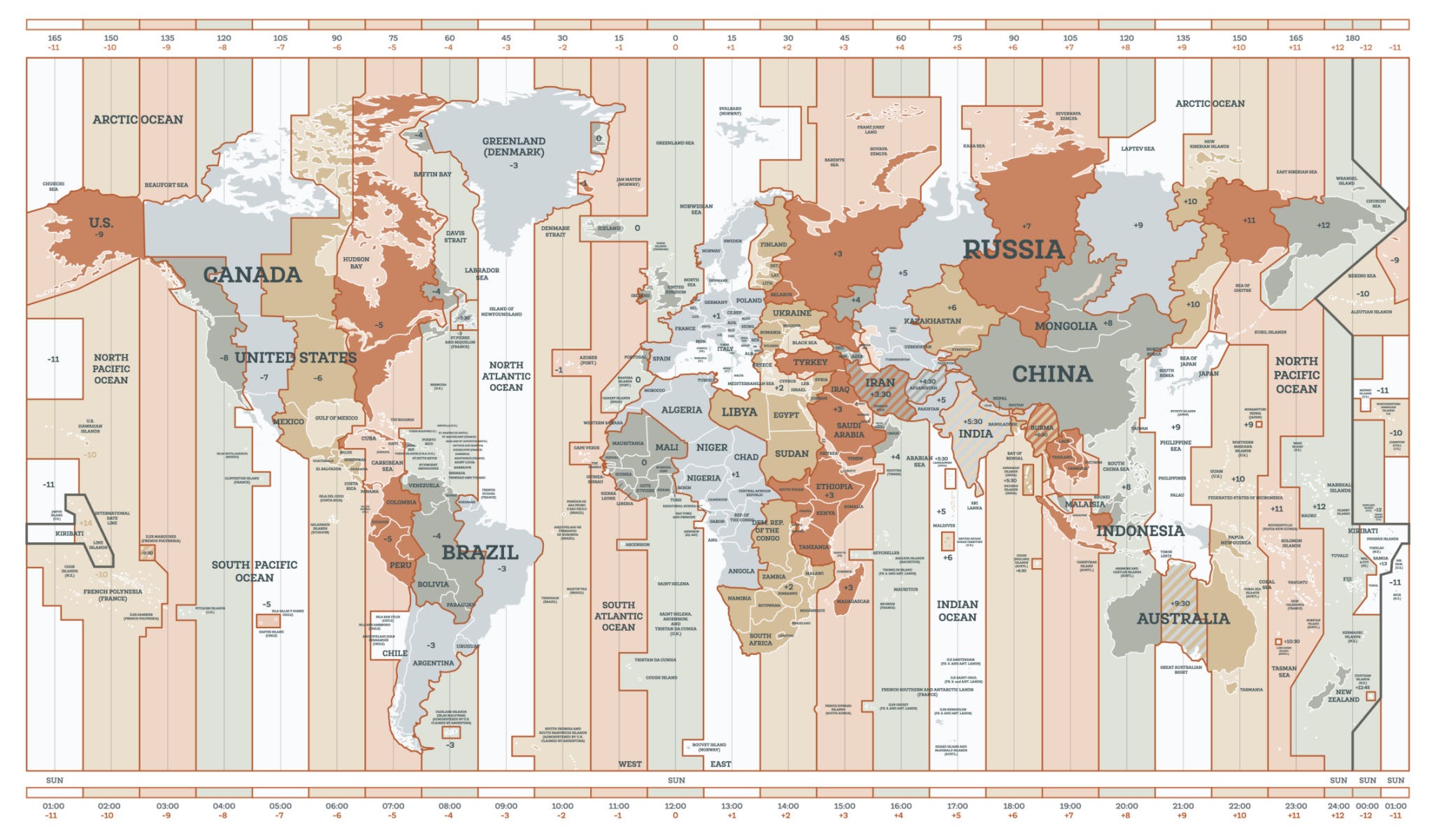
- India uses UTC +5:30
- US Eastern Standard Time uses UTC -5:00
- Total difference: 5.5 + 5 = 10.5 hours
India is 5.5 hours ahead of UTC. New York is 5 hours behind UTC. When you add them together, you get 10.5 hours.
The half-hour comes from India's unusual UTC +5:30 offset. Instead of being a clean 10 or 11 hours apart, it's that awkward 10.5 hours. That half-hour matters when you're scheduling meetings.
The DST Headache: Why This Changes Twice a Year
This is the part that confuses everyone.
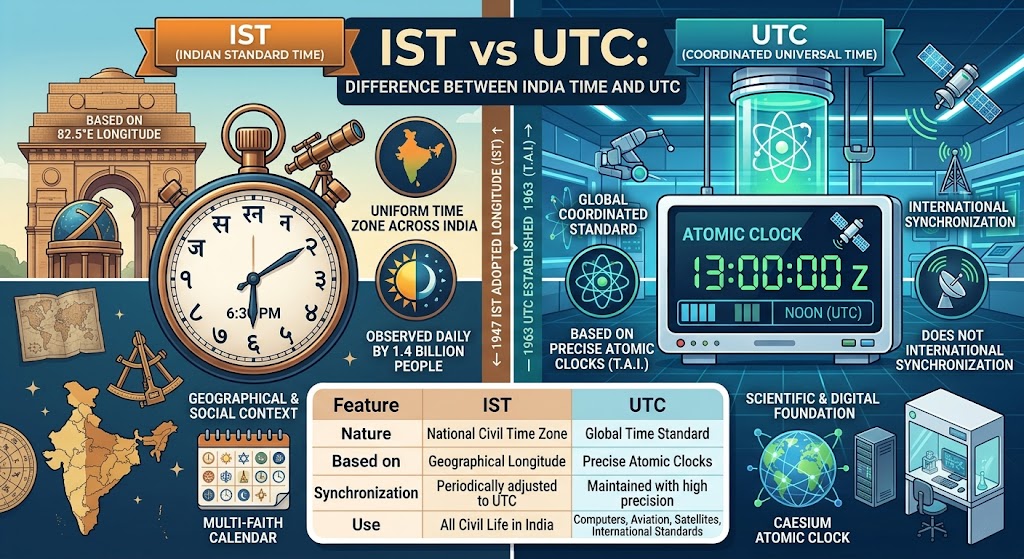
India doesn't observe Daylight Saving Time. IST stays at UTC +5:30 all year, every year.
The US East Coast does observe DST. From November to March, they're on EST (UTC -5:00). From March to November, they're on EDT (UTC -4:00).
| Time Zone | When | UTC Offset | Difference from IST |
|---|---|---|---|
| EST (Standard) | Nov - Mar | UTC -5:00 | IST is 10.5 hours ahead |
| EDT (Daylight) | Mar - Nov | UTC -4:00 | IST is 9.5 hours ahead |
What this means in practice:
- In winter: 9 AM EST = 7:30 PM IST
- In summer: 9 AM EDT = 6:30 PM IST
Notice the difference? A 9 AM call in winter is 7:30 PM in India. In summer, it's 6:30 PM. That one hour matters.
Pro tip: When someone says "Eastern Time," always ask: "Is that EST or EDT?" They might not know the difference themselves, but you need to.
Quick Reference: EST to IST Conversion Table
Here's a cheat sheet for standard time (winter, Nov - Mar). These are the most common conversions you'll need.
EST to IST (Winter, Nov - Mar):
| Eastern Time (EST) | India Time (IST) |
|---|---|
| 12:00 AM (midnight) | 10:30 AM |
| 1:00 AM | 11:30 AM |
| 2:00 AM | 12:30 PM |
| 3:00 AM | 1:30 PM |
| 4:00 AM | 2:30 PM |
| 5:00 AM | 3:30 PM |
| 6:00 AM | 4:30 PM |
| 7:00 AM | 5:30 PM |
| 8:00 AM | 6:30 PM |
| 9:00 AM | 7:30 PM |
| 10:00 AM | 8:30 PM |
| 11:00 AM | 9:30 PM |
| 12:00 PM (noon) | 10:30 PM |
| 1:00 PM | 11:30 PM |
| 2:00 PM | 12:30 AM (next day) |
| 3:00 PM | 1:30 AM (next day) |
| 4:00 PM | 2:30 AM (next day) |
| 5:00 PM | 3:30 AM (next day) |
| 6:00 PM | 4:30 AM (next day) |
| 7:00 PM | 5:30 AM (next day) |
| 8:00 PM | 6:30 AM (next day) |
| 9:00 PM | 7:30 AM (next day) |
| 10:00 PM | 8:30 AM (next day) |
| 11:00 PM | 9:30 AM (next day) |
During Daylight Time (Mar - Nov): Subtract 9.5 hours instead of 10.5.
So if it's 9 AM EDT, it's 6:30 PM IST — not 7:30 PM.
Real Scenarios: What This Actually Looks Like
Scenario 1: The Morning Call
Your US boss says, "Let's do a quick sync at 8 AM ET."
- In winter (EST): 8 AM = 6:30 PM IST. End of India's workday. Doable.
- In summer (EDT): 8 AM = 5:30 PM IST. Even better — earlier finish for India.
Takeaway: US morning = India evening. This is usually the best time for both sides.
When this fails: Financial services. If you need to react to market openings, NYSE opens at 9:30 AM ET, which is 7:00 PM IST in winter and 6:00 PM IST in summer. Your India team might be done for the day.
Scenario 2: The Late Afternoon Call
Your India team suggests a meeting at 4 PM IST.
- In winter (EST): 4 PM IST = 5:30 AM EST. No one in the US is awake.
- In summer (EDT): 4 PM IST = 6:30 AM EDT. Still too early for most.
Takeaway: India afternoon = US early morning. Not ideal unless someone's an early riser.
Scenario 3: The Best Overlap Window
Find the overlap between India's work hours (10 AM - 7 PM IST) and US East Coast work hours (9 AM - 6 PM ET).
Winter overlap:
- India: 6:30 PM - 7:00 PM IST
- US: 8:00 AM - 8:30 AM EST
Summer overlap:
- India: 6:30 PM - 7:00 PM IST
- US: 9:00 AM - 9:30 AM EDT
That's your window — a 30-minute to 1-hour overlap where both sides are working. Not a lot of time, but enough for a focused meeting.
How to Convert EST to IST in Your Head
If you don't have a converter handy, here's a simple trick:
IST = EST + 10.5 hours (winter) or 9.5 hours (summer)
Example: 3 PM EST (winter)
- Add 10 hours → 1 AM
- Add 30 more minutes → 1:30 AM IST (next day)
Going the other way (IST to EST):
EST = IST - 10.5 hours (winter) or 9.5 hours (summer)
Example: 6 PM IST
- Subtract 10 hours → 8 AM
- Subtract 30 minutes → 7:30 AM EST
But honestly? Just use the converter. The half-hour math is easy to mess up under pressure.
Common Mistakes (And How to Avoid Them)
1. Forgetting About EDT vs EST
This is the #1 mistake. Someone says "Eastern Time" and you assume it's always UTC -5. It's not.
Fix: Always check the date. March to November = EDT (UTC -4). November to March = EST (UTC -5).
Real example: You schedule a meeting for 9 AM ET in January (6:30 PM IST). In March, your calendar automatically updates to 9 AM ET (5:30 PM IST). If your India team isn't aware, they might show up an hour late.
2. Messing Up the Date Change
IST is so far ahead that when you convert, the date often changes.
Example: 10 PM EST Monday = 8:30 AM IST Tuesday. The date changes.
Fix: Always check the date, not just the time.
3. Scheduling During Holidays
Time zones aside, Indian and US holidays don't line up. Diwali, Thanksgiving, Independence Day — they're all different.
Fix: Check both countries' holidays before scheduling something important.
Tips for Scheduling Across EST and IST
After years of working with teams across both time zones, here's what actually works:
Find the overlap first. Don't guess. Use a tool to find the 1-2 hour window where both sides are working.
Rotate the inconvenience. Someone's always going to be inconvenienced. This week, the US team starts early. Next week, the India team stays late. Share the burden.
Use the 24-hour clock. 14:00 is impossible to confuse with 2:00 AM. This simple habit saves so many errors.
Share a link to the converter. Instead of explaining "8 AM EST is 6:30 PM IST," just send a link. People trust the tool more than your mental math.
Check holidays, not just time zones. Monday morning in the US might be Diwali in India. Time zones won't save you from that.
Frequently Asked Questions
What's the time difference between US Eastern Time and India?
In winter (EST): India is 10.5 hours ahead. In summer (EDT): India is 9.5 hours ahead.
Is India ahead of or behind Eastern Time?
Ahead. Way ahead. When it's Tuesday in India, it's still Monday evening in New York.
Does India observe Daylight Saving Time?
No. India stays on IST (UTC +5:30) all year. Only the US changes.
When does EST become EDT?
Second Sunday in March → first Sunday in November. That's when the difference changes from 10.5 to 9.5 hours.
What's the best time for a meeting between US East Coast and India?
Between 8:00 AM - 9:00 AM ET, which is 6:30 PM - 7:30 PM IST (winter) or 5:30 PM - 6:30 PM IST (summer).
What's 9 AM EST in IST?
Winter: 7:30 PM IST. Summer (EDT): 6:30 PM IST.
What's 6 PM IST in EST?
Winter: 7:30 AM EST. Summer: 8:30 AM EDT.
How many hours overlap is there between EST and IST?
Very little — usually 30 minutes to 1 hour. India ends their day while the US is just starting theirs.
Final Thoughts
EST to IST is one of the most common time zone conversions for business, and it's also one of the most confusing because of the half-hour offset and the DST changes.
Once you understand the basics — 10.5 hours ahead in winter, 9.5 hours ahead in summer, always check the date — it becomes manageable.
The most important rule: Always check whether it's EST or EDT. The difference between 9.5 and 10.5 hours matters.
And if you're ever in doubt, use the tool. It handles the math, accounts for DST, and shows you exactly what time works.
Convert EST to IST instantly → /timezone-converter/est-to-ist
Tags: EST to IST, convert EST to IST, Eastern Time to India time, EST to IST converter, EST to IST time difference, India Standard Time, EDT to IST, Eastern Daylight Time to IST, EST to IST conversion table, time difference US East Coast India, EST to IST 10.5 hours, EST to IST converter online, IST to EST, what time is EST in IST, EST time now in IST, EST to IST calculator, time zone converter EST IST, EST to IST work hours, EST to IST business hours, best time to call India from US East Coast