PST to IST: Convert Pacific Time to India Time – Complete Guide
You're in California. It's 8 AM. Your team in Bangalore needs an urgent update. But wait — what time is it in India right now?
If you're on the US West Coast, India is almost a full day ahead. When you're starting your day, they're wrapping up theirs. And when they're starting theirs, you're getting ready for bed.
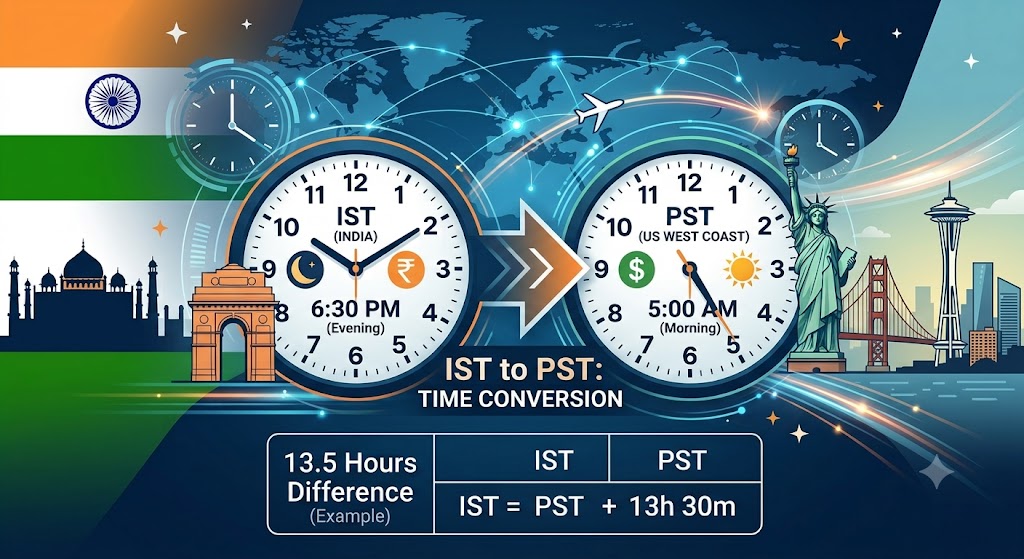
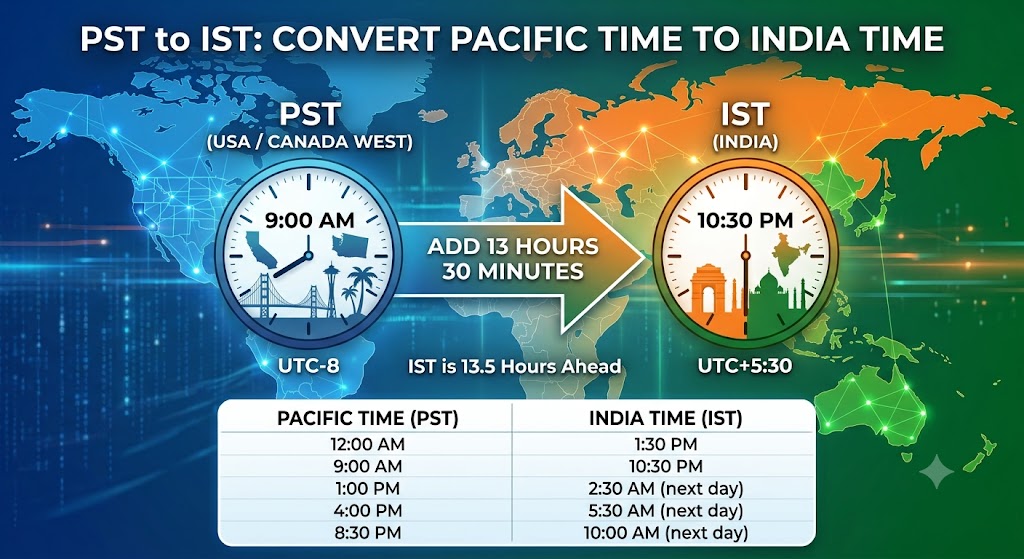
Pacific Standard Time (PST) is 13 hours and 30 minutes behind India Standard Time (IST).
That's right — 13.5 hours. It's one of the biggest time gaps you'll deal with. When it's 8 AM in California, it's already 9:30 PM in India. Your team is heading to bed while you're just getting started.
This guide breaks down everything you need to know about converting PST to IST — the math, the DST confusion, and how to actually make it work without driving everyone crazy.
Use the free PST to IST converter here →
The Short Answer: What's the Time Difference?
IST is 13.5 hours ahead of PST.
| If it's... | In California (PST) | In India (IST) |
|---|---|---|
| Early morning | 6:00 AM | 7:30 PM |
| Morning | 8:00 AM | 9:30 PM |
| Noon | 12:00 PM | 1:30 AM (next day) |
| Afternoon | 3:00 PM | 4:30 AM (next day) |
| Evening | 6:00 PM | 7:30 AM (next day) |
But there's a catch. That 13.5-hour difference only applies from November to March, when the US is on Standard Time.
From March to November, the US West Coast moves to Pacific Daylight Time (PDT) and the difference shrinks to 12.5 hours.
This is where people get confused. Let's clear it up.
Why Is India 13.5 Hours Ahead of California?
Here's the math:
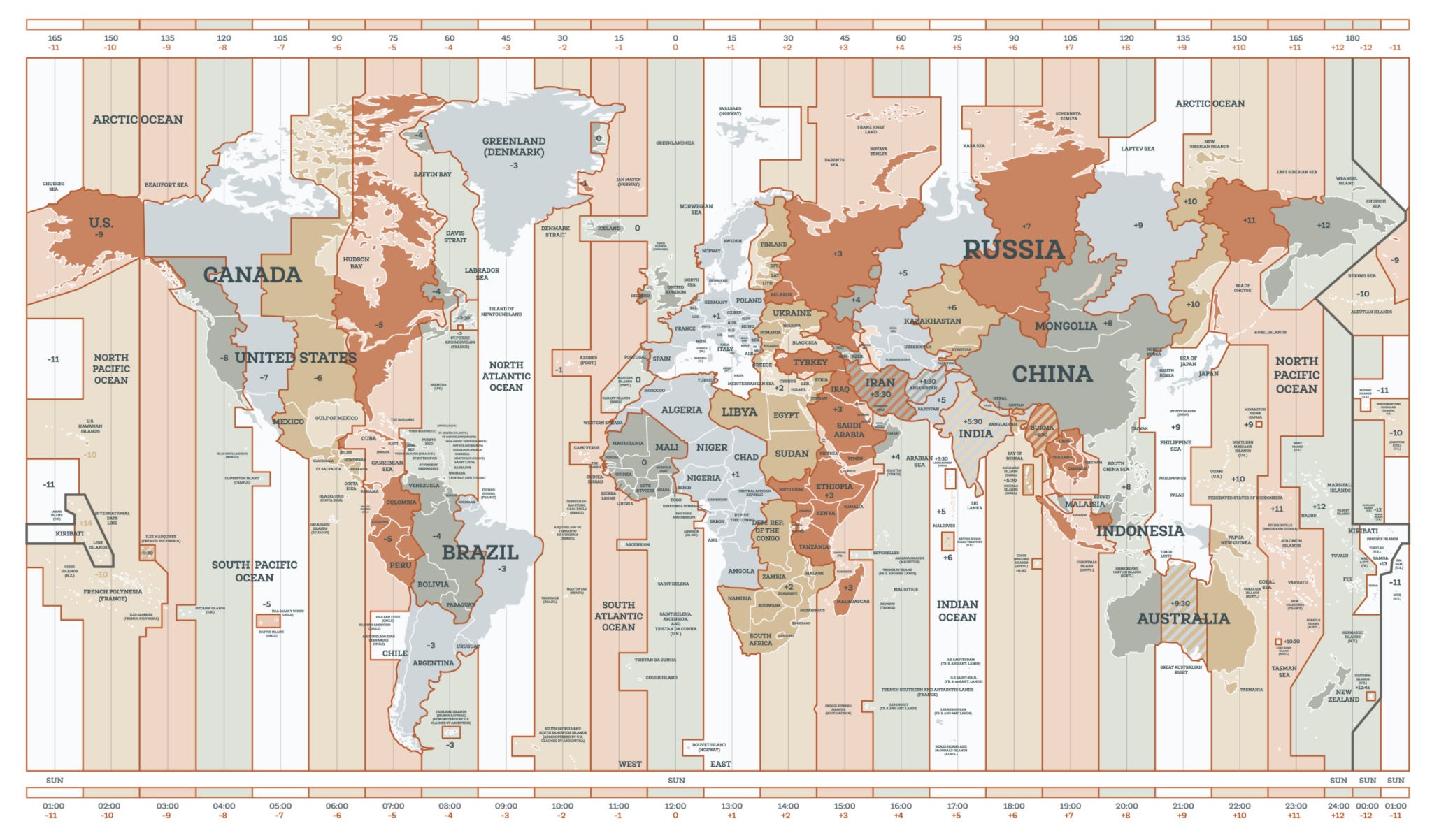
- India uses UTC +5:30
- US Pacific Standard Time uses UTC -8:00
- Total difference: 5.5 + 8 = 13.5 hours
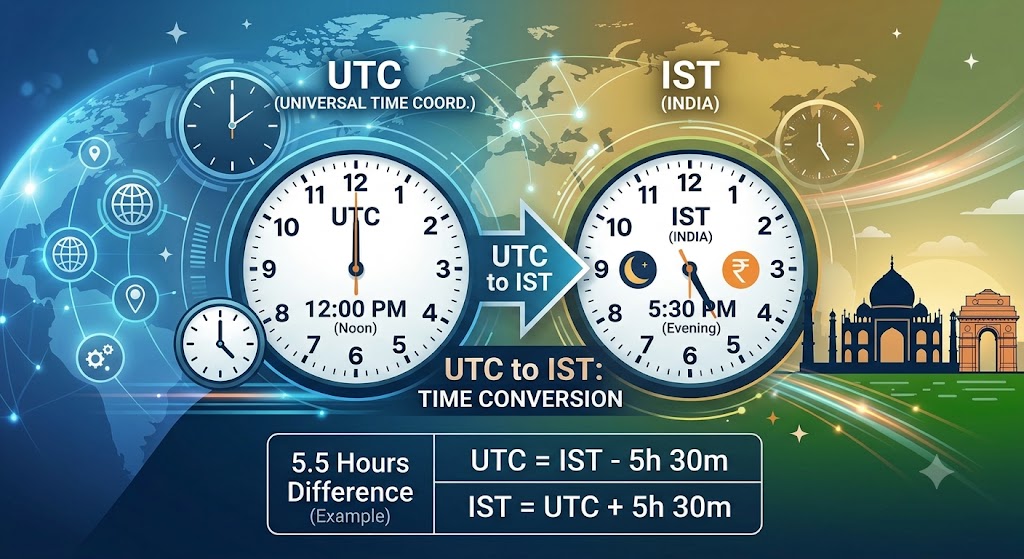
India is 5.5 hours ahead of UTC. California is 8 hours behind UTC. Add them together and you get 13.5 hours.
The half-hour comes from India's UTC +5:30 offset. Instead of a clean 13 or 14 hours, it's that awkward 13.5. That half-hour matters when you're scheduling.
The DST Problem: Why This Changes Twice a Year
Here's where it gets tricky.
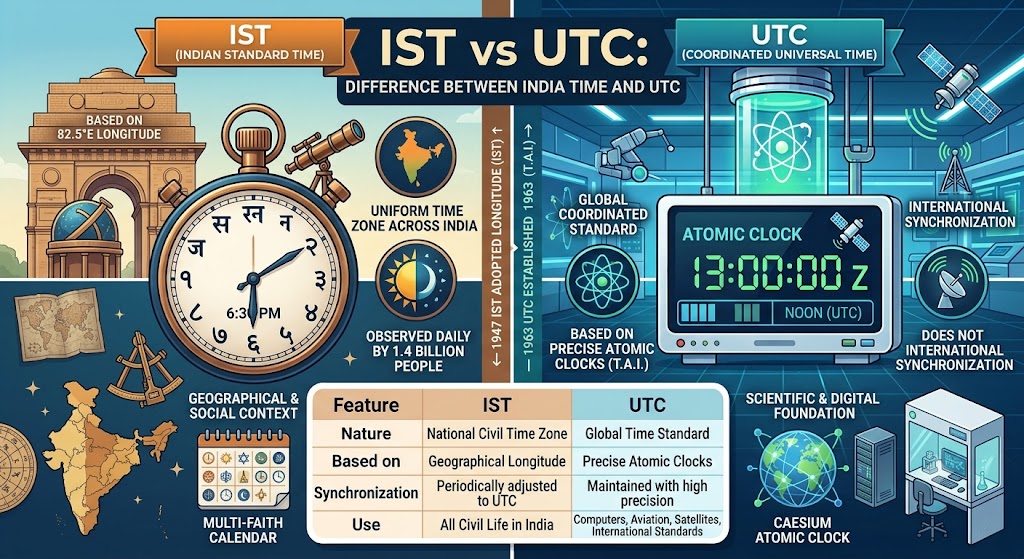
India doesn't observe Daylight Saving Time. IST stays at UTC +5:30 all year.
The US West Coast does observe DST. November to March, they're on PST (UTC -8:00). March to November, they're on PDT (UTC -7:00).
| Time Zone | When | UTC Offset | Difference from IST |
|---|---|---|---|
| PST (Standard) | Nov - Mar | UTC -8:00 | IST is 13.5 hours ahead |
| PDT (Daylight) | Mar - Nov | UTC -7:00 | IST is 12.5 hours ahead |
What this means in practice:
- In winter: 9 AM PST = 10:30 PM IST
- In summer: 9 AM PDT = 9:30 PM IST
A 9 AM call in winter is 10:30 PM in India. In summer, it's 9:30 PM. That one hour matters a lot.
Pro tip: When someone says "Pacific Time," always ask: "Is that PST or PDT?" It makes a real difference.
Quick Reference: PST to IST Conversion Table
Here's a cheat sheet for standard time (winter, Nov - Mar).
PST to IST (Winter, Nov - Mar):
| Pacific Time (PST) | India Time (IST) |
|---|---|
| 12:00 AM (midnight) | 1:30 PM |
| 1:00 AM | 2:30 PM |
| 2:00 AM | 3:30 PM |
| 3:00 AM | 4:30 PM |
| 4:00 AM | 5:30 PM |
| 5:00 AM | 6:30 PM |
| 6:00 AM | 7:30 PM |
| 7:00 AM | 8:30 PM |
| 8:00 AM | 9:30 PM |
| 9:00 AM | 10:30 PM |
| 10:00 AM | 11:30 PM |
| 11:00 AM | 12:30 AM (next day) |
| 12:00 PM (noon) | 1:30 AM (next day) |
| 1:00 PM | 2:30 AM (next day) |
| 2:00 PM | 3:30 AM (next day) |
| 3:00 PM | 4:30 AM (next day) |
| 4:00 PM | 5:30 AM (next day) |
| 5:00 PM | 6:30 AM (next day) |
| 6:00 PM | 7:30 AM (next day) |
| 7:00 PM | 8:30 AM (next day) |
| 8:00 PM | 9:30 AM (next day) |
| 9:00 PM | 10:30 AM (next day) |
| 10:00 PM | 11:30 AM (next day) |
| 11:00 PM | 12:30 PM (next day) |
During Daylight Time (Mar - Nov): Subtract 12.5 hours instead of 13.5.
So if it's 9 AM PDT, it's 9:30 PM IST — not 10:30 PM.
The Real Problem: There's Almost No Overlap
Here's the brutal truth about PST and IST: if you're in California and your team is in India, you're practically living on opposite sides of the planet. There's no standard 9-to-5 overlap. One of you is always working late or waking up early.
When India is working (10 AM - 7 PM IST), it's between 8:30 PM (previous day) and 5:30 AM in California.
When California is working (9 AM - 6 PM PST), it's between 10:30 PM and 7:30 AM in India.
They're almost completely opposite schedules. One side is sleeping while the other is working.
What This Means For You
Someone's always going to be inconvenienced. The goal isn't a perfect time — it's the least bad time, and making sure the inconvenience is shared.
The Best Time to Call Between PST and IST
Given the lack of overlap, here are your options:
Option 1: Morning in California, Late Night in India
- 7:00 AM - 8:00 AM PST = 8:30 PM - 9:30 PM IST
- California: Early start. Doable for some.
- India: Late evening. Not great but manageable for a quick call.
- Works best: Short sync calls, not long meetings.
Real example: A San Francisco startup often schedules stand-ups at 8:30 AM PST. That's 10:00 PM IST. India team members often have dinner or family commitments at that hour. Keep these meetings under 15 minutes.
Option 2: Evening in California, Morning in India
- 5:00 PM - 6:00 PM PST = 6:30 AM - 7:30 AM IST (next day)
- California: End of day. Fine.
- India: Early morning. Rough for people who don't start early.
- Works best: Teams with flexible morning schedules.
Real example: Some teams rotate this time slot weekly. One week, California stays late. The next, India starts early. It's not perfect, but it's fair.
Option 3: The Window
If you absolutely need an hour of overlap, aim for:
| Time (PST) | Time (IST) | Who Suffers |
|---|---|---|
| 7:30 AM PST | 9:00 PM IST | India (late night) + California (early) |
| 8:30 AM PST | 10:00 PM IST | India (pretty late) + California (reasonable) |
| 5:30 PM PST | 7:00 AM IST (next day) | India (early morning) + California (end of day) |
General rule: 8 AM PST / 9:30 PM IST is the most common compromise.
How to Convert PST to IST in Your Head
If you need to do it without a tool:
IST = PST + 13.5 hours (winter) or 12.5 hours (summer)
Example: 10 AM PST (winter)
- Add 13 hours → 11 PM
- Add 30 minutes → 11:30 PM IST
Going the other way (IST to PST):
PST = IST - 13.5 hours (winter) or 12.5 hours (summer)
Example: 6 PM IST
- Subtract 13 hours → 5 AM
- Subtract 30 minutes → 4:30 AM PST
But honestly? Just use the converter. The half-hour plus DST changes make mental math risky.
The Hidden Trap: What About Emergency Calls?
Nobody talks about this until it happens. What if there's a critical issue at 2 PM PST (2:30 AM IST)?
Problem: Production outage. No one in India is awake.
Solution: Set up an on-call rotation where someone from each team is available during the other's off-hours. It's expensive and exhausting, but it's the only way to handle emergencies.
Alternative: Use asynchronous communication tools (Slack, email, recorded video) for non-urgent updates. Not everything needs a live call.
Common Mistakes (And How to Avoid Them)
1. Forgetting About PDT vs PST
Someone says "Pacific Time" and you assume it's always UTC -8. It's not. March to November it's UTC -7.
Fix: Always check the date. If it's between March and November, it's PDT. If November to March, it's PST.
Real example: You schedule a meeting for 8 AM PST in February. When DST starts in March, your calendar app might not update correctly, and suddenly everyone shows up an hour early or late.
2. Messing Up the Date Change
IST is so far ahead that when you convert, the date often changes.
Example: 2 PM PST Monday = 3:30 AM IST Tuesday. The day changed.
Fix: Always check the date, not just the time.
3. Scheduling During Holidays
Time zones aside, Indian and US holidays don't line up. Diwali, Thanksgiving, Independence Day — they're all different.
Fix: Check both countries' holidays before scheduling something important.
4. Thinking There's a Normal Overlap
There isn't. Stop looking for one. The goal is the least bad time for everyone.
Tips for Scheduling Across PST and IST
After years of working with teams across both time zones, here's what actually works:
Accept the reality. Someone's always going to be inconvenienced. There's no magical time that works perfectly for both sides.
Rotate the burden. This week, California starts early. Next week, India stays late. Share the pain fairly.
Keep meetings short. When someone's working late or waking up early, 30 minutes is better than 60.
Use async communication when possible. Not everything needs a live call. Use Slack, email, or shared documents.
Check availability before scheduling. Don't assume. Ask both sides what times actually work for them.
Share a link to the converter. Instead of explaining "8 AM PST is 9:30 PM IST," just send a link. Let them check it themselves.
Frequently Asked Questions
What's the time difference between California and India?
In winter (PST): India is 13.5 hours ahead. In summer (PDT): India is 12.5 hours ahead.
Is India ahead of or behind Pacific Time?
Ahead. Way ahead. When it's Tuesday in India, it's still Monday evening in California.
Does India observe Daylight Saving Time?
No. India stays on IST (UTC +5:30) all year. Only the US changes.
When does PST become PDT?
Second Sunday in March → first Sunday in November. That's when the difference changes from 13.5 to 12.5 hours.
What's the best time for a meeting between California and India?
Around 8 AM PST / 9:30 PM IST is the most common compromise. Someone's always sacrificing, but this is the least bad option.
What's 9 AM PST in IST?
Winter: 10:30 PM IST. Summer (PDT): 9:30 PM IST.
What's 6 PM IST in PST?
Winter: 4:30 AM PST. Summer: 5:30 AM PDT.
Is there any working hours overlap between PST and IST?
Very little — usually 1-2 hours. California morning = India late night. That's your window.
Final Thoughts
PST to IST is one of the toughest time zone conversions because the gap is enormous — 13.5 hours — and there's almost no overlap. It's basically the opposite side of the world.
Once you accept that someone's going to be inconvenienced, it gets easier. The goal isn't a perfect time — it's the least bad time, and making sure that inconvenience is rotated fairly.
The most important rule: Always check whether it's PST or PDT. The difference between 12.5 and 13.5 hours matters a lot.
And if you're ever in doubt, use the tool. It handles the math, accounts for DST, and shows you exactly what time works.
Convert PST to IST instantly → /timezone-converter/pst-to-ist
Tags: PST to IST, convert PST to IST, Pacific Time to India time, PST to IST converter, PST to IST time difference, India Standard Time, PDT to IST, Pacific Daylight Time to IST, PST to IST conversion table, time difference US West Coast India, PST to IST 13.5 hours, PST to IST converter online, IST to PST, what time is PST in IST, PST time now in IST, PST to IST calculator, time zone converter PST IST, PST to IST work hours, PST to IST business hours, best time to call India from California