The 1884 International Meridian Conference: Who Won and Who Lost
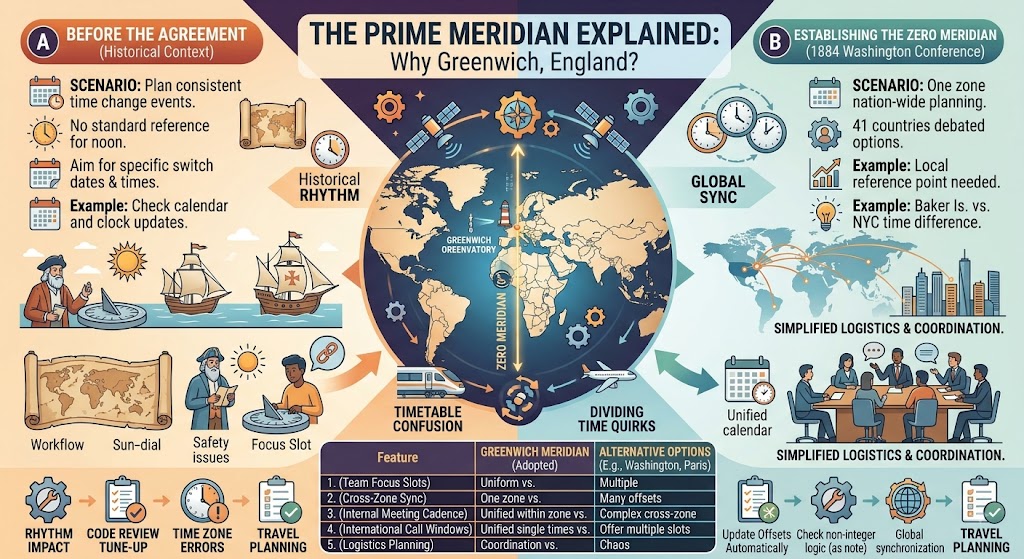
In October 1884, delegates from 25 nations gathered in Washington, D.C., for a conference that would reshape how the world tells time. The question was simple: where should the world's prime meridian be?
The answer — Greenwich — seems obvious today. But at the time, it was a bitter contest between national pride, scientific tradition, and economic power. The conference had clear winners and clear losers.
This guide explains what happened, who won, and who lost.
Use the free time zone converter here →
The Short Answer: Who Won and Who Lost
Greenwich won. The meridian passing through the Royal Observatory in Greenwich, England, became the world's prime meridian. France lost. It abstained from the vote and refused to adopt Greenwich time until 1911.
| Outcome | Country |
|---|---|
| Biggest winner | Great Britain |
| Other winners | United States, Germany, Russia, Japan |
| Biggest loser | France |
| Only dissenting vote | San Domingo (Dominican Republic) |
| Abstained | France, Brazil |
| Adopted Greenwich later | France (1911) |
The Conference: What Happened
The Basics
The International Meridian Conference was held in Washington, D.C., from October 13 to October 22, 1884.
| Aspect | Details |
|---|---|
| Dates | October 13–22, 1884 |
| Location | Washington, D.C. |
| Nations represented | 25 |
| Delegates | 41 |
| Convened by | United States |
| Purpose | Select a prime meridian |
The Key Resolution
Resolution 2 was the critical vote. It proposed adopting the meridian passing through the Royal Observatory at Greenwich as the initial meridian for longitude.
| Aspect | Details |
|---|---|
| Resolution | Greenwich as prime meridian |
| Vote | 22 in favor, 1 against, 2 abstained |
| Against | San Domingo (Dominican Republic) |
| Abstained | France, Brazil |
The Final Act
The conference concluded with a Final Act adopted unanimously, recording the resolutions and the votes on each.
The Winners: Why Greenwich Won
1. Britain's Maritime Dominance
By 1884, Britain was the world's dominant maritime power. Its ships already used Greenwich as the reference for navigation, and its empire spanned the globe.
| Factor | Explanation |
|---|---|
| Royal Navy | Used Greenwich charts |
| Merchant fleet | Largest in the world |
| Global empire | Time followed the flag |
| Observatory | World-class since 1675 |
2. The United States Already Used It
The United States had adopted Greenwich-based time zones in 1883, a year before the conference. This was a massive advantage.
| Aspect | Details |
|---|---|
| US adoption | 1883 (railroads) |
| Reference | Greenwich |
| Impact | Western Hemisphere aligned |
| Result | Greenwich was inevitable |
3. Navigational Pragmatism
Most of the world's sailors already used Greenwich charts. Changing to a different meridian would have required reprinting every navigational table and chart.
| Reason | Explanation |
|---|---|
| Existing charts | Already used Greenwich |
| Cost | Reprinting would be enormous |
| Safety | Navigators knew Greenwich |
| Tradition | Decades of practice |
4. The Decimal System Trade-Off
Britain's delegate, Sir William Thomson (later Lord Kelvin), acknowledged that England was making a sacrifice by not adopting the metric system. Some delegates accepted Greenwich only in hopes that Britain would adopt metric in return.
| Aspect | Details |
|---|---|
| Metric system | France's proposal |
| Britain's stance | Resisted metric |
| Trade-off | Some voted for Greenwich hoping for metric |
| Result | Metric not adopted |
The Losers: France and San Domingo
France: The Bitter Abstention
France was the biggest loser. It had hoped to make Paris the prime meridian and had proposed a neutral meridian that would pass through no major country.
| Aspect | Details |
|---|---|
| Preferred meridian | Paris |
| Alternative | Neutral meridian |
| Vote | Abstained |
| Adopted Greenwich | 1911 (27 years later) |
Why France Refused
France argued that the prime meridian should be neutral — not tied to any nation's capital. It also objected that Greenwich was not truly international.
| French Argument | Explanation |
|---|---|
| Neutrality | No nation should own the meridian |
| Metric system | Should be the basis of international standards |
| National pride | Paris deserved recognition |
The French delegate, Cruls, wrote that France would never accept abandoning its meridian for another nation's, and that a neutral meridian was the only solution without national pride at stake.
The 27-Year Resistance
France did not formally adopt Greenwich until 1911. For 27 years, French maps and charts continued to use Paris as the prime meridian.
| Year | French Position |
|---|---|
| 1884 | Abstained from vote |
| 1884–1911 | Continued using Paris meridian |
| 1911 | Adopted Greenwich |
San Domingo: The Only "No"
San Domingo (now the Dominican Republic) cast the only dissenting vote against Greenwich.
| Aspect | Details |
|---|---|
| Country | San Domingo (Dominican Republic) |
| Vote | Against Greenwich |
| Reason | Unknown |
| Legacy | The only "no" vote |
The Hidden Loser: The Universal Day
What Was Lost
The conference also considered a universal day — a single global time for all purposes. This proposal was voted down.
| Aspect | Details |
|---|---|
| Proposal | Single global time |
| Champion | Sandford Fleming |
| Outcome | Rejected |
| Result | Time zones instead |
Why It Failed
Delegates separated the question of longitude from the question of time. They accepted Greenwich for longitude but rejected a single time for the world.
| Argument | Explanation |
|---|---|
| Different questions | Longitude ≠ time |
| Local needs | Different regions need different times |
| Practicality | Time zones were enough |
| Sovereignty | Nations wanted control |
The Legacy
The rejection of the universal day meant the world would use time zones instead. This was Sandford Fleming's proposal, adapted at the conference.
The Results: What the Conference Actually Decided
| Resolution | Outcome |
|---|---|
| Prime meridian | Greenwich (22–1) |
| Longitude counted | East and west up to 180° |
| Universal day | Recommended but not required |
| Day begins | Mean midnight at Greenwich |
| Astronomical day | Hope it would shift to midnight |
The Global Impact
Britain's Victory
Britain achieved its goal: Greenwich became the world's prime meridian. The Royal Observatory, founded in 1675, became the center of world time.
| Aspect | Details |
|---|---|
| Prime meridian | Greenwich |
| Global standard | GMT |
| British influence | Dominant |
| Legacy | Still the reference today |
France's Long Resistance
France's refusal to adopt Greenwich for 27 years shows how deeply national pride shaped timekeeping.
| Aspect | Details |
|---|---|
| Resistance period | 1884–1911 |
| Reason | National pride, metric system |
| Resolution | Eventual adoption |
| Legacy | France still uses UTC+01:00 |
The World Adopts Greenwich
Despite France's resistance, the rest of the world gradually adopted Greenwich-based time.
| Region | Adoption |
|---|---|
| United States | 1883 |
| Britain | 1880 (law) |
| Japan | 1886 |
| India | 1906 |
| France | 1911 |
Quick Reference Card
━━━━━━━━━━━━━━━━━━━━━━━━━━━━━━━━━━━━━━━━━━━━━━━━━━━━━━━━━━
   1884 INTERNATIONAL MERIDIAN CONFERENCE — CHEAT SHEET
━━━━━━━━━━━━━━━━━━━━━━━━━━━━━━━━━━━━━━━━━━━━━━━━━━━━━━━━━━

THE BASICS:
  Dates: October 13–22, 1884
  Location: Washington, D.C.
  Nations: 25
  Delegates: 41
  Purpose: Choose a prime meridian

THE VOTE:
  Resolution 2: Greenwich as prime meridian
  22 in favor, 1 against, 2 abstained

WINNERS:
  Great Britain — Greenwich won
  United States — Already used it (1883)
  Germany, Russia, Japan — Voted for Greenwich

LOSERS:
  France — Abstained, adopted Greenwich in 1911
  San Domingo — Only "no" vote
  Brazil — Abstained

WHY GREENWICH WON:
  • Britain's maritime dominance
  • US already used Greenwich-based time
  • Most navigators used Greenwich charts
  • Reprinting charts would be costly

WHY FRANCE ABSTAINED:
  • Wanted Paris as prime meridian
  • Proposed a neutral meridian
  • Objected to Greenwich as "not international"
  • National pride

HIDDEN LOSER:
  Universal day (single global time) — rejected
  Result: Time zones instead

FRANCE'S RESISTANCE:
  1884 — Abstained
  1884–1911 — Used Paris meridian
  1911 — Adopted Greenwich

GOLDEN RULE:
  Greenwich won because Britain already won the seas.

━━━━━━━━━━━━━━━━━━━━━━━━━━━━━━━━━━━━━━━━━━━━━━━━━━━━━━━━━━
         Check live conversions at: /timezone-converter
━━━━━━━━━━━━━━━━━━━━━━━━━━━━━━━━━━━━━━━━━━━━━━━━━━━━━━━━━━
Frequently Asked Questions
Who won the 1884 International Meridian Conference?
Great Britain won. The conference adopted Greenwich as the world's prime meridian, which Britain had advocated and already used across its empire.
Who lost the 1884 International Meridian Conference?
France was the biggest loser. It wanted Paris as the prime meridian and abstained from the vote, refusing to adopt Greenwich until 1911. San Domingo (the Dominican Republic) cast the only dissenting vote.
Why did Greenwich win?
Britain's maritime dominance, the United States' prior adoption of Greenwich-based time in 1883, and the fact that most navigators already used Greenwich charts made it the practical choice.
Why did France abstain?
France wanted Paris as the prime meridian and argued for a neutral meridian. It also objected that Greenwich was not truly international and hoped to promote the metric system.
How long did France resist Greenwich time?
France did not formally adopt Greenwich until 1911, 27 years after the conference.
Which country voted against Greenwich?
San Domingo (now the Dominican Republic) cast the only vote against Greenwich.
What happened to the universal day proposal?
It was rejected. Delegates separated longitude from time and opted for time zones instead of a single global time.
Who proposed the time zone system?
Sandford Fleming, a Canadian railway engineer, proposed the 24-time-zone system. His idea was adapted at the 1884 conference.
Did the conference create time zones?
Not directly. The conference focused on the prime meridian. Time zones were already being adopted by railroads and countries, and the conference's choice of Greenwich made them consistent.
Why is Greenwich still the prime meridian today?
Because the 1884 conference established it as the global standard, and it was never seriously challenged after France's eventual adoption.
Final Thoughts
The 1884 International Meridian Conference was not a scientific debate. It was a geopolitical contest. Britain won because it already dominated the seas. The United States won because it had already adopted Greenwich time. France lost because it insisted on national pride over pragmatism.
Three things to remember:
- Greenwich won. Britain's maritime power made it inevitable
- France lost. It abstained and resisted for 27 years
- The universal day lost. Time zones won instead
Check time zone conversions instantly → /timezone-converter
Tags: 1884 International Meridian Conference, who won 1884 meridian conference, Greenwich prime meridian vote, France abstained meridian conference, San Domingo voted against Greenwich, why Greenwich won prime meridian, International Meridian Conference results, prime meridian history, GMT adoption history, time zone converter