The History of Standard Time: How Railroads Killed Local Solar Time
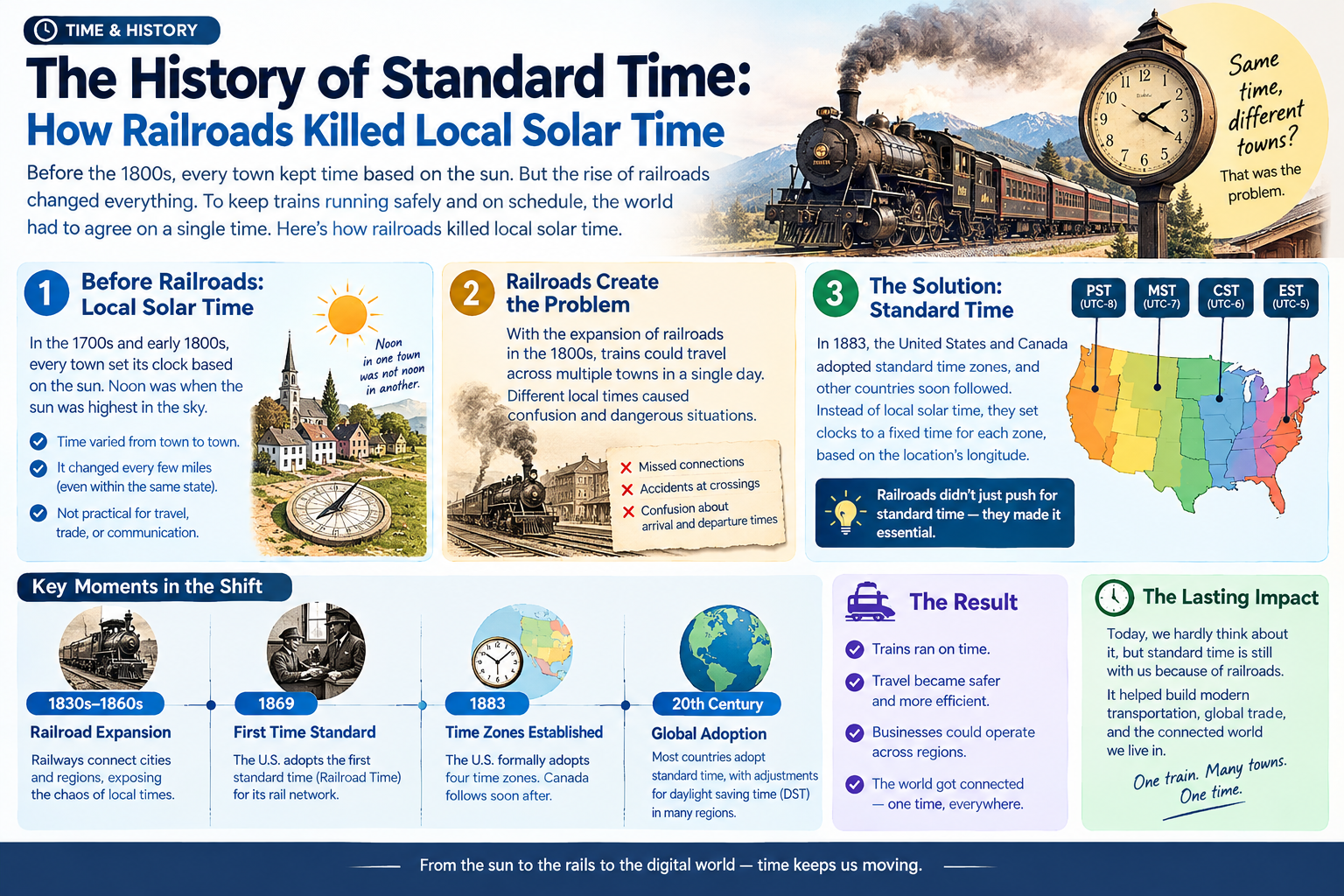
Before the 1880s, time was a local affair. Every town set its clocks by the sun. Noon was when the sun was highest in the sky — and that moment was different in every single place.
This worked fine for centuries. Then railroads arrived, and the entire system collapsed.
A train traveling from New York to Chicago passed through dozens of local times, each off by minutes from the next. Schedules became impossible. Accidents happened. Something had to change.
The solution — standardized time zones — was invented not by scientists or governments, but by railroads. This is the story of how train companies killed local solar time and created the time system we still use today.
Use the free time zone converter here →
The Short Answer: Why Standard Time Was Invented
Standard time was created because railroads needed consistent schedules across long distances. Local solar time made train timetables impossible to manage.
| Aspect | Details |
|---|---|
| Before | Every town had its own local solar time |
| The problem | Railroads crossed dozens of local times |
| The solution | Standardized time zones |
| Who drove it | Railroad companies, not governments |
| Key figure | Sandford Fleming, Canadian railway engineer |
| Key event | General Time Convention, October 1883 |
| Result | 4 standard time zones in North America |
| Global standard | Greenwich Mean Time (GMT) |
The World Before Standard Time: Every Town Had Its Own Noon
Local Solar Time
For most of human history, time was defined by the sun. When the sun reached its highest point in the sky, it was noon. Simple, intuitive, and deeply local.
| Aspect | Explanation |
|---|---|
| What it was | Time based on the sun's position at each location |
| Noon | When the sun was highest in the sky |
| How it was measured | Sundials, then local observatory clocks |
| Variation | Every town had a slightly different time |
| The issue | Differences of minutes, not hours |
A town 100 km west of another would have noon a few minutes later. Over short distances, this didn't matter. People rarely traveled far, and communication was slow.
How Different Was It?
| Location | Difference from Greenwich |
|---|---|
| Greenwich, England | 0 minutes |
| Bristol, England | About 10 minutes behind |
| New York | About 12 minutes behind Boston |
| Chicago | About 18 minutes behind New York |
| San Francisco | About 24 minutes behind Chicago |
These small differences were invisible in daily life. But they became catastrophic for railroads.
The Railroad Problem: Chaos on the Tracks
Why Railroads Couldn't Function
Railroads connected distant cities at high speed. A single line could pass through dozens of local times. This created serious problems.
| Problem | Explanation |
|---|---|
| Timetable chaos | Each station used its own local time |
| Missed connections | Passengers and freight arrived at wrong times |
| Safety hazards | Two trains on the same track could misjudge timing |
| Collisions | Confusion over schedules contributed to accidents |
| No coordination | Different railroads used different reference times |
By the 1870s, the situation was unsustainable. Railroads in the United States alone operated with over 50 different local times at stations along their routes.
The Real Danger
A famous example illustrates the danger: two trains on the same track, each believing it had the right of way based on its own local time. The result was collisions, injuries, and deaths.
Railroad companies realized they needed a single, unified time system.
Sandford Fleming: The Man Who Invented Time Zones
Who Was He?
Sandford Fleming was a Scottish-Canadian railway engineer and inventor. He is widely credited as the father of standard time.
| Aspect | Details |
|---|---|
| Born | 1827, Scotland |
| Moved to | Canada |
| Profession | Railway engineer |
| Key contribution | Proposed global standard time system |
| Proposed in | 1876 |
| Idea | Divide the world into 24 time zones |
Fleming's Proposal
In 1876, Fleming proposed dividing the world into 24 time zones, each one hour apart. He suggested using Greenwich as the prime meridian.
His system was elegant:
- The world would be divided into 24 zones
- Each zone would be exactly 15 degrees of longitude wide
- Each zone would be one hour apart
- Greenwich would be the reference point
Fleming's idea was revolutionary. But it took years to convince the world.
The 1883 General Time Convention
The Turning Point
On October 11, 1883, railroad representatives from the United States and Canada met in Chicago for the General Time Convention. They agreed to adopt a standardized time system.
| Aspect | Details |
|---|---|
| Date | October 11, 1883 |
| Location | Chicago, Illinois |
| Who | Railroad companies of US and Canada |
| Decision | Adopt 4 standard time zones |
| Implementation | November 18, 1883 |
| Name | "The Day of Two Noons" |
The Four Zones
The convention created four standard time zones for North America:
| Zone | Offset | Region |
|---|---|---|
| Eastern | UTC−05:00 | East Coast |
| Central | UTC−06:00 | Midwest |
| Mountain | UTC−07:00 | Rocky Mountains |
| Pacific | UTC−08:00 | West Coast |
These zones are still in use today, over 140 years later.
The Day of Two Noons: November 18, 1883
What Happened
On November 18, 1883, North America officially switched to standard time. The transition was so dramatic that the day became known as "The Day of Two Noons."
| Aspect | Details |
|---|---|
| Date | November 18, 1883 |
| Nickname | The Day of Two Noons |
| What happened | Clocks were reset to standard time |
| Effect | Some towns experienced noon twice |
| Reaction | Mixed — some resisted, some celebrated |
Why "Two Noons"?
When a town's clocks were reset to standard time, the local solar noon and the new standard noon did not match. In some places, the clock was adjusted backward or forward, causing the sun to reach its peak at a different clock time.
In towns that moved backward, residents experienced two noons in one day — one by solar time, one by standard time.
The Reaction
Not everyone was happy. Some towns refused to adopt standard time. Others called it "railroad time" and continued using local solar time for years.
| Reaction | Details |
|---|---|
| Railroads | Adopted immediately |
| Cities | Mostly adopted, some resisted |
| Rural areas | Slower to adopt |
| Legal status | Not yet official — only railroad time |
The Legal Fight: When Did Standard Time Become Law?
The United States
The US government did not officially adopt standard time until 1918, with the Standard Time Act.
| Aspect | Details |
|---|---|
| Year | 1918 |
| Law | Standard Time Act |
| What it did | Made standard time official |
| Also created | Daylight Saving Time |
| Who enforced | Interstate Commerce Commission |
Until 1918, standard time was a voluntary railroad convention, not a law. This meant towns could legally ignore it — and many did.
The Global Spread
Other countries adopted standard time at different times:
| Country | Year Adopted |
|---|---|
| United Kingdom | 1880 |
| United States | 1883 (railroads), 1918 (law) |
| Canada | 1883 (railroads) |
| Japan | 1886 |
| India | 1906 |
| China | 1949 (unified) |
Greenwich Mean Time: The Global Reference
Why Greenwich?
Greenwich, England, became the global reference point for time because of its Royal Observatory, founded in 1675. By the 1880s, most of the world's shipping already used Greenwich as the prime meridian.
| Aspect | Details |
|---|---|
| Prime meridian | 0° longitude |
| Location | Greenwich, London |
| Established | 1675 (observatory) |
| International agreement | 1884 (Washington Conference) |
| Standard | Greenwich Mean Time (GMT) |
The 1884 Washington Conference
In 1884, representatives from 25 nations met in Washington, D.C., and agreed to adopt Greenwich as the prime meridian. This made GMT the global standard for time.
| Aspect | Details |
|---|---|
| Date | October 1884 |
| Location | Washington, D.C. |
| Attendees | 25 nations |
| Decision | Greenwich = prime meridian |
| Result | Global standard time |
GMT vs UTC
Today, UTC (Coordinated Universal Time) has largely replaced GMT as the global standard. But GMT is still used informally and in some contexts.
| Aspect | GMT | UTC |
|---|---|---|
| Type | Time zone | Time standard |
| Based on | Earth's rotation | Atomic clocks |
| Leap seconds | No | Yes |
| Common use | UK winter time | Global reference |
The Impact: How Standard Time Changed the World
What Standard Time Enabled
| Impact | Explanation |
|---|---|
| Railroad safety | Consistent schedules reduced accidents |
| Global commerce | Predictable timing for trade |
| Communication | Telegraph and later telephone coordination |
| Aviation | Foundation for flight schedules |
| Computing | Basis for Unix time and network protocols |
What Was Lost
| Loss | Explanation |
|---|---|
| Local solar connection | Noon no longer matched the sun |
| Regional identity | Towns lost their unique time |
| Simplicity | Time became a complex global system |
Quick Reference Card
━━━━━━━━━━━━━━━━━━━━━━━━━━━━━━━━━━━━━━━━━━━━━━━━━━━━━━━━━━
        HISTORY OF STANDARD TIME CHEAT SHEET
━━━━━━━━━━━━━━━━━━━━━━━━━━━━━━━━━━━━━━━━━━━━━━━━━━━━━━━━━━

BEFORE 1883:
  • Every town had its own local solar time
  • Noon = sun at highest point
  • Railroads crossed 50+ local times in the US

THE PROBLEM:
  • Impossible schedules
  • Missed connections
  • Train collisions

THE SOLUTION:
  • Sandford Fleming proposed 24 global time zones (1876)
  • 1883 General Time Convention → 4 North American zones
  • November 18, 1883 → "The Day of Two Noons"

KEY DATES:
  1876 → Fleming proposes global time zones
  1883 → US/Canada railroads adopt standard time
  1884 → Washington Conference adopts Greenwich
  1918 → US Standard Time Act makes it law

KEY FIGURE:
  Sandford Fleming — father of standard time

━━━━━━━━━━━━━━━━━━━━━━━━━━━━━━━━━━━━━━━━━━━━━━━━━━━━━━━━━━
         Check live conversions at: /timezone-converter
━━━━━━━━━━━━━━━━━━━━━━━━━━━━━━━━━━━━━━━━━━━━━━━━━━━━━━━━━━
Frequently Asked Questions
Why was standard time invented?
Standard time was invented because railroads could not operate safely or efficiently with dozens of local solar times. Consistent schedules required a unified time system.
Who invented standard time?
Sandford Fleming, a Scottish-Canadian railway engineer, proposed the global time zone system in 1876. Railroads implemented it in 1883.
What was "The Day of Two Noons"?
November 18, 1883 — the day North American railroads switched to standard time. Some towns experienced noon twice as clocks were reset.
When did standard time become law in the US?
The Standard Time Act of 1918 made standard time official in the United States. Before that, it was a voluntary railroad convention.
Why is Greenwich the prime meridian?
Greenwich was chosen because its Royal Observatory was already the reference point for most of the world's shipping. The 1884 Washington Conference formalized this.
What is the difference between GMT and UTC?
GMT is a time zone based on Earth's rotation. UTC is a time standard based on atomic clocks. UTC is now the global reference.
Did everyone accept standard time immediately?
No. Many towns and rural areas resisted for years. Some continued using local solar time well into the 20th century.
How did standard time affect everyday people?
It changed how people thought about time. Noon no longer matched the sun, but schedules became predictable and global coordination became possible.
Final Thoughts
Standard time was not created by scientists or governments. It was created by railroads that needed to run trains safely and on time. What began as a practical solution became the foundation of our modern world.
Three things to remember:
- Local solar time was killed by railroads. Trains needed consistent schedules
- Sandford Fleming invented time zones. His 1876 proposal became reality in 1883
- Standard time is a human invention. It is not a law of nature
Check time zone conversions instantly → /timezone-converter
Tags: history of standard time, railroads and time zones, local solar time, Sandford Fleming, 1883 General Time Convention, why time zones were created, Greenwich Mean Time history, railroad time, standard time act 1918, noon before time zones, time zone converter