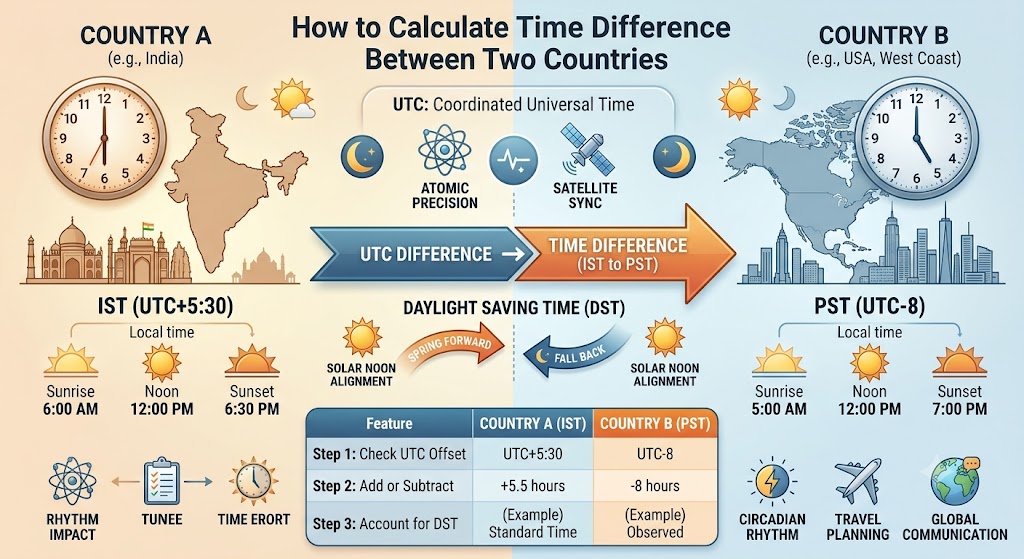
How to Calculate Time Difference Between Two Countries – Complete Guide
You're sitting in New York at 10 AM and you need to call your colleague in London. What time is it there?
Before you pick up the phone, you pause.
5 hours ahead? 4 hours ahead? Wait — is it Daylight Saving Time in the UK right now?
Suddenly what should be a simple question becomes a mental gymnastics routine.
Calculating time differences between countries doesn't have to be confusing. Once you understand how the system works, you'll never hesitate again.
This guide walks you through the simple math behind time zones, step-by-step examples, and common mistakes to avoid.
Use the free time zone converter here →
The Short Answer: How to Calculate Time Difference
The basic formula:
Time Difference = Target UTC Offset - Source UTC Offset
Then add or subtract that difference from your source time.
Example:
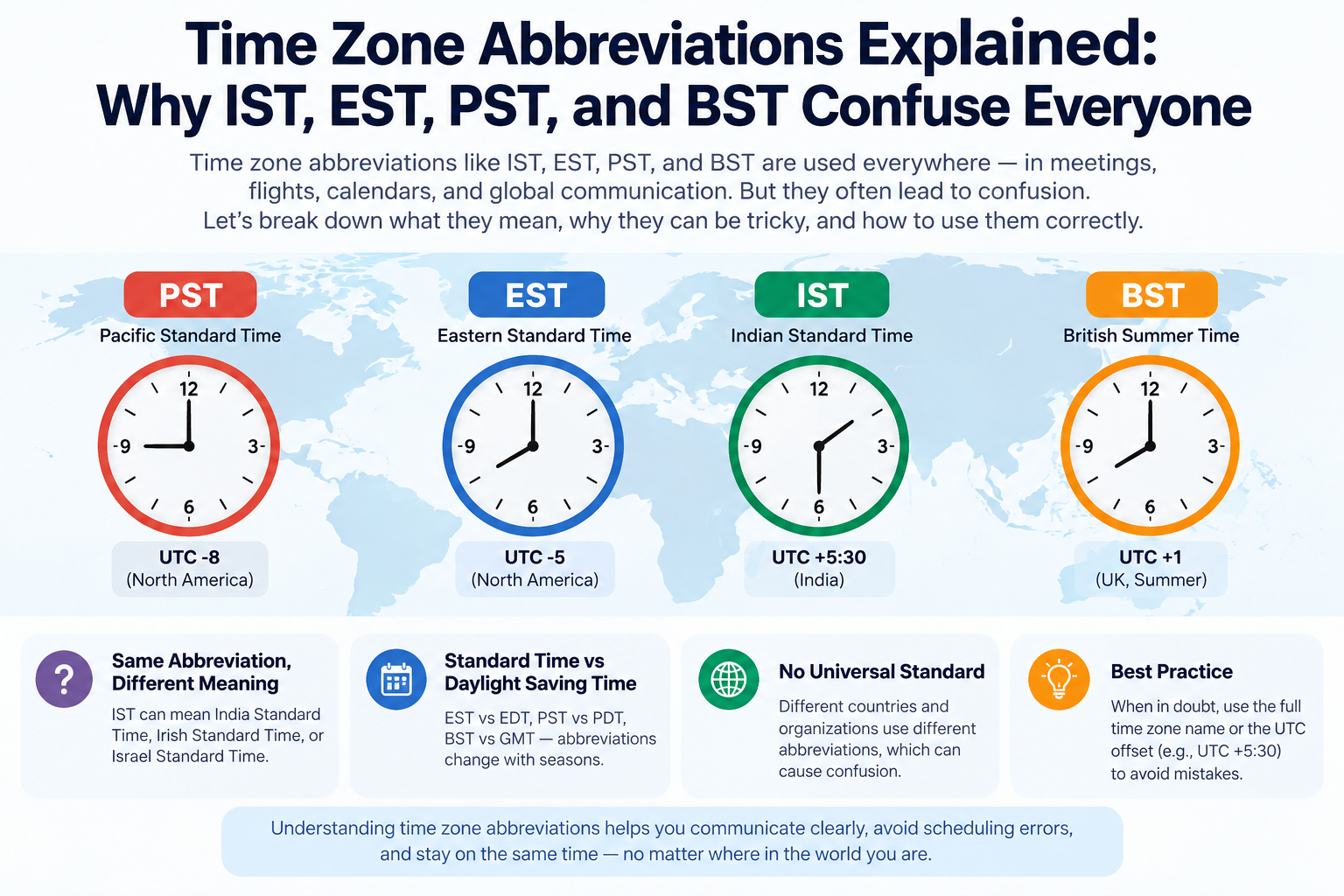
- New York (EST) = UTC -5:00
- London (GMT) = UTC +0:00
- Difference = 0 - (-5) = +5 hours
So if it's 10 AM in New York, it's 3 PM in London.
That's the entire logic. Everything else is just details.
Step 1: Understand UTC — The World's Reference Point
Before you can calculate time differences, you need to understand what time zones are measured against.
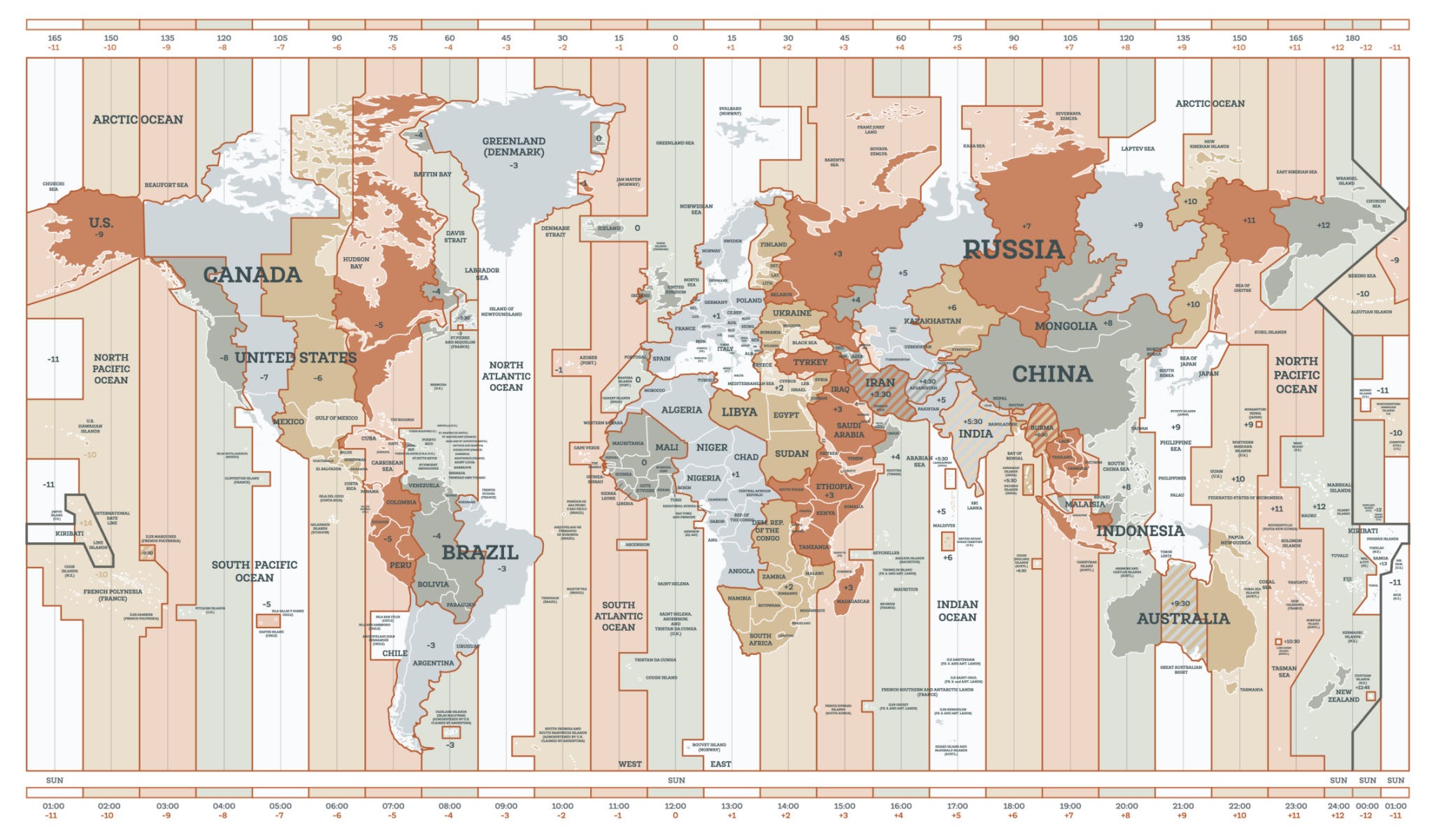
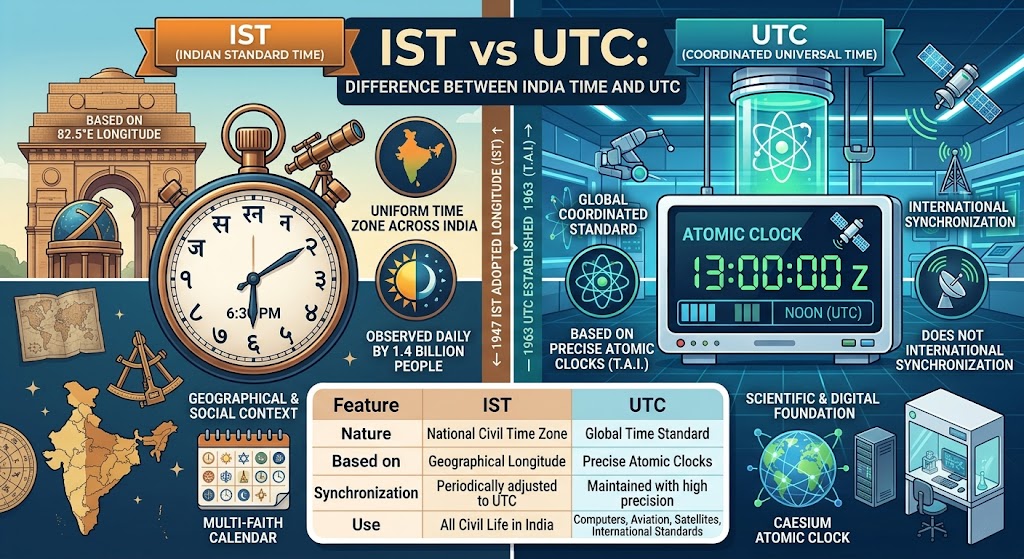
UTC (Coordinated Universal Time) is the world's primary time standard. It's the reference point from which all time zones are defined. Every time zone is defined by its offset from UTC.
Some examples of UTC offsets from NOAA reference data:
| Location | UTC Offset |
|---|---|
| Hawaii | UTC -10:00 |
| Los Angeles (PST) | UTC -8:00 |
| New York (EST) | UTC -5:00 |
| London (GMT) | UTC +0:00 |
| Paris (CET) | UTC +1:00 |
| India (IST) | UTC +5:30 |
| Tokyo (JST) | UTC +9:00 |
| Sydney (AEST) | UTC +10:00 |
Note: UTC is not a time zone — it's a time standard. It's the foundation that every clock in the world uses as a reference. When UTC is 12:00, Paris is 13:00, New York is 07:00, and India is 17:30.
In the United States, local times are determined by subtracting a certain number of hours from UTC — the more time zones you're away from Greenwich (England), the more hours you subtract. The switch to Daylight Saving Time does not affect UTC itself — it only changes local UTC offsets.
Step 2: Find the UTC Offset for Each Country
Every country or region has a UTC offset — the number of hours (and sometimes minutes) it's ahead of or behind UTC.
Here are common offsets:
US Time Zones (Standard Time)
| Time Zone | UTC Offset |
|---|---|
| Hawaii Standard Time | UTC -10:00 |
| Alaska Standard Time | UTC -9:00 |
| Pacific Standard Time (PST) | UTC -8:00 |
| Mountain Standard Time (MST) | UTC -7:00 |
| Central Standard Time (CST) | UTC -6:00 |
| Eastern Standard Time (EST) | UTC -5:00 |
European Time Zones
| Time Zone | UTC Offset |
|---|---|
| GMT (UK, Iceland) | UTC +0:00 |
| Central European Time (CET) | UTC +1:00 |
| Eastern European Time (EET) | UTC +2:00 |
Asia and Other Regions
| Time Zone | UTC Offset |
|---|---|
| India Standard Time (IST) | UTC +5:30 |
| China Standard Time (CST) | UTC +8:00 |
| Japan Standard Time (JST) | UTC +9:00 |
| Australian Eastern Standard Time (AEST) | UTC +10:00 |
| New Zealand Standard Time (NZST) | UTC +12:00 |
Most time zones are on the hour, but some have half-hour offsets. India (UTC+5:30) and Iran (UTC+3:30) are common examples. There's also one time zone with a 45-minute offset — Nepal (UTC+5:45).
Step 3: Apply the Formula
Here's the complete step-by-step method:
Step 1: Identify the UTC offset for the source location
Step 2: Identify the UTC offset for the target location
Step 3: Subtract the source offset from the target offset
Step 4: Add or subtract the difference from the source time
Step 5: Account for Daylight Saving Time if applicable
The Formula in Code (Simplified)
From the timefyi TypeScript library:
function getTimeDifference(tz1: string, tz2: string) {
  // Get UTC offsets for both timezones
  const offset1 = getUtcOffset(tz1); // in minutes
  const offset2 = getUtcOffset(tz2);

  // Calculate difference in hours
  const diffHours = (offset2 - offset1) / 60;

  return diffHours;
}
The formula is always: Target Offset - Source Offset = Time Difference
This works for any time zones, including those with half-hour or 45-minute offsets.
Step 4: Account for Daylight Saving Time
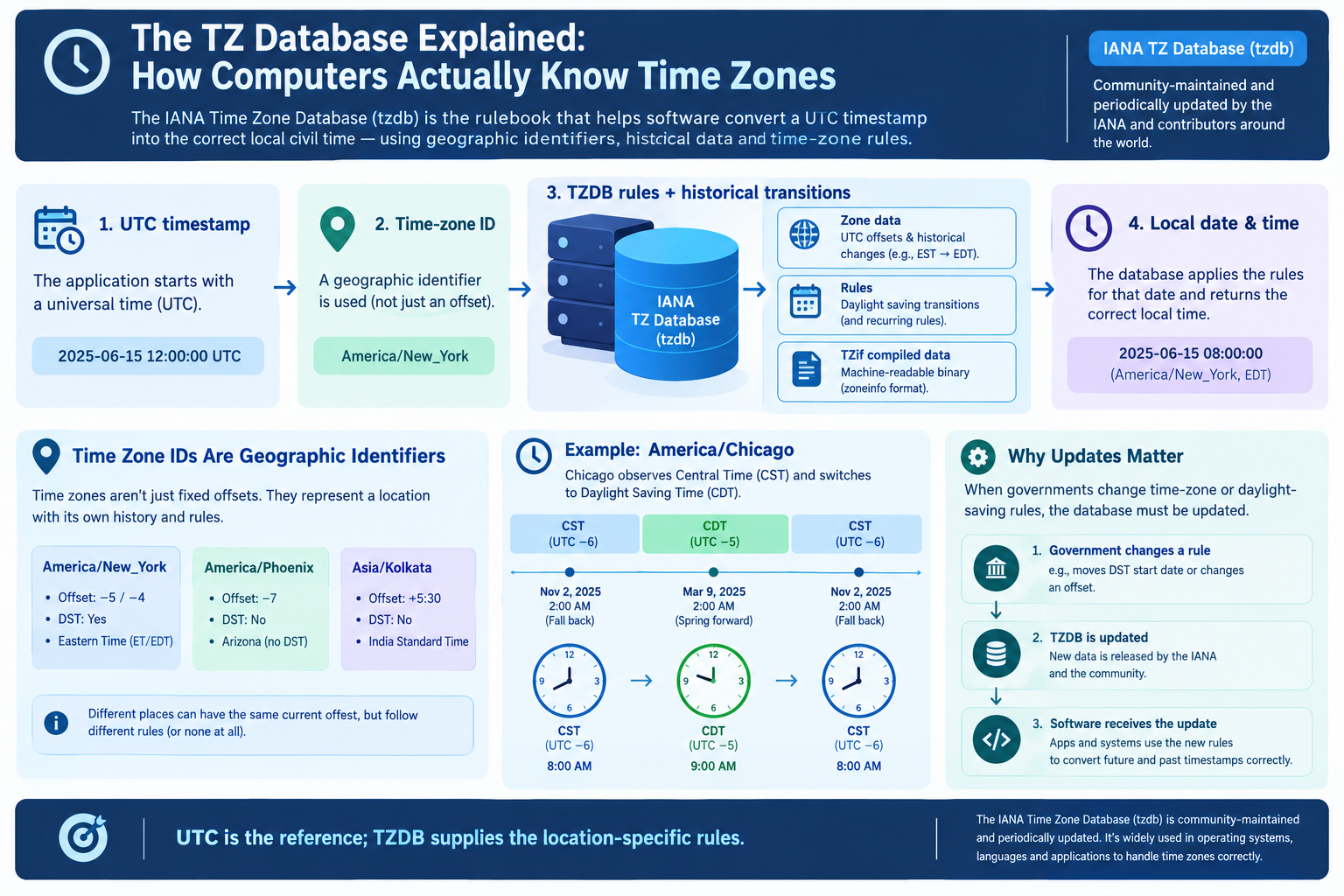
This is where people get confused. UTC never changes for DST. But local UTC offsets can shift when countries observe DST.
Example:
- New York normally uses EST at UTC -5:00
- During Daylight Saving Time, New York switches to EDT at UTC -4:00
- London normally uses GMT at UTC +0:00
- During DST, London switches to BST at UTC +1:00
So in summer, the difference between New York and London is 4 hours, not 5. In winter, it's 5 hours.
The key: Always check whether DST is active in both locations. Your calculation is only as accurate as your DST information.
You can determine DST status by comparing January and July offsets for a timezone — if they differ, DST is observed.
Step-by-Step Examples
Example 1: New York to London (Simple)
Problem: You're in New York at 9 AM EST. What time is it in London (GMT)?
Step 1: Source offset (New York, EST) = UTC -5:00
Step 2: Target offset (London, GMT) = UTC +0:00
Step 3: Difference = 0 - (-5) = +5 hours
Step 4: 9 AM + 5 hours = 2 PM
Answer: 2 PM in London
Example 2: London to Sydney (With Date Change)
Problem: It's 6 PM GMT in London. What time is it in Sydney (AEST, UTC +10:00)?
Step 1: Source offset (London, GMT) = UTC +0:00
Step 2: Target offset (Sydney, AEST) = UTC +10:00
Step 3: Difference = 10 - 0 = +10 hours
Step 4: 6 PM + 10 hours = 4 AM (next day)
Answer: 4 AM the next day in Sydney
Example 3: New York to India (Half-Hour Offset)
Problem: It's 8 AM EST in New York. What time is it in India (IST, UTC +5:30)?
Step 1: Source offset (New York, EST) = UTC -5:00
Step 2: Target offset (India, IST) = UTC +5:30
Step 3: Difference = 5.5 - (-5) = 10.5 hours
Step 4: 8 AM + 10.5 hours = 6:30 PM
Answer: 6:30 PM in India
Example 4: Los Angeles to Tokyo (Large Difference)
Problem: It's 10 AM PST in Los Angeles. What time is it in Tokyo (JST, UTC +9:00)?
Step 1: Source offset (Los Angeles, PST) = UTC -8:00
Step 2: Target offset (Tokyo, JST) = UTC +9:00
Step 3: Difference = 9 - (-8) = 17 hours
Step 4: 10 AM + 17 hours = 3 AM (next day)
Answer: 3 AM the next day in Tokyo
Example 5: Calculating Time Using Longitudes (Geography Method)
If you know the longitudes of two locations, you can also calculate time differences manually. From geography curriculum resources:
Rule: Earth rotates 360° in 24 hours, so:
- 15° of longitude = 1 hour of time difference
- 1° of longitude = 4 minutes of time difference
Problem: A football match is being played at 6:00 PM (18:00) in Town Y at longitude 125°E. What time will people in Town T at longitude 120°W watch it?
Step 1: Find the longitudinal difference:
- 125°E + 120°W = 245° difference
Step 2: Convert to time:
- 245° ÷ 15° = 16 hours and 5° remaining
- 5° × 4 minutes = 20 minutes
- Total difference = 16 hours 20 minutes
Step 3: Town T is behind Town Y (West), so subtract:
- 18:00 - 16 hours 20 minutes = 1:40 AM
Answer: People in Town T will watch the match at 1:40 AM
Common Mistakes (And How to Avoid Them)
1. Forgetting About DST
This is the #1 mistake. Always check whether each country observes DST and what the current date is.
Fix: Use a reliable source or tool to check current UTC offsets.
2. Mixing Up Positive and Negative Offsets
When calculating differences, always use Target - Source. If you reverse the order, you'll get the wrong direction.
Fix: Write it down: Target Offset - Source Offset = Difference
3. Ignoring the 30-Minute or 45-Minute Offsets
Some time zones have half-hour or 45-minute offsets (India, Iran, Nepal, Chatham Islands).
Fix: Always check exact offsets. Don't assume every zone is on the hour.
4. Forgetting the Date Change
When the time difference is large enough, the date changes.
Fix: Always check the date, not just the time. 10 AM + 17 hours = 3 AM the next day.
5. Not Considering Ambiguous Times During DST Transitions
When DST ends in the fall, clocks go back 1 hour. The same local time can occur twice in a single day. If you're converting a time during this transition, you need to know which occurrence you're referring to. During these transitions, ambiguous times are typically interpreted as standard time.
Fix: Use a time zone library or tool that handles ambiguity correctly.
Quick Reference Tables
US to Europe Time Differences (Winter)
| US Time Zone | UK (GMT) | France (CET) | Germany (CET) |
|---|---|---|---|
| EST (UTC-5) | +5h | +6h | +6h |
| CST (UTC-6) | +6h | +7h | +7h |
| MST (UTC-7) | +7h | +8h | +8h |
| PST (UTC-8) | +8h | +9h | +9h |
US to Asia Time Differences (Winter)
| US Time Zone | India (IST) | Japan (JST) | China (CST) | Australia (AEST) |
|---|---|---|---|---|
| EST (UTC-5) | +10.5h | +14h | +13h | +15h |
| CST (UTC-6) | +11.5h | +15h | +14h | +16h |
| MST (UTC-7) | +12.5h | +16h | +15h | +17h |
| PST (UTC-8) | +13.5h | +17h | +16h | +18h |
Note: These change during DST. Always verify current offsets.
Practical Tools for Time Difference Calculation
You can calculate time differences manually using the steps above, but modern tools make it much easier:
Timezone conversion libraries like the timefyi TypeScript engine can:
- Look up current time in any IANA timezone
- Calculate time differences between zones
- Convert times between timezones
- Generate 24-hour comparison tables
- Find overlapping business hours
The engine uses the Intl.DateTimeFormat API built into JavaScript runtimes, which relies on ICU data. This means:
- Timezone rules stay up to date with your operating system
- DST transitions are handled automatically
- Half-hour offsets like Asia/Kolkata (+05:30) and 45-minute offsets like Asia/Kathmandu (+05:45) are supported natively
Frequently Asked Questions
How do I calculate time difference between two countries?
Find the UTC offset for each country, subtract the source offset from the target offset, and add or subtract that difference from your source time.
What is UTC?
UTC (Coordinated Universal Time) is the world's primary time standard. All time zones are defined by their offset from UTC.
Why do some countries have 30-minute time zones?
Some countries like India chose half-hour offsets as a compromise to cover their geographic span with a single time zone. Nepal even has a 45-minute offset.
Does UTC change for Daylight Saving Time?
No. UTC is constant. Only local time zone offsets change when countries observe DST.
How do I account for DST in time difference calculations?
Check whether each location observes DST and verify the current date. During DST, the UTC offset shifts by 1 hour in the observing location.
What is the formula for time difference?
Time Difference = Target UTC Offset - Source UTC Offset. Then apply the difference to your source time.
How do I calculate time difference using longitudes?
Earth rotates 360° in 24 hours, so 15° of longitude = 1 hour. Divide the longitudinal difference by 15 to get the time difference in hours.
What happens when the time difference crosses midnight?
The date changes. Always check the date, not just the time. 10 AM + 17 hours = 3 AM the next day.
Can I calculate time difference between any two countries?
Yes. As long as you know the UTC offset for each country, the math works for any two locations.
Why are some time zones off by 45 minutes?
Nepal uses UTC+5:45, which is the only 45-minute time zone in the world. It was chosen to place the country's time zone between India and China time.
Final Thoughts
Calculating time differences between countries is simple arithmetic once you understand UTC offsets. The formula never changes: Target Offset - Source Offset = Time Difference.
The real challenge is remembering to account for Daylight Saving Time and half-hour offsets. Most mistakes happen when people assume the offset is always the same year-round or that all time zones are on the hour.
Two rules to remember:
- Always check if DST is active in both locations
- Always check the date, not just the time
Follow those rules, and you'll never schedule a meeting at 3 AM again.
Calculate Time Difference Instantly →
Tags: how to calculate time difference between countries, time difference calculator, UTC offset, time zone conversion, calculate time zones, time difference between two countries, international time difference, time zone math, world time zones, time conversion guide, how to convert time zones, calculate time difference manually, time zone examples, UTC to local time, time difference formula, half-hour time zones, Daylight Saving Time conversion, time zone arithmetic, international meeting planner, time difference between India and US, time difference between UK and Australia