China's Single Time Zone: Politics vs Geography (Full Deep Dive)
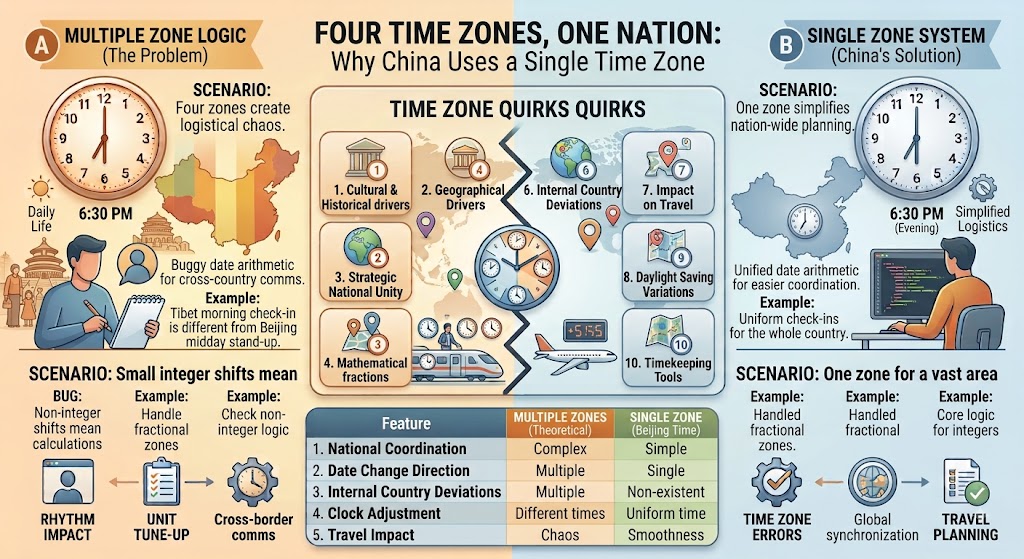
China is one of the largest countries on Earth, spanning approximately five geographical time zones from its eastern coast to its western frontier. Yet the entire nation officially runs on a single clock: Beijing Time (UTC+08:00).
When it is noon in Beijing, the sun is just rising in Kashgar. When workers in Shanghai finish their day, their counterparts in Urumqi are still waiting for lunch.
This is not a scientific decision. It is a political one. This deep dive explores how China unified its time, why the decision persists, and the dual-time reality that exists in the country's far west.
Use the free time zone converter here →
The Short Answer: Why China Uses One Time Zone
China adopted a single time zone in 1949 to promote national unity and simplify administration across its vast territory. The political goal was to bind the country together with a shared clock, overriding the natural logic of geographical time zones.
| Aspect | Details |
|---|---|
| Official time zone | Beijing Time (UTC+08:00) |
| Geographical time zones | Five (UTC+05:00 to UTC+09:00) |
| Year unified | 1949 |
| Reason | National unity, administrative efficiency |
| DST | Not observed since 1991 |
| The exception | Xinjiang uses an unofficial two-hour offset |
| Anchor city | Beijing (symbolically) |
| Actual time source | East 120° meridian |
The Geographic Reality: Five Time Zones
China's Vast Span
China stretches across 62 degrees of longitude, roughly from UTC+05:00 in the far west to UTC+09:00 in the east.
| Region | Geographical Offset |
|---|---|
| Eastern China | UTC+09:00 |
| Central China | UTC+08:00 |
| Western China | UTC+07:00 |
| Xinjiang | UTC+06:00 |
| Far West | UTC+05:00 |
The Sun Doesn't Lie
The natural rhythm of the sun varies dramatically across this span. In Kashgar, the sun might rise at 10:00 AM by the official clock. In Harbin, the sun rises before 4:00 AM.
| Location | Sunrise (Beijing Time) |
|---|---|
| Harbin | ~3:30 AM |
| Beijing | ~4:45 AM |
| Urumqi | ~7:00 AM |
| Kashgar | ~10:00 AM |
This mismatch between the official clock and the solar day is the core tension of China's time system.
The Historical Context: Five Time Zones Before 1949
The Republic of China's System
Before the Communist victory in 1949, China recognized five time zones, established by the Central Observatory of the Beiyang government.
| Time Zone | Offset | Region |
|---|---|---|
| Kunlun | UTC+05:30 | Far West |
| Sinkiang-Tibet | UTC+06:00 | Xinjiang, Tibet |
| Kansu-Szechwan | UTC+07:00 | Central West |
| Chungyuan | UTC+08:00 | Central/East |
| Changpai | UTC+08:30 | Northeast |
The 1949 Decision
After the founding of the People's Republic of China, the new government abolished the five-zone system. The rationale was straightforward: a single time zone would simplify administration, unify national schedules, and symbolize the unity of the new nation .
| Before 1949 | After 1949 |
|---|---|
| Five time zones | One time zone |
| Local solar alignment | National uniformity |
| Administrative complexity | Administrative simplicity |
The Political Logic: Why One Time Zone?
National Unity as a Priority
China's leaders prioritized central control and national cohesion over local solar convenience. A single time zone meant that government offices, railways, and military operations across the country would operate on the same schedule [citation:11][citation:16].
| Goal | How One Time Zone Helps |
|---|---|
| Administrative efficiency | All offices open and close together |
| Transportation | No time zone conversions for schedules |
| National unity | One country, one clock |
| Central control | Easier coordination from Beijing |
The Practical Benefit
With 94% of China's population living in the eastern provinces, the single time zone aligns well with the vast majority of the country [citation:11].
| Factor | Impact |
|---|---|
| Population concentration | East dominates |
| Economic centers | East dominates |
| Political power | East dominates |
| Result | Single zone works for most |
The Xinjiang Exception: A Dual-Time Reality
Where the System Breaks
Xinjiang is China's westernmost region. It is so far west that Beijing Time means the sun rises at 10:00 AM in winter. This has led to a dual-time system that exists nowhere else in China [citation:2][citation:6].
| Time System | Offset | Used By |
|---|---|---|
| Beijing Time | UTC+08:00 | Government, official business |
| Xinjiang Time | UTC+06:00 | Local life, Uyghur community |
Who Uses Which Time?
| Group | Preferred Time |
|---|---|
| Han Chinese | Beijing Time |
| Uyghur population | Xinjiang Time |
| Government offices | Beijing Time |
| Local buses | Xinjiang Time |
| Trains and planes | Beijing Time |
| Schools (Han) | Beijing Time |
| Schools (Uyghur) | Xinjiang Time |
The dual-time system creates a parallel reality: two clocks, two schedules, one region [citation:6].
The Practical Chaos
This dual system creates constant confusion. A meeting scheduled for "10:00" could mean two different things depending on who you ask.
| Scenario | Beijing Time | Xinjiang Time |
|---|---|---|
| Meeting time | 10:00 | 08:00 |
| School start | 08:00 | 08:00 |
| Dinner time | 20:00 | 18:00 |
The problem is so acute that people often clarify: "Beijing time or Xinjiang time?" [citation:6].
The Time Source: Why Beijing Time Isn't Beijing's Time
The Meridian, Not the City
"Beijing Time" is a misnomer. It is not the local solar time of Beijing. It is the standard time of the UTC+08:00 time zone, anchored to the 120° East meridian.
| Aspect | Details |
|---|---|
| Official name | China Standard Time (CST) |
| Colloquial name | Beijing Time |
| Reference meridian | 120° East |
| Beijing's longitude | ~116° East |
| Difference | Beijing is ~14 minutes behind |
The Real Timekeeper: Xi'an
The institution that actually generates and broadcasts China's official time is not in Beijing. It is the National Time Service Center in Xi'an, Shaanxi Province [citation:13].
| Aspect | Details |
|---|---|
| Location | Xi'an, Shaanxi |
| Reason | Geographic center, strategic depth |
| Established | 1966 (Project 326) |
| Function | Generates and broadcasts Beijing Time |
Xi'an was chosen because it is geographically central, geologically stable, and far from coastal borders — a Cold War strategic consideration [citation:13].
The Consequences: Living Out of Sync
The Western Experience
For residents of Xinjiang and Tibet, living on Beijing Time means living out of sync with the sun.
| Consequence | Effect |
|---|---|
| Late sunrises | Dark mornings |
| Late sunsets | Late dinners |
| Shifted schedules | Work starts late, ends late |
| Cultural adaptation | "Midnight" dinners common |
The "Midnight Dinner" Phenomenon
In Urumqi, dinner at 10:00 PM or later is normal. When the rest of China is asleep, Xinjiang is just finishing its evening meal [citation:16].
| Activity | Beijing Time | Xinjiang Local Reality |
|---|---|---|
| Sunrise | 7:00 AM | 5:00 AM |
| Lunch | 12:00 PM | 2:00 PM |
| Dinner | 7:00 PM | 9:00-10:00 PM |
| Bedtime | 11:00 PM | 1:00 AM |
Quick Reference Card
━━━━━━━━━━━━━━━━━━━━━━━━━━━━━━━━━━━━━━━━━━━━━━━━━━━━━━━━━━
   CHINA'S SINGLE TIME ZONE — CHEAT SHEET
━━━━━━━━━━━━━━━━━━━━━━━━━━━━━━━━━━━━━━━━━━━━━━━━━━━━━━━━━━

OFFICIAL TIME:
  China Standard Time (CST) = Beijing Time = UTC+08:00
  Reference meridian: 120° East
  NOT Beijing's local solar time (~14 min difference)

GEOGRAPHIC REALITY:
  China spans ~5 time zones
  From UTC+05:00 (far west) to UTC+09:00 (east)
  But officially uses only UTC+08:00

HISTORY:
  Before 1949: Five time zones
  1949: Communist government unified to one
  Reason: National unity, administrative efficiency

THE XINJIANG EXCEPTION:
  Dual-time system exists
  Beijing Time → Government, trains, planes, Han Chinese
  Xinjiang Time (UTC+06:00) → Local life, Uyghur community

THE TIME SOURCE:
  Actual time generated in Xi'an, Shaanxi
  National Time Service Center (est. 1966)
  Chosen for geographic centrality and strategic depth

CONSEQUENCES:
  Western regions live out of sync with sun
  "Midnight dinners" common in Urumqi
  Constant clarification needed: "Beijing or Xinjiang time?"

GOLDEN RULE:
  China chose politics over geography. One nation, one clock.

━━━━━━━━━━━━━━━━━━━━━━━━━━━━━━━━━━━━━━━━━━━━━━━━━━━━━━━━━━
         Check live conversions at: /timezone-converter
━━━━━━━━━━━━━━━━━━━━━━━━━━━━━━━━━━━━━━━━━━━━━━━━━━━━━━━━━━
Frequently Asked Questions
Why does China have only one time zone?
China adopted a single time zone in 1949 for political and administrative reasons. The government wanted to promote national unity and simplify coordination across the vast country [citation:11][citation:16].
How many time zones does China geographically span?
China spans approximately five geographical time zones, from UTC+05:00 in the far west to UTC+09:00 in the east [citation:8].
What is Beijing Time?
Beijing Time is the colloquial name for China Standard Time (CST), which is UTC+08:00. It is not Beijing's local solar time; it is the standard time of the 120° East meridian [citation:13].
Does Xinjiang use a different time zone?
Yes. Xinjiang unofficially uses Xinjiang Time (UTC+06:00) , which is two hours behind Beijing Time. This dual-time system is used alongside the official Beijing Time [citation:2][citation:15].
Who uses Xinjiang Time?
Ethnic Uyghurs and other local communities in Xinjiang typically use Xinjiang Time for daily life. Government offices, trains, planes, and Han Chinese generally use Beijing Time [citation:2][citation:6].
Where is China's official time generated?
China's official time is generated by the National Time Service Center in Xi'an, Shaanxi Province. Xi'an was chosen for its geographic centrality and strategic depth [citation:13].
Why do people in Xinjiang eat dinner at midnight?
Because they live on Beijing Time, which is two hours ahead of their natural solar time. When the sun sets late, dinner happens late by the official clock [citation:16].
Did China ever have multiple time zones?
Yes. Before 1949, the Republic of China recognized five time zones. The Communist government abolished them after taking power [citation:9][citation:14].
Does China observe daylight saving time?
No. China stopped observing daylight saving time in 1991 [citation:9].
What is the IANA time zone identifier for Xinjiang?
The IANA identifier is Asia/Urumqi, which observes UTC+06:00 year-round with no daylight saving time [citation:15].
Final Thoughts
China's single time zone is one of the boldest administrative decisions in the history of timekeeping. It prioritized national unity over geographical logic, and for the vast majority of the country's population, it works.
But in the far west, the system creates a daily contradiction. Xinjiang lives on two clocks: the official Beijing Time and the unofficial Xinjiang Time. For the people caught between them, time is not a simple fact — it is a choice, a negotiation, and a constant clarification.
Three things to remember:
- China chose politics over geography. One time zone for a five-zone country
- Xinjiang lives on two clocks. Beijing Time officially, Xinjiang Time locally
- Beijing Time isn't Beijing's time. It is UTC+08:00, generated in Xi'an
Check time zone conversions instantly → /timezone-converter
Tags: China single time zone, why China has one time zone, Beijing Time UTC+8, Xinjiang time UTC+6, Urumqi time, China time zone politics, China five time zones history, dual time system Xinjiang, China Standard Time, time zone converter