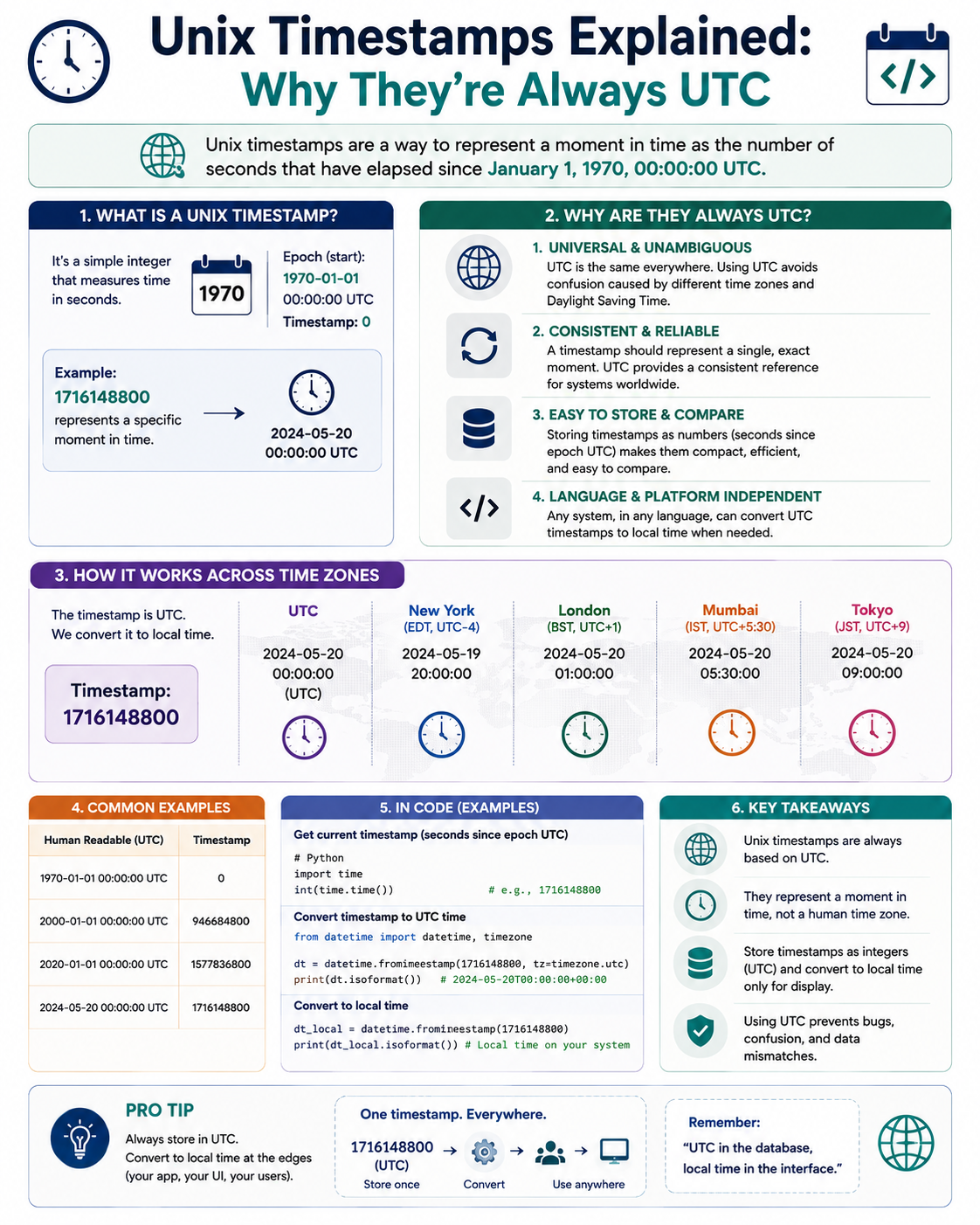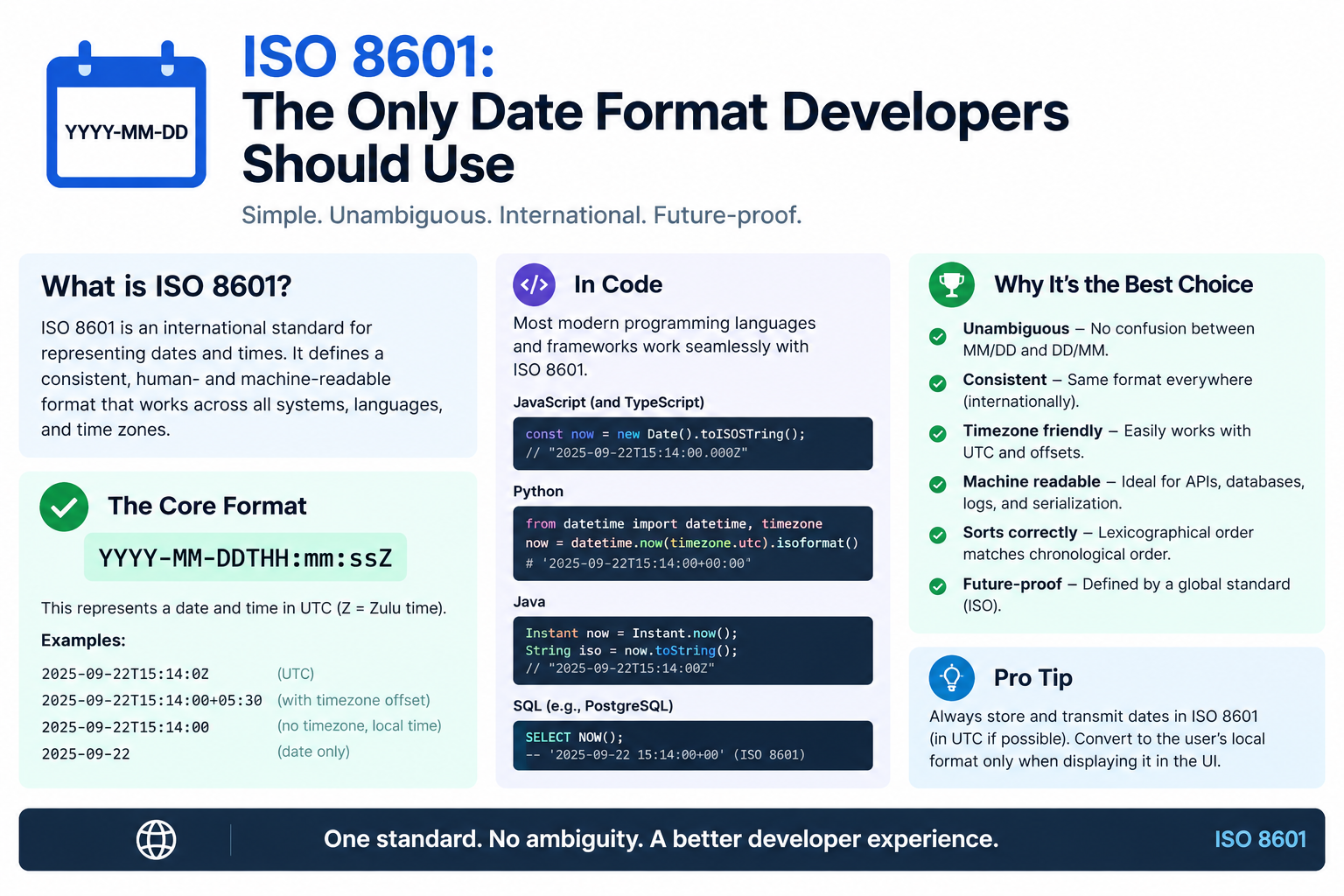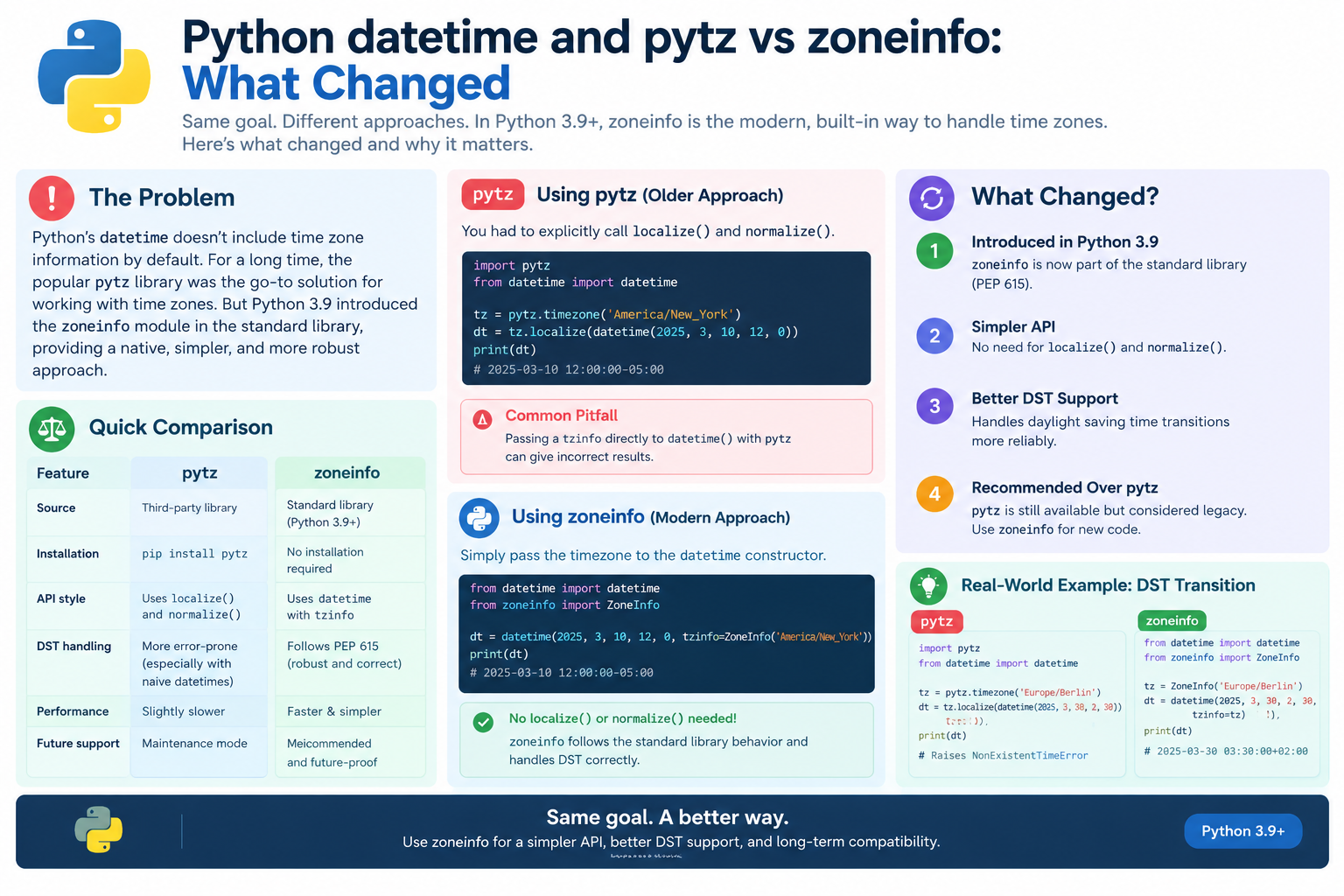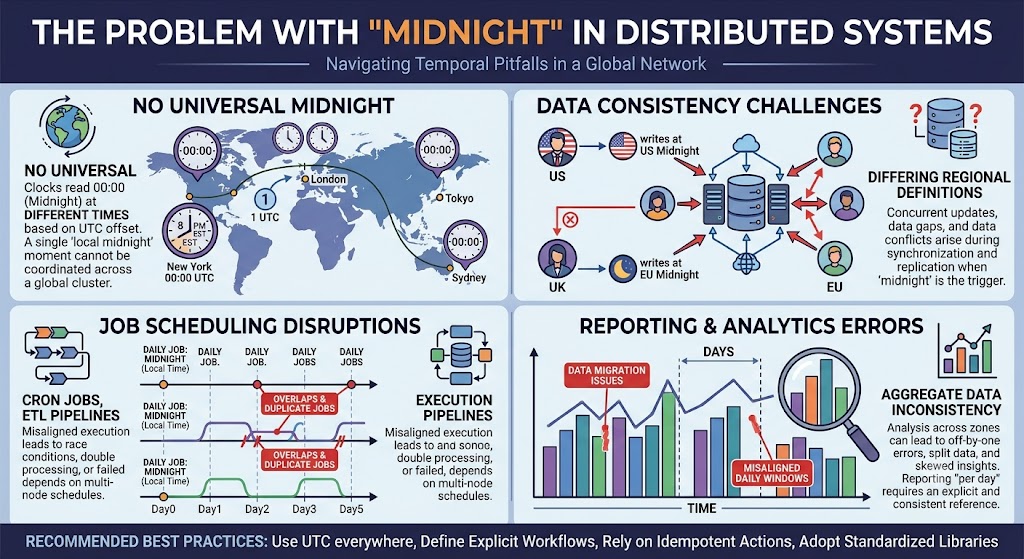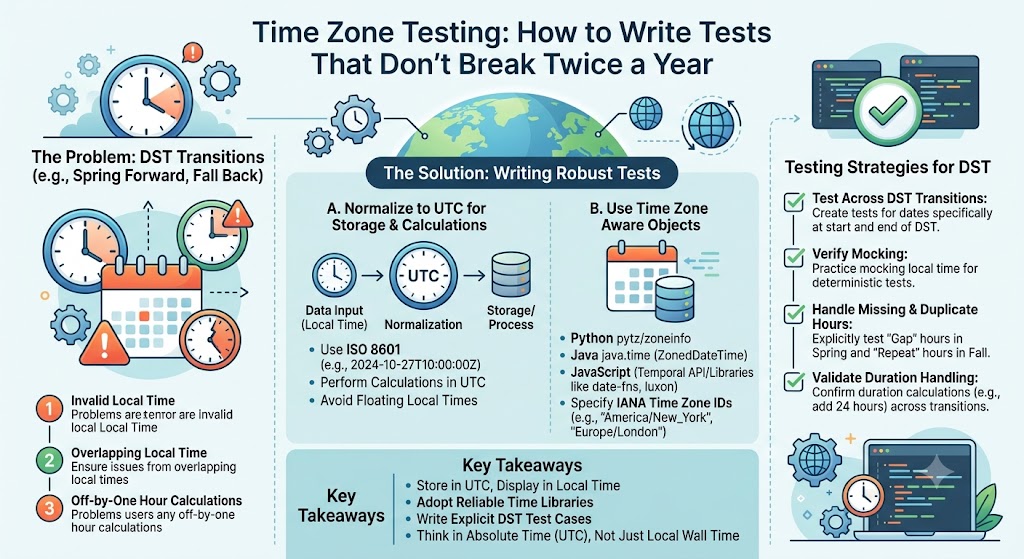
Time Zone Testing: How to Write Tests That Don't Break Twice a Year
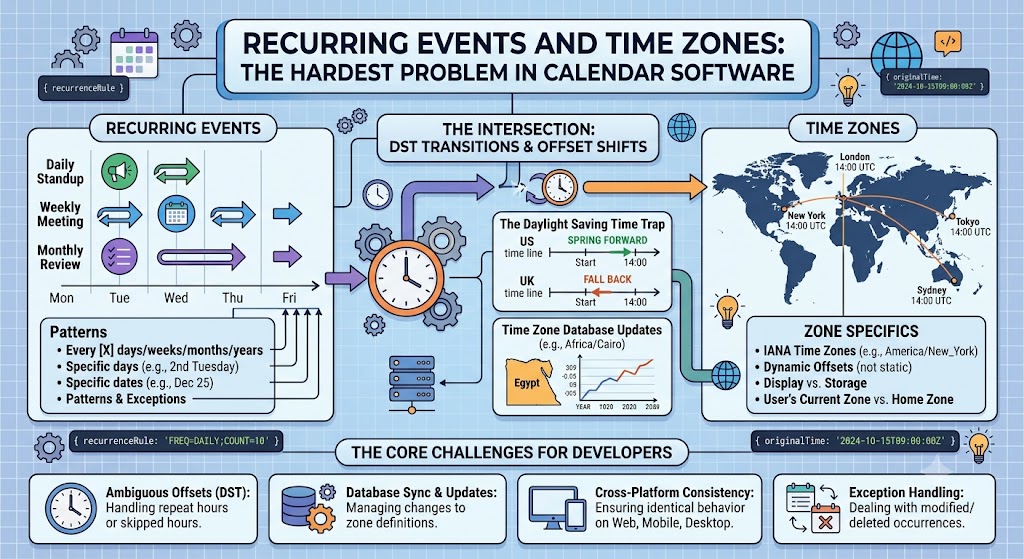
Every March and November, something strange happens in CI pipelines. Tests that passed for months suddenly fail. Someone reruns them, and they pass again. The culprit is almost always the same: time zones and daylight saving time.
Time zone bugs are uniquely painful because they hide for most of the year, then surface all at once. This guide explains how to write tests that survive DST transitions and do not break twice a year.
Use the free time zone converter here →
The Short Answer: Why Time Zone Tests Break
Tests break twice a year because they depend on the current time or the system time zone, both of which change during DST transitions.
| Root Cause | Effect |
|---|---|
| Using the real clock | Results depend on when tests run |
| Relying on system zone | Different on CI vs laptop |
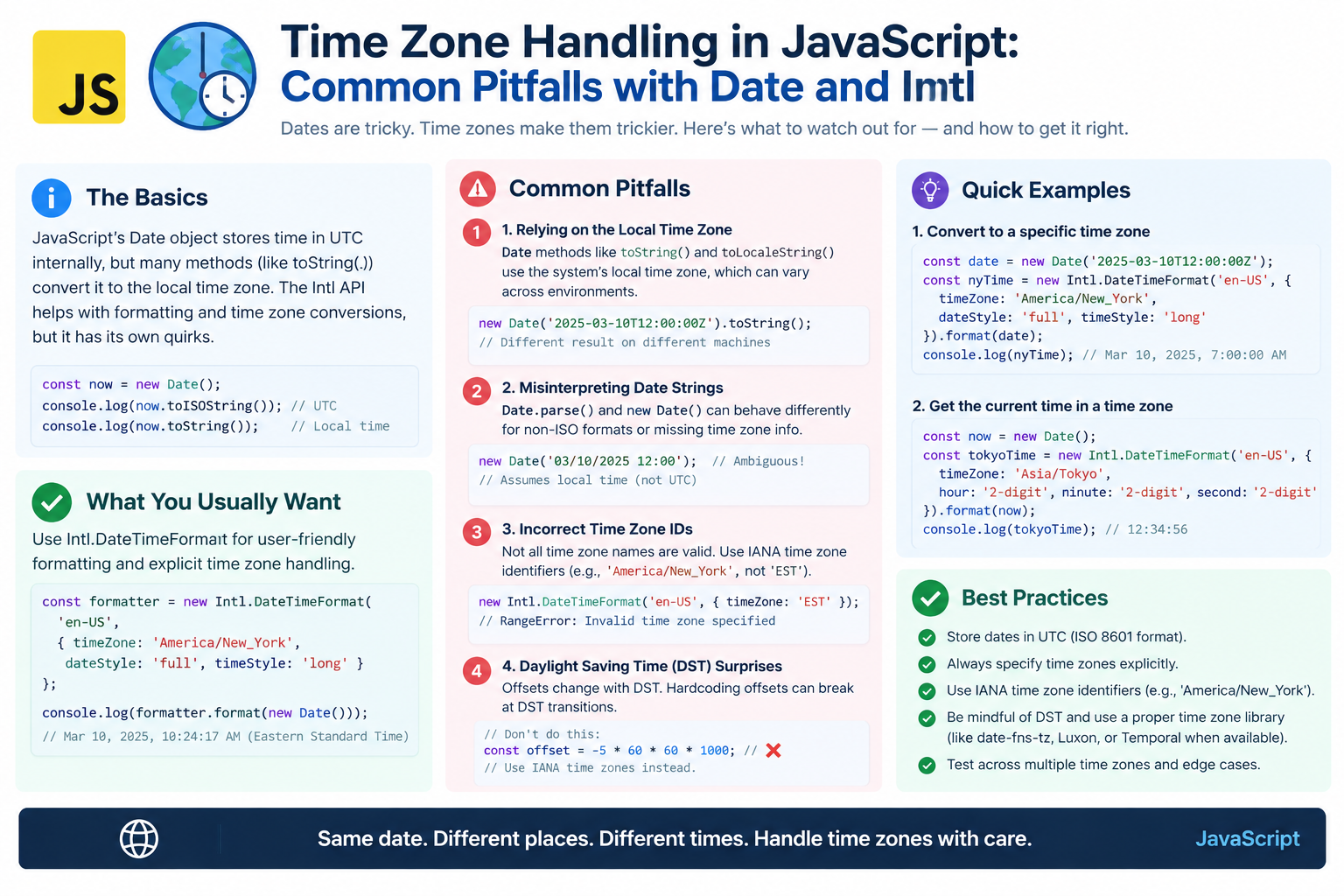
| Hardcoded offsets | Wrong after DST shift |
| No DST test cases | Bugs go undetected |
| Assuming UTC | Breaks in non-UTC environments |
| Unmocked time | Flaky, unpredictable results |
Why Time Zone Tests Are Uniquely Fragile
The Hidden Dependency
Most tests look deterministic. But if they touch time, they depend on invisible factors.
| Dependency | Changes When |
|---|---|
| Current time | Every second |
| System time zone | Machine or container |
| DST rules | Twice a year |
| IANA database | Several times a year |
| Locale | Environment |
Why It Passes Locally and Fails in CI
| Environment | Time Zone |
|---|---|
| Developer laptop | Local (e.g., IST) |
| CI runner | Usually UTC |
| Container | Often UTC |
| Serverless | Usually UTC |
A test that passes on a laptop in India may fail in CI running UTC.
Why It Fails Twice a Year
A test that assumes a fixed offset passes for months, then fails on the DST transition date because the offset changed.
| Season | Offset |
|---|---|
| Winter | UTC−05:00 |
| Summer | UTC−04:00 |
| Test assumption | One of them |
| Result | Failure in the other season |
Principle 1: Freeze Time
The single most important fix is to never use the real clock in tests. Freeze time to a fixed instant.
How Freezing Works
Replace the system clock with a controlled one that returns a fixed value.
| Approach | Example |
|---|---|
| Freezegun (Python) | @freeze_time("2026-09-22") |
| Sinon (JS) | sinon.useFakeTimers() |
| Jest (JS) | jest.useFakeTimers() |
| Timecop (Ruby) | Timecop.freeze |
| Clock (Java) | Clock.fixed(...) |
Python Example With Freezegun
from freezegun import freeze_time
from datetime import datetime, timezone

@freeze_time("2026-09-22T14:30:00Z")
def test_order_timestamp():
    order = create_order()
    assert order.created_at == datetime(
        2026, 9, 22, 14, 30, tzinfo=timezone.utc
    )
Why This Helps
| Benefit | Explanation |
|---|---|
| Deterministic | Same result every run |
| Fast | No waiting for real time |
| Reproducible | Fails the same way everywhere |
| DST-safe | No dependence on today's date |
What to Freeze
| Freeze | Do Not Freeze |
|---|---|
| Tests involving "now" | Pure functions |
| Date calculations | String parsing |
| Age calculations | Static data |
| Scheduling logic | Formatting only |
Principle 2: Never Trust the System Time Zone
The Problem
Tests that rely on the machine's time zone pass locally and fail in CI.
# BAD — depends on system zone
dt = datetime(2026, 9, 22, 12, 0)
assert dt.astimezone().hour == 12  # Fails in non-UTC CI
The Fix: Set the Zone Explicitly
Always specify the time zone in the test.
# GOOD — explicit zone
from zoneinfo import ZoneInfo

tz = ZoneInfo("America/New_York")
dt = datetime(2026, 9, 22, 12, 0, tzinfo=tz)
assert dt.utcoffset().total_seconds() == -4 * 3600
Pinning the Zone in CI
You can also pin the time zone in the test environment.
| Environment Variable | Effect |
|---|---|
| TZ=UTC | Forces UTC |
| TZ=America/New_York | Forces Eastern |
| TZ=Asia/Kolkata | Forces India |
Best practice: Pin TZ in CI and write explicit zones in tests.
The Two-Layer Defense
| Layer | Purpose |
|---|---|
| CI env var | Consistent baseline |
| Explicit zone in test | No hidden dependency |
Principle 3: Test the DST Edges Explicitly
The Two Critical Cases
Every DST-aware system should have tests for both transitions.
| Transition | Test Case |
|---|---|
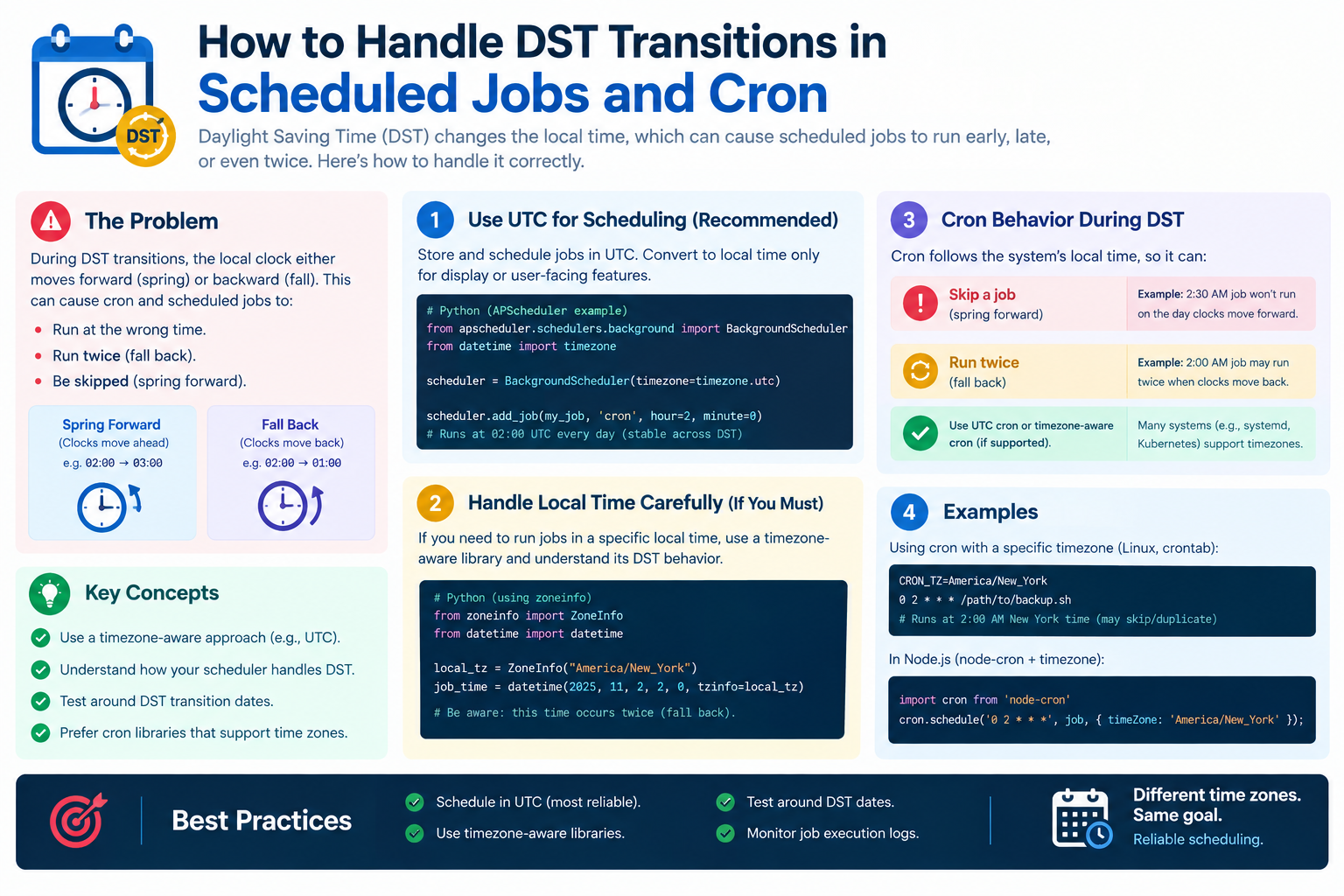
| Spring forward | Missing hour |
| Fall back | Repeated hour |
Spring Forward Test
def test_spring_forward_missing_hour():
    tz = ZoneInfo("America/New_York")
    # 2026-03-08 02:30 does not exist
    dt = datetime(2026, 3, 8, 2, 30, tzinfo=tz)
    # Assert the library's behavior
    assert dt.utcoffset().total_seconds() == -4 * 3600
Fall Back Test
def test_fall_back_repeated_hour():
    tz = ZoneInfo("America/New_York")
    first = datetime(2026, 11, 1, 1, 30, fold=0, tzinfo=tz)
    second = datetime(2026, 11, 1, 1, 30, fold=1, tzinfo=tz)

    assert first.utcoffset().total_seconds() == -4 * 3600  # EDT
    assert second.utcoffset().total_seconds() == -5 * 3600  # EST
Why Explicit Tests Matter
| Reason | Explanation |
|---|---|
| Real bugs | DST breaks real systems |
| Rare cases | Only twice a year |
| Silent failures | No error, just wrong data |
| Regression guard | Prevents future breakage |
DST Test Checklist
| Check | Question |
|---|---|
| ☐ | Missing hour tested? |
| ☐ | Repeated hour tested? |
| ☐ | fold handling tested? |
| ☐ | Both hemispheres covered? |
| ☐ | Southern hemisphere DST? |
Principle 4: Test With Real IANA Zones, Not Offsets
The Offset Trap
Tests that use fixed offsets pass until the zone changes.
# BAD — fixed offset
tz = timezone(timedelta(hours=-5))
This fails in summer, when Eastern is −04:00.
Use IANA Zones
# GOOD — real zone
from zoneinfo import ZoneInfo
tz = ZoneInfo("America/New_York")
The zone knows its own rules.
Offset vs Zone in Tests
| Approach | DST Safe? |
|---|---|
| Fixed offset | No |
| IANA zone | Yes |
| Hardcoded string | Fragile |
| Zone from library | Correct |
Principle 5: Pin the tzdata Version
Why It Matters
Time zone rules change. Your tests should run against a known version.
| Change Type | Example |
|---|---|
| DST rule change | Country adopts or drops DST |
| Offset change | Region shifts its base offset |
| Zone rename | City name changes |
How to Pin
| Ecosystem | Method |
|---|---|
| Python | Pin tzdata in requirements |
| Node | Pin tzdata package |
| Java | Pin JDK or tzdata update |
| Containers | Lock base image |
Why Pinning Helps
| Benefit | Explanation |
|---|---|
| Reproducible | Same rules everywhere |
| Controlled updates | Update on your schedule |
| No surprises | CI does not change rules |
Common Test Failures and Fixes
| Failure | Cause | Fix |
|---|---|---|
| Off-by-one day | UTC midnight conversion | Use date-only for dates |
| Wrong hour | System zone differs | Pin TZ, use explicit zone |
| Flaky around midnight | Real clock used | Freeze time |
| Fails twice a year | Hardcoded offset | Use IANA zone |
| Passes locally, fails in CI | Zone mismatch | Set TZ=UTC in CI |
| Leap day failure | No Feb 29 handling | Add explicit test |
| Duplicate job in test | Repeated hour | Test fold handling |
| Missing run | Skipped hour | Test spring forward |
CI Configuration Checklist
What to Set in CI
| Setting | Value |
|---|---|
| TZ | UTC |
| tzdata version | Pinned |
| Locale | C.UTF-8 or pinned |
| Container image | Locked digest |
| Test command | Same as local |
Why UTC in CI
| Benefit | Explanation |
|---|---|
| Consistent baseline | Same everywhere |
| No DST | No shifting offsets |
| Standard practice | Most CI defaults |
The Trap of Only Testing in UTC
If CI only runs in UTC, DST bugs can hide. Add a second CI job that runs in a DST-observing zone.
| Job | TZ |
|---|---|
| Job 1 | UTC |
| Job 2 | America/New_York |
| Job 3 (optional) | Australia/Sydney |
This catches bugs that only appear in DST-observing environments.
Testing Patterns by Scenario
Scenario 1: Timestamp Creation
| Test | Approach |
|---|---|
| Freeze time | Yes |
| Assert UTC | Yes |
| Check offset | If relevant |
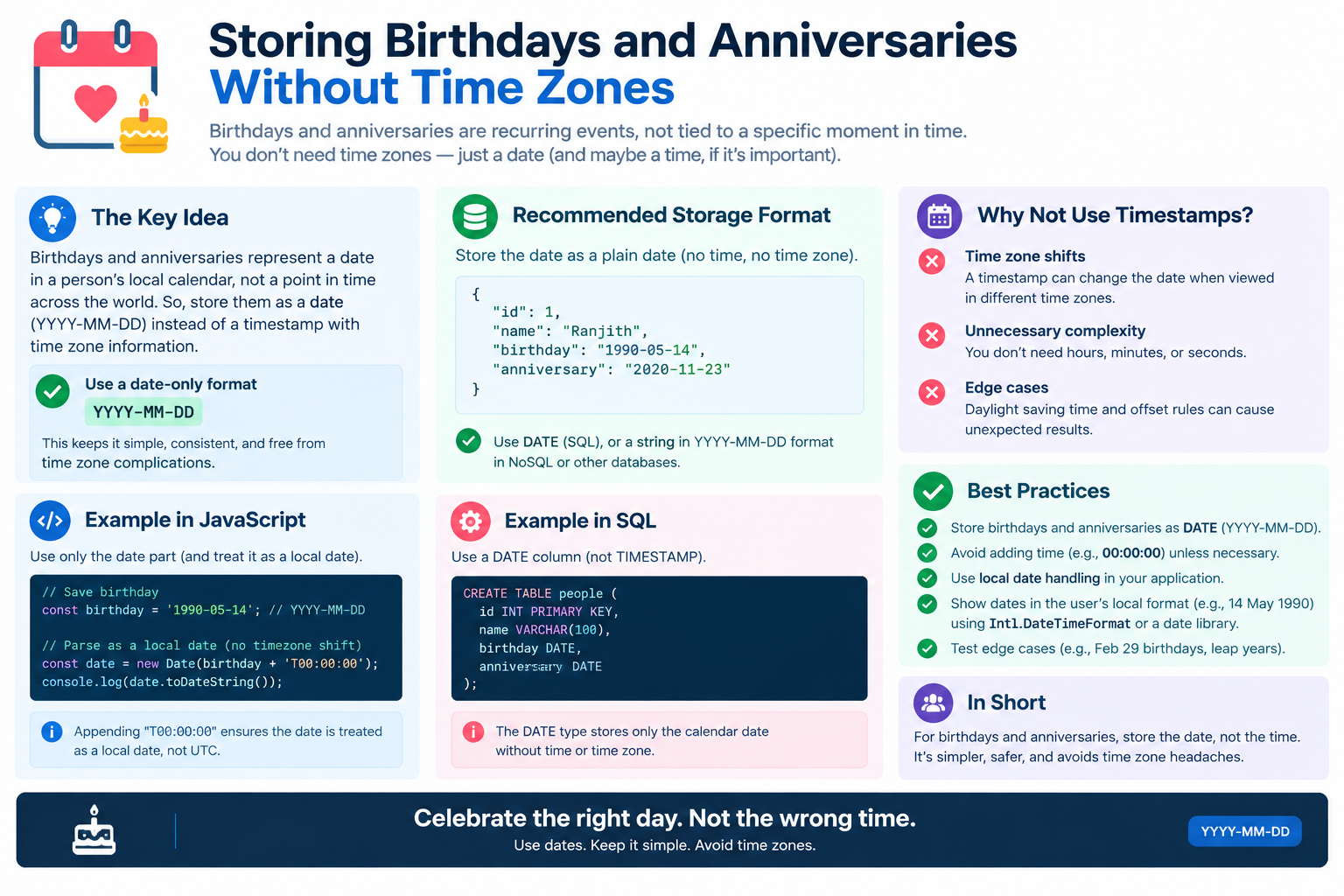
Scenario 2: Birthday Display
| Test | Approach |
|---|---|
| Store date-only | Yes |
| Display in multiple zones | Assert same date |
| Never convert | Assert no zone applied |
Scenario 3: Scheduled Job
| Test | Approach |
|---|---|
| Freeze time to DST day | Yes |
| Assert single run | Yes |
| Assert no skip | Yes |
Scenario 4: Age Calculation
| Test | Approach |
|---|---|
| Freeze "today" | Yes |
| Test birthday today | Yes |
| Test day before | Yes |
| Test Feb 29 | Yes |
Scenario 5: API Response
| Test | Approach |
|---|---|
| Assert ISO 8601 format | Yes |
| Assert offset present | Yes |
| Reject ambiguous input | Yes |
Quick Reference Card
━━━━━━━━━━━━━━━━━━━━━━━━━━━━━━━━━━━━━━━━━━━━━━━━━━━━━━━━━━
   TIME ZONE TESTING — CHEAT SHEET
━━━━━━━━━━━━━━━━━━━━━━━━━━━━━━━━━━━━━━━━━━━━━━━━━━━━━━━━━━

WHY TESTS BREAK TWICE A YEAR:
  • Using the real clock
  • Relying on system time zone
  • Hardcoded offsets
  • No DST test cases

FIVE PRINCIPLES:
  1. Freeze time — never use the real clock
  2. Never trust the system zone — be explicit
  3. Test DST edges — spring and fall
  4. Use IANA zones, not offsets
  5. Pin the tzdata version

FREEZE TIME TOOLS:
  Python  → freezegun
  JS      → sinon, jest.useFakeTimers
  Ruby    → Timecop
  Java    → Clock.fixed

DST TESTS TO WRITE:
  • Spring forward (missing hour)
  • Fall back (repeated hour, fold=0/1)
  • Southern hemisphere DST
  • Leap day (Feb 29)

CI CONFIGURATION:
  TZ=UTC
  tzdata pinned
  Locale pinned
  Container digest locked

RUN MULTIPLE ZONE JOBS:
  Job 1 → TZ=UTC
  Job 2 → TZ=America/New_York
  Job 3 → TZ=Australia/Sydney

COMMON FIXES:
  Off-by-one day  → use date-only for dates
  Wrong hour      → pin TZ, use explicit zone
  Flaky at night  → freeze time
  Fails in CI     → set TZ=UTC in CI

GOLDEN RULE:
  Freeze time. Use IANA zones. Test DST edges.

━━━━━━━━━━━━━━━━━━━━━━━━━━━━━━━━━━━━━━━━━━━━━━━━━━━━━━━━━━
         Check live conversions at: /timezone-converter
━━━━━━━━━━━━━━━━━━━━━━━━━━━━━━━━━━━━━━━━━━━━━━━━━━━━━━━━━━
Frequently Asked Questions
Why do my tests fail twice a year?
They likely depend on the system time zone or a hardcoded offset. When DST changes the offset, the test's assumptions break.
How do I write DST-safe tests?
Freeze time to a fixed instant, use IANA time zones instead of offsets, pin the TZ environment variable in CI, and write explicit tests for both DST transitions.
What is time freezing?
Time freezing replaces the system clock with a controlled one that returns a fixed value. Libraries like freezegun (Python) and sinon (JS) do this.
Why does my test pass locally but fail in CI?
Your laptop uses a local time zone, while CI usually runs in UTC. Set TZ=UTC in CI and write explicit zones in tests.
How do I test ambiguous times during fall back?
Use the fold attribute. fold=0 means the first occurrence, fold=1 means the second. Assert both offsets.
How do I test the missing hour during spring forward?
Construct a datetime in the missing hour and assert the library's behavior. Most libraries shift the time rather than raise an error.
Should I test in multiple time zones?
Yes. Run at least one CI job in UTC and one in a DST-observing zone like America/New_York to catch bugs that only appear in DST regions.
How do I test birthday handling?
Store birthdays as date-only values. Test that they display the same date in every time zone, and never convert them.
How do I test February 29?
Freeze time to a common year and a leap year. Assert your system's policy for celebrating leap-day birthdays.
Should I pin the tzdata version?
Yes. Time zone rules change, and pinning ensures your tests run against a known, reproducible version.
What is the biggest mistake in time zone testing?
Using the real clock. Any test that depends on "now" is inherently flaky and will eventually fail at the wrong moment.
Final Thoughts
Time zone tests break twice a year because they depend on invisible, changing factors. The fix is not complicated, but it requires discipline: freeze time, use IANA zones, pin the environment, and test the DST edges explicitly.
Do this, and your tests will pass in March, November, and every other month of the year.
Three things to remember:
- Freeze time. Never let tests depend on the real clock
- Use IANA zones, not offsets. Offsets break twice a year
- Test DST edges explicitly. Spring forward and fall back
Check time zone conversions instantly → /timezone-converter
Tags: time zone testing, DST test failures, how to test time zones, freeze time in tests, mock time zone Python, freezegun DST, CI time zone configuration, testing ambiguous times, time zone unit tests, time zone converter